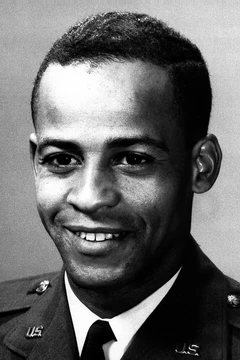
John B. McKay
American test pilot and X-15 astronaut who flew above 295600 ft.
Last updated
John Barron McKay was an American naval officer, World War II pilot, aeronautical engineer, test pilot, and astronaut. He was one of twelve pilots who flew the North American X-15, an experimental spaceplane jointly operated by the United States Air Force and NASA. On September 28, 1965, he flew the X-15 to an altitude of 295600 ft, thereby qualifying as an astronaut according to the United States definition of the boundary of space.
However, this altitude did not surpass the Kármán line as defined by the FAI, the FAI-accepted boundary of 100 km. Born on December 8, 1922, in Portsmouth, Virginia, McKay served as a Naval Aviator in the Pacific Theater during World War II, earning the Air Medal with two clusters and a Presidential Unit Citation. He graduated from Virginia Polytechnic Institute in 1950 with a Bachelor of Science degree in Aeronautical Engineering.
Test pilot
John B. McKay spent over two decades with NACA and later NASA, from early 1951 until late 1971, focusing on high-speed flight research. He started as an intern but became a pilot in mid-1952.
Besides the X-15, he piloted experimental aircraft like the D-558-1, D-558-2, X-1B, and X-1E, and worked as a research pilot on programs for the F-100, F-102, F-104, and F-107. In 1958, he was chosen for the U.S. Air Force's Man In Space Soonest program, which never launched. He authored several technical papers and belonged to the American Institute of Aeronautics and Astronautics and the Society of Experimental Test Pilots.
Accident
On November 9, 1962, McKay undertook Flight 74 of the X-15 program on the X-15 56-6671 which was the Number-Two X-15 on its 31st flight. The X-15 was attached to its mothership the Boeing NB-52B Stratofortress 53-008, nicknamed Balls 8. McKay's mission was to reach an altitude of 125,000 ft at Mach 5.5 and to fly the aircraft without the lower part of its ventral fin. The X-15 was released from the Stratofortress on schedule at 45,000 ft over Mud Lake, Nevada at 10:23:07.0 local time with a launch speed of 450 knots.
Upon release, McKay was unable to attain the full power of the rocket engine which became stuck at 30% power and unresponsive to throttle control. Due to the lack of throttle response it was decided to make a forced landing at Mud Lake instead of landing at Edwards Air Force Base. McKay was at an altitude of 53,950 ft having attained a speed of Mach 1.49 when he started his descent for landing at Mud Lake. The motor was kept operating for 70.5 seconds to burn excess fuel and to reduce weight.
The flaps failed to activate during landing and the aircraft speed at touchdown was higher than normal. Due to the excess speed and weight the aircraft experienced failures because of the increased dynamic loading which eventually led to its overturning. The X-15 airframe rolled and struck the lakebed while inverted. McKay suffered crushed vertebrae.
Although McKay returned to flight as an X-15 pilot, his injuries contributed to an early death. Recurring severe pain caused by the crash forced his early retirement.
Did You Know?
- On November 9, 1962, McKay's X-15 engine stuck at 30% power, forcing an emergency landing at Mud Lake where the aircraft rolled inverted, crushing his vertebrae.
- McKay died on April 27, 1975, at age 52; injuries from the X-15 crash were a major factor in his premature death.
Frequently Asked Questions
When did John B. McKay die?
John B. McKay died on 27 April 1975 in Lancaster, California, U.S.
Where did John B. McKay study?
John B. McKay studied at Virginia Tech and B.S. 1950.
More in People Who Have Flown in Suborbital Spaceflight
Test yourself
Three questions drawn from this entry’s sources. Pick an answer to check it.
Answers checked against the source article
Sources
Compiled from Wikipedia and the sources listed below. Text from Wikipedia is available under CC BY-SA 4.0; this entry is adapted from it.
- Wikipedia: John B. McKay (CC BY-SA 4.0).
Spotted an error? Know more?
Reader corrections go straight into our review queue. Suggest an edit · How this site is sourced