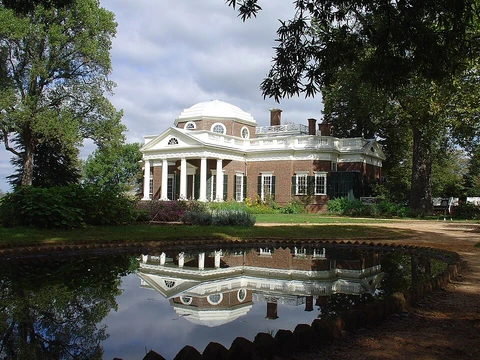
Thomas Jefferson Randolph
Favorite grandson of Thomas Jefferson and executor of his estate.
Last updated

via Wikipedia: Thomas Jefferson Randolph · see source
Thomas Jefferson Randolph was a Virginia planter, soldier, and politician who served in the Virginia House of Delegates, as rector of the University of Virginia, and as a colonel in the Confederate Army. He was the favorite grandson of President Thomas Jefferson, managed Monticello near the end of Jefferson's life, and served as executor of his estate. Randolph also participated in the Virginia Constitutional Convention of 1850 and the Virginia Secession Convention of 1861.
Early life and education
Thomas Jefferson Randolph was the firstborn son of Thomas Mann Randolph Jr., who would serve as Virginia's governor, and Martha Jefferson Randolph, often called Patsy. His mother was the eldest daughter of President Thomas Jefferson, making Randolph the president's eldest grandson. He came from the First Families of Virginia and was also a direct descendant of Pocahontas. Randolph had one older sister and seven other siblings who lived past childhood.
He was privately tutored, as was typical for his social standing, and spent part of his youth at Monticello and at his grandfather's Poplar Forest plantation. In 1809, his parents moved into Monticello, but they later separated because of his father's drinking problem; Randolph, his mother, and his siblings stayed at Monticello. When he was fifteen in 1807, his father sent him to Philadelphia for advanced studies, with Jefferson guiding part of his education toward botany, other natural sciences, and anatomy.
Randolph quickly took on the role of family leader. In 1819, his brother-in-law Charles Bankhead, who was an alcoholic and married to Randolph's eldest sister Ann Cary Randolph, badly wounded him at the Albemarle County courthouse, much to Jefferson's distress. Jefferson died when Randolph was thirty-four, and his father died two years later. In 1815, Randolph married Jane Hollins Nicholas, daughter of Wilson Cary Nicholas, a former Congressman and Senator.
Marriage and family
Nicholas became president of the new Richmond branch of the Second Bank of the United States and helped Jefferson get loans for nearly ten years, but Jefferson had co-signed some of Nicholas's notes, which created serious trouble after the Panic of 1819 and the resulting depression. Jane Nicholas Randolph started and taught a school on the family's Edgehill estate from 1829 until 1850, when Randolph's youngest brother George Wythe Randolph left the main plantation house with his wife and moved to Richmond. Thomas and Jane Randolph had thirteen children.
Career
Thomas Jefferson Randolph, like his father and grandfathers before him, was a planter and prominent figure in Albemarle County, Virginia, and his plantations, including Monticello, relied on enslaved labor. He first took over management of Monticello in 1815, returning during a drought to run the estate for his separated mother and his grandfather, Thomas Jefferson. In 1817, Jefferson leased two of his quarter-farms, Tufton and Lego, to Randolph, who constructed a stone house there and relocated his growing family.
Randolph was close to his grandfather and was named executor of Jefferson’s estate in the will executed in 1826. That same year, after his father finished his term as Virginia’s 21st governor and faced mounting creditor troubles, Randolph bought his father’s Edgehill plantation at a foreclosure auction. Jefferson’s own estate was deeply in debt at his death on July 4, 1826, worsened by Randolph’s father-in-law Nicholas defaulting on debts before 1823.
The principal of Jefferson’s debts was not cleared until 1878, after Randolph’s death, and Nicholas’s marriage of roughly $70,000 accounted for most of the over $100,000 shortfall. Randolph ordered the sale of Monticello’s goods and property, including the 130 people Jefferson had enslaved. On January 19, 1827, about six months after Jefferson’s death, Randolph auctioned these enslaved individuals, raising around $35,000 toward the debt’s principal and another $12,840 for interest and expenses.
Randolph’s mother kept Sally Hemings out of the auction, granting her “her time,” which let her live freely in Charlottesville with her two younger sons.
Death and legacy
Randolph lived several years longer than his wife. He passed away at Edgehill on October 7, 1875, after a carriage accident, and was interred next to her in the Monticello family cemetery. His property, Tufton, is now incorporated into Monticello and houses the Thomas Jefferson Center for Historic Plants. The University of Virginia library holds some of his and his family’s correspondence.
In an 1868 letter to fellow historian James Parton, Henry S. Randall wrote that the claim Thomas Jefferson kept the enslaved woman Sally Hemings as his mistress and fathered her children had once been widely credited by respectable people. Randall also noted that after Jefferson died, his eldest grandson Randolph spoke with the historian and pointed out the striking resemblance between Hemings’s children and their grandfather. During the 1850s, Randolph told Randall that Jefferson’s nephew Peter Carr was the father of Hemings’s children, and that Randolph’s mother had informed him Jefferson was away for fifteen months before one of the children’s births, making paternity impossible.
In 1998, a Y-DNA study disproved the Carrs as possible fathers of Eston Hemings, Sally’s youngest son; no genetic connection was found between the Carr and Hemings lines for Eston’s descendants. The test did reveal a match between the Jefferson male line and a Hemings descendant, but it offered no information about the fathers of Sally Hemings’s other children. Historian Andrew Burstein has observed that the white Jefferson descendants who began the family’s denial in the mid-1800s blamed two of Jefferson’s nephews, whose DNA later did not match, and that no other Jefferson had the same level of physical access to Sally Hemings that the president had.
Frequently Asked Questions
When and where was Thomas Jefferson Randolph born?
Thomas Jefferson Randolph was born on 12 September 1792 in Charlottesville, Virginia, U.S.
When did Thomas Jefferson Randolph die?
Thomas Jefferson Randolph died on 7 October 1875 in Edge Hill, Virginia, U.S.
More in People from Monticello
Sources
Compiled from Wikipedia and the sources listed below. Text from Wikipedia is available under CC BY-SA 4.0; this entry is adapted from it.
- Wikipedia: Thomas Jefferson Randolph (CC BY-SA 4.0).
Spotted an error? Know more?
Reader corrections go straight into our review queue. Suggest an edit · How this site is sourced