John Hemings
Enslaved woodworker who crafted interiors at Monticello and Poplar Forest.
Last updated
John Hemmings (1776–1833) was an American woodworker born into slavery at Thomas Jefferson's Monticello. A member of the large mixed-race Hemings family, he trained in the Monticello Joinery and became a highly skilled carpenter and woodworker, crafting furniture and fine woodwork for Monticello and Poplar Forest. He was freed in 1826 by Jefferson's will and given the tools of the joinery.
Early life and education
John Hemmings entered the world at Monticello on April 24, 1776, as an enslaved child. His mother was Betty Hemings, also enslaved and of mixed race, while his father, Joseph Neilson, worked as Jefferson's chief carpenter and was Irish. Hemmings was the eleventh child Betty bore, making him half-brother to the six children she had with enslaver John Wayles—including Sally Hemings—as well as to her four oldest children whose father remains unknown.
A 1655 Virginia law tied a person's status to their mother, so Hemmings remained enslaved even though he was three-quarters European. The Hemings family arrived at Monticello because John Wayles's daughter Martha married Thomas Jefferson. Growing up, Hemmings understood that girls in the family would work as house servants while boys would become butlers, valets, or artisans. Jefferson gave the Hemings family more freedom than typical for the era: men could travel alone, learn trades, and keep wages from hiring themselves out on free days, while women handled childcare, sewing, and baking instead of farm labor.
As a young child, Hemmings worked in the fields. At fourteen, he became an out-carpenter, felling trees and constructing fences, barns, and three slave cabins on Mulberry Row. He also learned to read and write at some point, though the timing and teacher are unknown; unlike other family members, he spelled his surname with two m's.
Marriage and family
Though Virginia law at the time did not recognize marriages between enslaved people, John married Priscilla and maintained a lifelong partnership with her. Priscilla worked as a nursemaid for the children of Thomas Jefferson's daughter Martha Randolph, initially at Edge Hill three miles from Monticello and later at Monticello itself. Jefferson's grandchildren grew fond of Hemmings, calling him "Daddy" and requesting small wooden toys when they visited his cabin on Mulberry Row; he also corresponded with granddaughter Septimia Randolph.
The couple held religious services in their cabin and were described as deeply devout. They had no children of their own but were close with Sally Hemings's three boys. When Priscilla died in 1830, Hemmings spent more than a year carving her headstone.
Career
At the Monticello Joinery, white joiners worked alongside enslaved craftsmen. John Hemmings began his training at age seventeen in 1793, when Thomas Jefferson wrote to his son-in-law Tom Randolph asking that Hemmings learn wheel-making and woodworking from house joiner David Watson. Because Jefferson was constantly remodeling his properties, the joinery was well-stocked with materials, giving Hemmings plenty of practice. He later served as principal assistant to James Dinsmore.
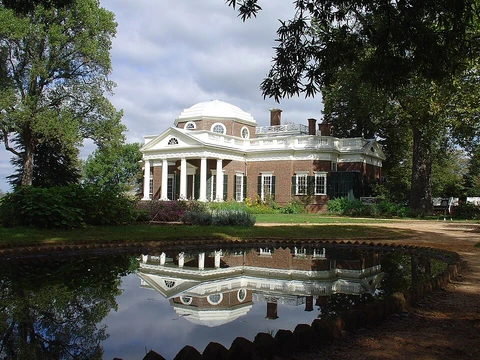
Hemmings helped build the louvered enclosures on Monticello's south side that shielded Jefferson's private rooms; he turned one into an aviary for Jefferson's mockingbirds. On his own, he completed the Chinese railing, Venetian blinds, cellar sashes, bedchamber closet, and window shutters. At Poplar Forest, he crafted the classical interior trim, finished the roof and its decorative railing, installed a large central skylight, and repaired it after an 1819 storm.
He also installed plaster ornaments by William Coffee and fixed damage from a roof leak in 1819 and a fire in 1825. Hemmings brought Jefferson's sons Beverley, Madison, and Eston to Poplar Forest to teach them carpentry. In 1809, Hemmings took over the Monticello Joinery, shifting its focus to furniture making. Only eight works are positively attributed to him: a Campeachy chair, boxes for books sold to Congress, a desk for granddaughter Ellen Randolph Coolidge, a bedstead, a chess table, Pembroke tables, a hanging cabinet, and a dressing table.
The boxes were destroyed, the desk lost in a shipwreck, the Pembroke tables likely burned at Poplar Forest, and the bedstead and dressing table remain unlocated. The hanging cabinet, made of walnut and poplar for Septimia Anne Randolph's doll clothes, was given to the Thomas Jefferson Memorial Foundation in 1957. The mahogany Campeachy chair, made between 1809 and 1819, was sold to the same foundation in 1970. Hemmings considered the writing desk for Ellen Randolph Coolidge his masterpiece; both he and Jefferson were devastated when it was lost in a shipwreck.
In 1814, Hemmings built a four-person landau carriage for an aging Jefferson, with ironwork by Joseph Fossett and painting by Burwell Colbert.
Legacy
Monticello has rebuilt some slave cabins on Mulberry Row, including a reconstructed cabin that John Hemmings and Priscilla shared, furnished based on a diary description from one of Jefferson's grandchildren. A tour explores the Hemings family experience through seven members. The Joinery's foundation and chimney remain. It displayed a campeche chair Hemmings made for Jefferson, a copy of French chairs from the joinery, and a hanging cabinet he made.
More in People from Monticello
Sources
Compiled from Wikipedia and the sources listed below. Text from Wikipedia is available under CC BY-SA 4.0; this entry is adapted from it.
- Wikipedia: John Hemings (CC BY-SA 4.0).
Spotted an error? Know more?
Reader corrections go straight into our review queue. Suggest an edit · How this site is sourced