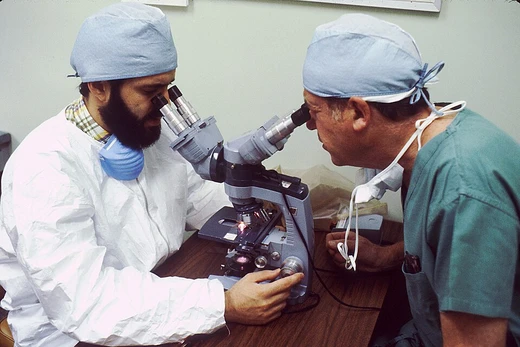
Discovery of disease-causing pathogens
Pathogen discovery is complex, often taking decades.

The discovery of disease-causing pathogens is a central activity in medical science, involving viruses, bacteria, protozoa, fungi, helminths, and prions. The process is often complex and controversial, sometimes taking decades or centuries, and is impeded by factors such as lack of animal models, pre-existing theories of disease, variable pathogenicity, organisms that look alike but behave differently, and lack of research effort.
- Field
- Medical science, microbiology
- Known for
- Identifying pathogens as causes of disease, including Vibrio cholerae and Giardia lamblia
Lore & Background
The identification of Vibrio cholerae as the cause of cholera spanned from 1849 to 1884. Gabriel Pouchet first reported the bacterium in 1849 but did not appreciate its significance. Filippo Pacini published detailed drawings in 1854 and correctly described how the bacteria caused diarrhea, but his work was ignored. In 1884, Robert Koch re-discovered the organism, but some scientists opposed the theory, with von Pettenkofer and Emmerich deliberately drinking cultures to disprove it; von Pettenkofer developed only transient diarrhea, while Emmerich suffered a severe attack.
Reader's Guide
The discovery of disease-causing pathogens has profound significance for public health and medical treatment. The case of Vibrio cholerae illustrates how pre-existing theories, such as humorism and miasma theory, delayed acceptance of the germ theory, leading to over a million deaths in Europe and Russia between 1849 and 1891. The Giardia lamblia example shows that even after discovery in 1681, it was long considered harmless until the 1970s, when it was recognized as a treatable cause of chronic diarrhea. These histories underscore the importance of persistent research and the challenges posed by variable pathogenicity, lack of animal models, and resistance to new theories.
Did You Know?
- The discovery of Vibrio cholerae took from 1849 to 1884, with over a million deaths in Europe and Russia during that period.
- Filippo Pacini correctly described how Vibrio cholerae caused diarrhea in 1854, but his work was ignored by the scientific community.
- At the 1874 International Sanitary Conference, many delegates still favored miasma theory, but no formal vote was taken declaring cholera caused by environmental toxins.
- A long-standing hypothesis suggests that certain CFTR mutations may confer resistance to cholera toxin, but this remains unproven and is not the result of a single 1995 study.
More in Pathology 1-24
Spotted an error? Know more?
Reader corrections go straight into our review queue. Suggest an edit · How this site is sourced