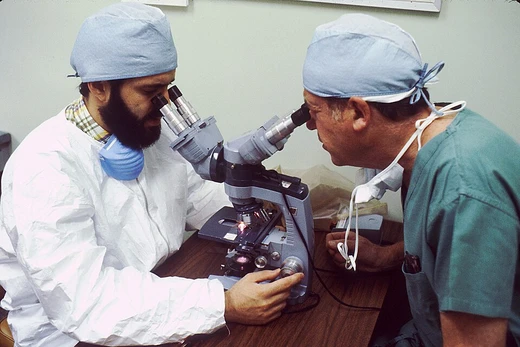
Clinical pathology
Diagnoses disease via lab analysis of bodily fluids and tissues.

Clinical pathology is a medical specialty focused on diagnosing disease through the laboratory analysis of bodily fluids—including blood, urine, and tissue homogenates or extracts—using techniques from chemistry, microbiology, hematology, molecular pathology, and immunohaematology. Training requires a medical residency. The term "clinical pathology" is used in the US, UK, Ireland, many Commonwealth countries, Portugal, Brazil, Italy, Japan, and Peru. Equivalent terms include "laboratory medicine" (Austria, Germany, Romania, Poland, and other Eastern European countries), "clinical analysis" (Spain), and "clinical/medical biology" (France, Belgium, Netherlands, North and West Africa).
The American Board of Pathology certifies clinical pathologists and recognizes subspecialties: chemical pathology (clinical chemistry), hematopathology, blood banking/transfusion medicine, clinical microbiology, cytogenetics, and molecular genetics pathology. In some countries, certified clinical biologists oversee additional subspecialties such as reproductive biology (including assisted reproductive technology, sperm banks, and semen analysis) and immunopathology.
Clinical pathologists are often medical doctors, though in parts of South America, Europe, Africa, and Asia, non-physicians (Ph.D. or Pharm.D. holders) may practice after a variable residency period. In the US, clinical pathologists collaborate with clinical scientists, medical technologists, hospital administrators, and referring physicians to ensure accurate and optimal laboratory testing. Pathology has two major divisions: clinical pathology and anatomical pathology; many pathologists practice both, known as general pathology. Veterinary pathology has similar specialties. Clinical pathology subspecialties include clinical chemistry, clinical hematology/blood banking, hematopathology, clinical microbiology, and emerging fields like molecular diagnostics and proteomics. Many areas overlap with anatomic pathology, including immunoassays, flow cytometry, microbiology, cytogenetics, and tissue-based assays. Under CLIA law, only board-certified Ph.D., DSc, MD, or DO professionals approved by the US Department of Health and Human Services can direct CLIA-certified laboratories.
- Field
- Clinical pathology
- Also known as
- Laboratory medicine (in some countries), clinical analysis (Spain), clinical/medical biology (France, Belgium, Netherlands, North and West Africa)
- Practitioners
- Medical doctors (M.D.), Ph.D.s, or Pharm.D.s depending on country
- Subspecialties
- Chemical pathology, hematopathology, blood banking/transfusion medicine, clinical microbiology, cytogenetics, molecular genetics pathology
- Certifying body
- American Board of Pathology (in the US)
- Regulatory framework
- CLIA (US) requires board-certified M.D., D.O., Ph.D., or D.Sc. to direct laboratories
Lore & Background
Clinical pathology is practiced under various names globally: 'laboratory medicine' in Austria, Germany, Romania, Poland, and other Eastern European countries; 'clinical analysis' in Spain; and 'clinical/medical biology' in France, Belgium, the Netherlands, and parts of Africa. In France, it is called 'Biologie médicale' and is practiced by both M.D.s and Pharm.D.s after a four-year residency, with specialists known as 'Biologiste médical' (clinical biologist). The European Federation of Clinical Chemistry and Laboratory Medicine (EFLM) uses the term 'Specialists in Laboratory Medicine' for all European clinical pathologists regardless of training background.
Reader's Guide
Clinical pathology is significant as the backbone of laboratory-based diagnosis, enabling detection of disease through analysis of blood, urine, and other fluids. Its subspecialties—chemical pathology, hematopathology, blood banking, clinical microbiology, cytogenetics, and molecular genetics—cover a wide range of diagnostic needs. The field's global variation in naming and practitioner qualifications (M.D., Ph.D., or Pharm.D.) reflects different healthcare systems, but the core function remains consistent: ensuring accurate and optimal use of laboratory testing. In the US, clinical pathologists often practice both clinical and anatomical pathology (general pathology), and both can direct CLIA-certified laboratories. Overlap between the two divisions is expanding with molecular diagnostics and proteomics, supporting personalized medicine. The field's legacy includes standardized reference ranges for tests, quality control protocols, and integration of automation with manual review for abnormal findings.
Did You Know?
- In France, clinical pathology is known as 'Biologie médicale' and specialists are called 'Biologiste médical' (clinical biologist).
- The American Board of Pathology certifies clinical pathologists and recognizes subspecialties including chemical pathology, hematopathology, and molecular genetics pathology.
- Under US CLIA law, only board-certified M.D., D.O., Ph.D., or D.Sc. can serve as a medical or clinical laboratory director.
More in Pathology 1-24
Spotted an error? Know more?
Reader corrections go straight into our review queue. Suggest an edit · How this site is sourced