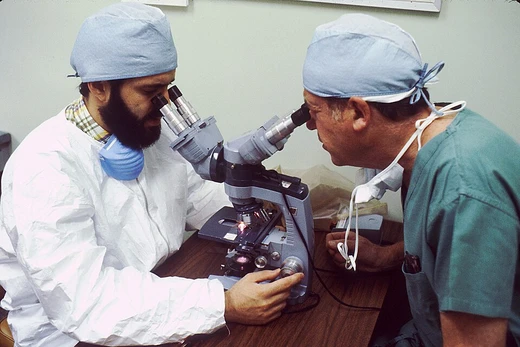
Clinical biologist
Health professional specialized in clinical biology and laboratory diagnostics.

A clinical biologist is a health professional—such as a medical doctor, pharmacist, or biologist—whose expertise lies in clinical biology, a medical field that grew out of clinical pathology. This specialty also covers interventional biology, which includes assisted reproductive technology. The training involves a medical residency that lasts between three and five years, depending on the country. The term is most commonly used in France, Switzerland, Belgium, and parts of Western Europe, Africa, and Asia.
In France, a clinical biologist (biologiste médical) is either a medical doctor or a pharmacist who undergoes a four-year specialization in medical biology. The profession is tightly regulated; these specialists oversee and interpret laboratory analyses. Their path includes a national competitive exam (internat de biologie médicale) and a structured residency in clinical labs. They are central to laboratory diagnostics, clinical decision-making, and managing the quality of biological analyses.
In Italy, becoming a clinical or medical biologist requires earning a Bachelor’s and a Master’s degree in Biological Sciences, followed by four years of postgraduate specialization (Scuola di Specializzazione) in Clinical Pathology and Clinical Biochemistry.
In Switzerland, the equivalent role is the FAMH Specialist in Laboratory Medicine, a title granted by the Foederatio Analyticorum Medicinalium Helveticorum (FAMH). This postgraduate certification requires a four-year training program completed while working in an accredited medical laboratory. It is open to holders of a medical degree (MD), a pharmacy degree, or a master’s or PhD in biomedical sciences, biology, or related fields. Training covers hematology, clinical chemistry, medical microbiology, immunology, and genetics. These specialists supervise and interpret lab analyses, validate results, communicate with clinicians, ensure quality management and compliance with ISO 15189 standards, and help train laboratory technical staff. The FAMH title is federally recognized and mandatory for leading and validating medical diagnostic labs in Switzerland.
In Belgium, a clinical biologist (biologiste clinique) is a medical doctor or pharmacist who completes a five-year postgraduate specialization in clinical biology, regulated by the Belgian Ministry of Public Health.
- Field
- Clinical biology (medical specialty derived from clinical pathology)
- Training duration
- 3 to 5 years of medical residency (varies by country)
- Common regions
- France, Switzerland, Belgium, Western Europe, Africa, Asia
- Equivalent title in switzerland
- FAMH Specialist in Laboratory Medicine
- Key responsibilities
- Overseeing and interpreting laboratory analyses, quality management, advising clinicians
Lore & Background
In France, a clinical biologist (biologiste médical) is a doctor in medicine or pharmacy who has completed a four-year specialization in medical biology. Their training includes a national competitive exam (internat de biologie médicale) and a structured residency program in clinical laboratories. They play a key role in laboratory diagnostics, clinical decision-making, and quality management of biological analyses. In Italy, to become a clinical or medical biologist, one must achieve a BSc. and MSc. in Biological Sciences and then four years of postgraduate specialization (Scuola di Specializzazione) in Clinical Pathology and Clinical Biochemistry.
Reader's Guide
Clinical biologists are central to modern medical diagnostics, bridging laboratory science and patient care. Their training, which varies from 3 to 5 years depending on the country, ensures they can oversee and interpret laboratory analyses, validate results, and communicate with clinicians. In France, the profession is strictly regulated, with clinical biologists responsible for quality management of biological analyses. In Switzerland, the FAMH Specialist in Laboratory Medicine is federally recognized and mandatory to lead and validate medical diagnostic laboratories, with training covering hematology, clinical chemistry, medical microbiology, immunology, and genetics. In Belgium, clinical biologists work in both hospital and private laboratories, advising clinicians on diagnostic strategies. The profession's significance lies in its role in ensuring accurate diagnostics, quality control, and compliance with standards such as ISO 15189 in Switzerland, ultimately impacting clinical decision-making and patient outcomes.
Did You Know?
- In France, clinical biologists must pass a national competitive exam called the internat de biologie médicale.
- In Switzerland, the FAMH Specialist in Laboratory Medicine title is a mandatory requirement to lead and validate medical diagnostic laboratories.
- In Belgium, the specialization in clinical biology lasts five years and is regulated by the Belgian Ministry of Public Health.
- The concept of clinical biology includes interventional biology, such as assisted reproductive technology.
Frequently Asked Questions
Who is a Clinical biologist?
A Clinical biologist is a health professional—typically a physician, pharmacist, or biologist—whose specialty is clinical biology, a medical discipline that grew out of clinical pathology. In some jurisdictions the role also extends to interventional biology, including assisted reproductive technology.
What are a Clinical biologist's core responsibilities?
They oversee and interpret laboratory analyses, manage quality control within diagnostic labs, and advise treating clinicians on how to read and act on test results. In practice, they serve as the interpretive bridge between raw lab data and patient-care decisions.
How long does it take to become a Clinical biologist?
The required medical residency lasts between three and five years, with the exact length depending on the country. This postgraduate training is layered on top of a prior medical or life-science degree and is specific to the clinical biology specialty.
Where is the title 'Clinical biologist' most commonly used?
The designation is most prevalent in France, Switzerland, Belgium, and the wider Western European region, as well as parts of Africa and Asia. In other countries the same professional role may carry a different title or be folded into a broader laboratory-medicine category.
What is the Swiss equivalent of a Clinical biologist?
In Switzerland the equivalent designation is 'FAMH Specialist in Laboratory Medicine,' reflecting the Swiss medical board's naming convention for the same clinical-biology specialty recognized in neighboring countries like France and Belgium.
More in Pathology 1-24
Spotted an error? Know more?
Reader corrections go straight into our review queue. Suggest an edit · How this site is sourced