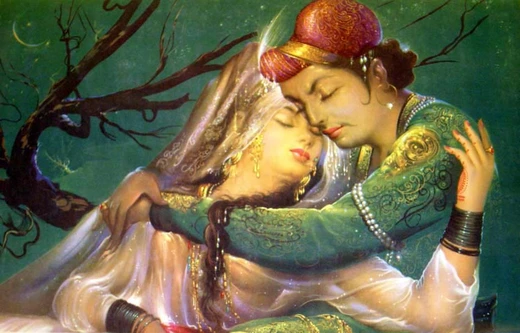
Mirza Sahiban
A classical Punjabi folk tragedy of love, elopement, and death.
Last updated
Mirza Sahiban is a classical Punjabi folk tragedy about two lovers from chieftain families who elope and die.[1]
Key facts and history
Mirza was the son of Banjal, a Kharal chief of Danabad, while Sahiban was the daughter of Khiva Khan of the Sials.[2] The lovers were "milk cousins," as Mirza's mother and Sahiban's father were nursed by the same woman.[3] Mirza and Sahiban studied together as children and fell in love as they grew older.[3] Sahiban's marriage was fixed with a local, and the couple eloped on her wedding day.[3]
During their escape, Sahiban hid Mirza's arrows up a tree, fearing he would kill her pursuing brothers.[3] Defenseless, Mirza was killed by Sahiban's brothers, and in the common telling Sahiban kills herself.[3] Pilu's original poem does not record Sahiban's fate, while some versions have her strangled by her brothers.[3] The poet Pilu, active in the 17th century, produced the initial literary version of this narrative.[2]
Pilu, together with his student Hafiz Barkhurdar, created a well-known rendition of the Mirza-Sahiban legend.[1]
What the cited sources add
Karan Bali notes that the earliest cinematic version, Mirza Sahiban (1929), dates to the silent era.[3] The 1947 film Mirza Sahiban starred Noor Jehan and was her final film in undivided India before she moved to Pakistan after Partition.[3] Pakistani filmmaker Mushtaq Gazdar wrote that the story's mixed success rate may stem from Sahiban's hesitation in her commitment to her lover.[3] Hari Narayan argues that filmmakers have perpetuated the myth that Sahiban's ambivalence was to blame for Mirza's death.[4]
The 2012 Punjabi film Mirza – The Untold Story reworked the tale by giving the family animosity a modern context involving drug smuggling.[4] Jamal Shahid reports that a 2015 musical performance of Mirza Sahiban at the Pakistan National Council of Arts featured Laila Malik as Sahiban and Sher Ashiq Jatt as Mirza.[5]
References
- Wikipedia, "Mirza Sahiban" (CC BY-SA 4.0), which cites: Mahapatra, "THE WRITTEN LANGUAGES OF THE WORLD: A SURVEY OF THE DEGREE AND MODES OF USE, Volume II: INDIA. Book 1. Constitutional Languages", Laval University Press, 1989, p. 438 (we also read that source) en.wikipedia.org
- Wikipedia, "Mirza Sahiban" (CC BY-SA 4.0), which cites: Banga, "Precolonial and Colonial Punjab: Society, Economy, Politics, and Culture: Essays for Indu Banga", Manohar, 2005, p. 171 (we also read that source) en.wikipedia.org
- Karan Bali, "Before 'Mirzya', Mirza and Sahiban have died over and over again for their love (numerous versions of the legend exist, including productions in Punjabi on both sides of the border)", Scroll.in website, 13 S. facts only, no text reused. scroll.in
- Hari Narayan, "Sahibaan remains unheard", The Hindu newspaper, 12 October 2016. facts only, no text reused. thehindu.com
- Jamal Shahid, "A beloved folk story comes to life", Dawn newspaper, 11 January 2015. facts only, no text reused. dawn.com
Each numbered sentence above was checked against the source it cites before publication. Sentences citing Wikipedia adapt text from the English Wikipedia article Mirza Sahiban (contributors), used under CC BY-SA 4.0; this entry is available under the same licence. Other sources were used for facts only; no text or images are copied from them.
More in Pakistani folklore
Sources
Compiled from Wikipedia and the sources listed below. Text from Wikipedia is available under CC BY-SA 4.0; this entry is adapted from it.
- Wikipedia: Mirza Sahiban (CC BY-SA 4.0).
Spotted an error? Know more?
Reader corrections go straight into our review queue. Suggest an edit · How this site is sourced