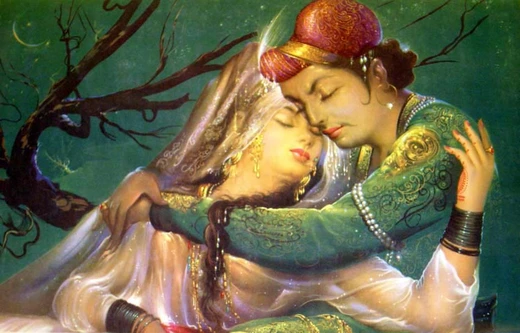
Sassui Punnhun
A tragic folktale of a faithful lover seeking her husband.
Last updated
Sassui Punnhun is a tragic folktale known in Sindhi, Balochi, and Punjabi traditions, set in Sindh and Makran.[1] Within Sindh, this story is counted among seven well-known tragic romances, while in Punjab it is considered one of four such popular tales.[2][3]
Key facts and history
Later it appears in Karim Jo Risalo of Shah Abdul Karim of Bulri.[4] She ran barefoot towards Kech Makran, crossing miles of desert.[5] After a shepherd tried to force himself on her, Sassui prayed and was buried in a mountain valley.[5] Punnhun also prayed and was buried in the same valley.[5]
The oldest known reference to this narrative appears in writings by Qazi Qadan.[4] Shah Abdul Latif Bhittai's Shah Jo Risalo includes this story as one of its seven heroines.[4] Punnhun's father was Jam Aali, a Baloch ruler who governed Kech in Balochistan.[6] Sassui's father was the Raja who ruled Bhambore, a town in Sindh.[6]
Upon waking, Sassui discovered that her brothers-in-law had deceived her.[5] The supposed burial sites of the lovers are found near Lasbela in Balochistan, a distance of 45 miles west of Karachi.[7][8]
What the cited sources add
A 2019 Daily Times article states that Mir Punnhun Khan was from the tribe of Hoths, a local tribe in Balochistan.[9] The same article identifies Punnhun as the son of Mir Aalii, who was the son of King Mir Hoth Khan.[9] A 2017 article from goodtimes.com.pk specifies that the alleged grave is in the Pub range to the west of Karachi.[8]
References
- Wikipedia, "Sassui Punnhun" (CC BY-SA 4.0), which cites: ; ; Dr.Nabi Bux Khan Baloach, "Popular Folk Stories:Sassui Punhun", Sindhi Adabi Board, 1976 (original not read by us) en.wikipedia.org
- Wikipedia, "Sassui Punnhun" (CC BY-SA 4.0), which cites: ʻAbd al-Laṭīf (Shah), "Risalo", Harvard University Press, 2018 (original not read by us) en.wikipedia.org
- Wikipedia, "Sassui Punnhun" (CC BY-SA 4.0), which cites: Jamal Shahid, "A beloved folk story comes to life", Dawn, 11 January 2015; Karan Bali, "Before 'Mirzya', Mirza and Sahiban have died over and over again for their love (Numerous versions of the legend exist, including productions in Punjabi on both sides of the border)", Scroll.in website, 13 S; "Love Legends in History of Punjab", Punjabi World website, 20 April 2007; Sahibaan remains unheard The Hindu (newspaper), Published 11 October 2016, Retrieved 8 November 2020; Mahapatra, "THE WRITTEN LANGUAGES OF THE WORLD: A SURVEY OF THE DEGRE en.wikipedia.org
- Wikipedia, "Sassui Punnhun" (CC BY-SA 4.0), which cites: Dr. Motilal Jotwani, "Sufis Of Sindh", Publications Division Ministry of Information & Broadcasting; Schimmel, "Pain and Grace: A Study of Two Mystical Writers of Eighteenth-Century Muslim India", BRILL, 13 November 2018; N. Hanif, "Biographical Encyclopaedia of Sufis: South Asia", Sarup & Sons, 2000 (original not read by us) en.wikipedia.org
- Wikipedia, "Sassui Punnhun" (CC BY-SA 4.0), which cites: Ikram, "The cultural heritage of Pakistan", Oxford University Press, 1955, p. 152–153 (original not read by us) en.wikipedia.org
- Wikipedia, "Sassui Punnhun" (CC BY-SA 4.0), which cites: ; Pannke, "Saints and singers : Sufi music in the Indus Valley", Karachi : Oxford University Press, 2014, p. 109; (original not read by us) en.wikipedia.org
- Wikipedia, "Sassui Punnhun" (CC BY-SA 4.0), which cites: "The Eternal Love of Sassi Punnu", goodtimes.com.pk, 16 December 2017; "Sassui Punnhu Grave Neglected - Dawn News", 24 April 2013 (we also read that source) en.wikipedia.org
- "The Eternal Love of Sassi Punnu", goodtimes.com.pk, 16 December 2017. facts only, no text reused. goodtimes.com.pk
- "Historical significance of Punnu Fort", Daily Times, 2019-03-20. facts only, no text reused. dailytimes.com.pk
Each numbered sentence above was checked against the source it cites before publication. Sentences citing Wikipedia adapt text from the English Wikipedia article Sassui Punnhun (contributors), used under CC BY-SA 4.0; this entry is available under the same licence. Other sources were used for facts only; no text or images are copied from them.
More in Pakistani folklore
Sources
Compiled from Wikipedia and the sources listed below. Text from Wikipedia is available under CC BY-SA 4.0; this entry is adapted from it.
- Wikipedia: Sassui Punnhun (CC BY-SA 4.0).
Spotted an error? Know more?
Reader corrections go straight into our review queue. Suggest an edit · How this site is sourced