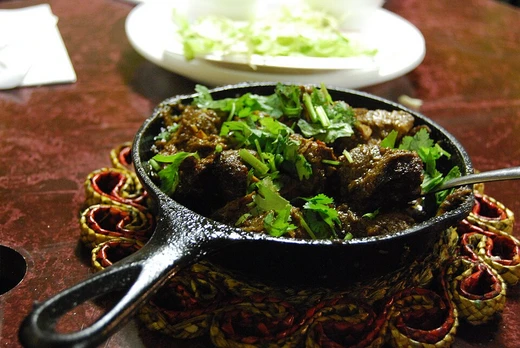
Mughlai cuisine
Indo-Persian cuisine from the Mughal Empire.
Mughlai cuisine comprises delicately-spiced dishes developed or popularised in the early-modern Indo-Persian cultural centres of the Mughal Empire. It combines Indian subcontinent cooking with Persian culinary styles and methods, including the use of the tandoor, braised meat, yoghurt marinades, and cheese. The cuisine is notable for its elaborate buffets and distinctive dishes such as biryani, korma, and kebabs.
Quick Facts
- Period
- early-modern
- Cultural centres
- Indo-Persian centres of the Mughal Empire
- Key manuscripts
- Nuskha-i-Shahjahani
- Ḵẖulāṣat-i Mākūlāt u Mashrūbāt
- Alwān-E-Niʿmat
- Notable emperor associated
- Shah Jahan (r. 1627-1658)
- Another emperor associated
- Aurangzeb (r. 1658–1707)
- Yet another emperor associated
- Jahangir (r. 1605–1627)
Facts from the source article.
History
The Mughal Empire in northern Hindustan was Indo-Persian, with a hybridized, pluralistic Persianate culture. Mughlai cuisine introduced Central Asian styles of food and new cooking methods to Hindustan, combining them with local spices and vegetables for the Mughal court. Biryani, for instance, developed in the royal Mughal kitchens by merging native spicy rice dishes with Persian pilau and the Persian method of marinating meat in yoghurt. Decorated Indo-Persian cookery books and culinary manuscripts adorned the personal libraries of the Mughal elite. A popular work from the period was the Nuskha-i-Shahjahani, said to record dishes prepared for the court of Emperor Shah Jahan. This Persian manuscript has ten chapters covering breads, pottages, stews, meat with onions, mashed vegetables, layered rice dishes, pilau, kebabs, savoury porridge, omelettes, rice with lentils, and a final chapter on jams, pickles, fried bread, sweets, warm pudding, and basic recipes for yoghurt, panīr, and colouring butter and dough. Another well-known cookery book from the time of Emperor Aurangzeb or some years later was the Ḵẖulāṣat-i Mākūlāt u Mashrūbāt, with 40 chapters each covering one dish type, starting with breads and then savoury dishes including qalīya, dopiyāza, bharta, kabāb, khichṛī, zerbiryān, and achār, plus a chapter on sālanhā-i hindī. Sweetmeats described in that work include phirni, shir berenj, falooda, panbhatta, malida, and several sweet dumplings. The Alwān-E-Niʿmat from the reign of Jahangir is dedicated entirely to sweetmeats, describing nan ḵẖata'i, sweetened puri, fried sweet samosa, laddu, and halva, with samosas and puris cooked slowly in a sealed pot.
Cuisine
Mughlai cuisine spans a wide range of heat, from very mild to fiery, and is known for its characteristic fragrance and generous use of both ground and whole spices. A full Mughlai meal is a grand spread, often featuring up to a hundred main dishes alongside many sides. Among the notable main courses are biryani, keema matar, kofta chorba, murgh kali mirch, mutton rogan josh, and shahi kaju aloo. Kebabs, which first appeared during the Delhi Sultanate, evolved from simple grilled meat into a refined dish seasoned with aromatic spices and dried fruit. Korma is a gentle curry with a thick sauce, prepared by slowly cooking meat or vegetables in yogurt and spices. Murgh musallam consists of marinated spiced chicken, while pasanda features marinated meat in a creamy sauce made with yogurt, nuts, and mild spices. A common side is Mughlai paratha, a Bengali flatbread filled with minced meat or egg. Desserts include anjeer halwa, gulab jamun, falooda, seviyan, phirni, barfi, and shahi tukra. The Mughals also valued fresh fruits, especially several types of indigenous Indian mangoes, as desserts. A typical Mughal beverage is sherbet; food writer Lizzie Collingham notes that the Mughals considered mangoes ideal for this and provides a recipe for green mango sherbet.
More in Pakistani Cuisine
Spotted an error? Know more?
Reader corrections go straight into our review queue. Suggest an edit · How this site is sourced