
Uche Okeke
Seminal Nigerian modernist artist and theorist.

GualdimG · CC BY-SA 4.0
Christopher Uchefuna Okeke (April 30, 1933 – January 5, 2016), known as Uche Okeke, worked as an illustrator, painter, sculptor, and teacher. He also wrote about art and aesthetics and played a key role in shaping Nigerian modernism.
Okeke was born in Nimo, in what is now Anambra State, Nigeria, to Isaac Okonkwo Okeke and Monica Mgboye Okeke. From 1940 to 1953, he attended St. Peter Claver's Primary School in Kafanchan, Metropolitan College in Onitsha, and Bishop Shanahan College in Orlu. Even as a student, he showed a strong interest in drawing and painting. Before studying fine art at the Nigerian College of Arts, Science and Technology (now Ahmadu Bello University, Zaria), he had already exhibited taxidermy at a Field Society meeting in Jos Museum, helped prepare and present *Nigerian Drawings and Paintings* with curator Bernard Fagg, and held a solo exhibition of drawings and paintings in Jos and Kaduna, which Sir Ahmadu Bello attended.
In 1958, Okeke became a founding member of the Zaria Art Society. The group formed during Nigeria's struggle for independence and included key figures in Nigerian modernist art such as Yusuf Grillo, Bruce Onobrakpeya, Oseloka Osadebe, and Demas Nwoko. While his British professors at the college taught Western techniques, the Zaria Society rejected the imposition of European art school ideas on young African artists. At school, Okeke studied the Igbo, Yoruba, and Hausa ethnic groups, searching for ways to express his Nigerian identity. He noted that ancient Nigerian symbols often appeared on pottery or body paintings, and that Igbo designs are called Uli patterns.
In 1971, Okeke joined the Department of Fine and Applied Arts at the University of Nigeria in Nsukka as a professor. Along with colleagues and students, he helped develop a distinctive style that became known as the Nsukka School. Together with Chike Aniakor and Obiora Udechukwu, he shaped the art and aesthetics of Nigerian modernism in the 1970s.
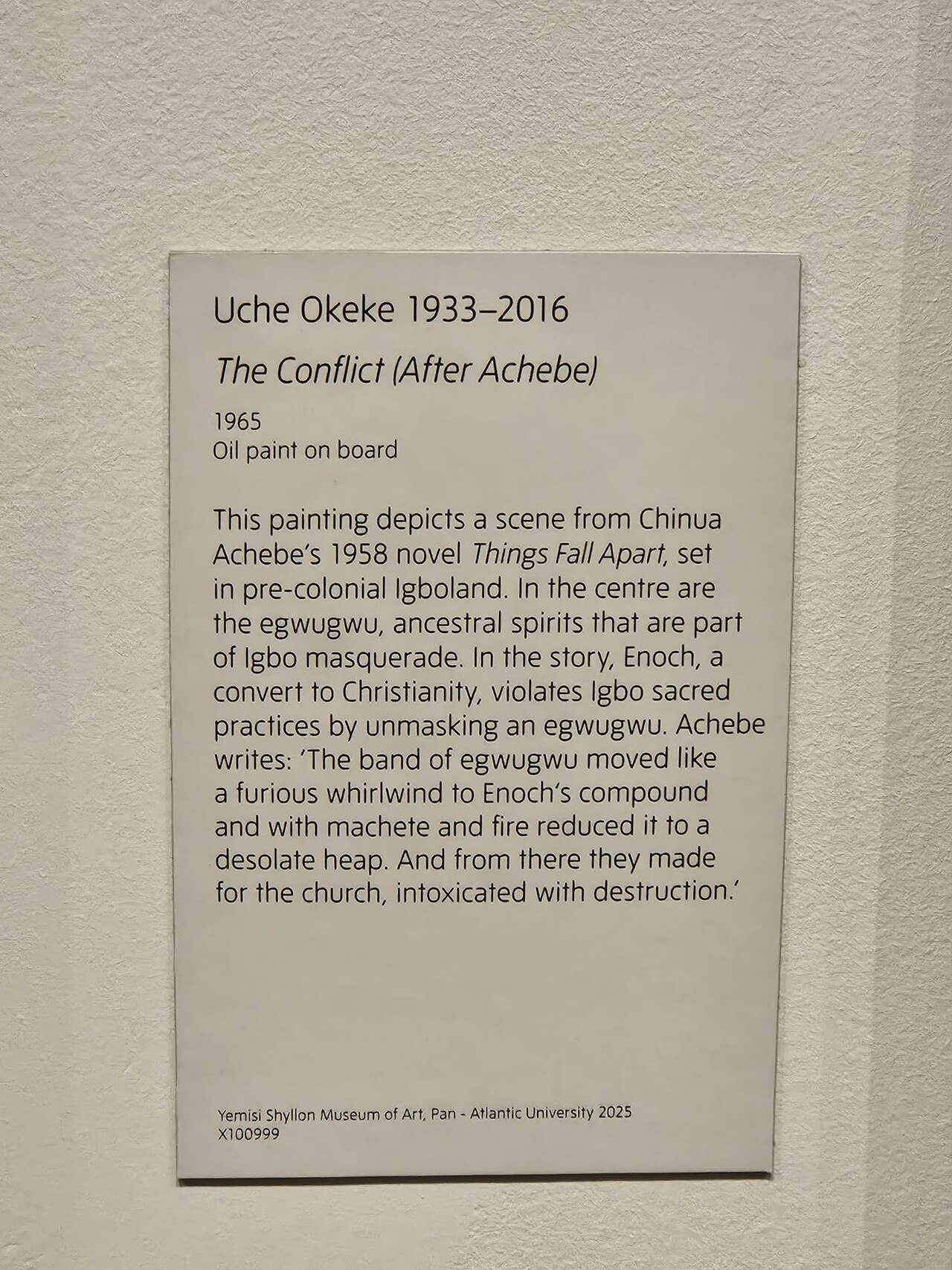
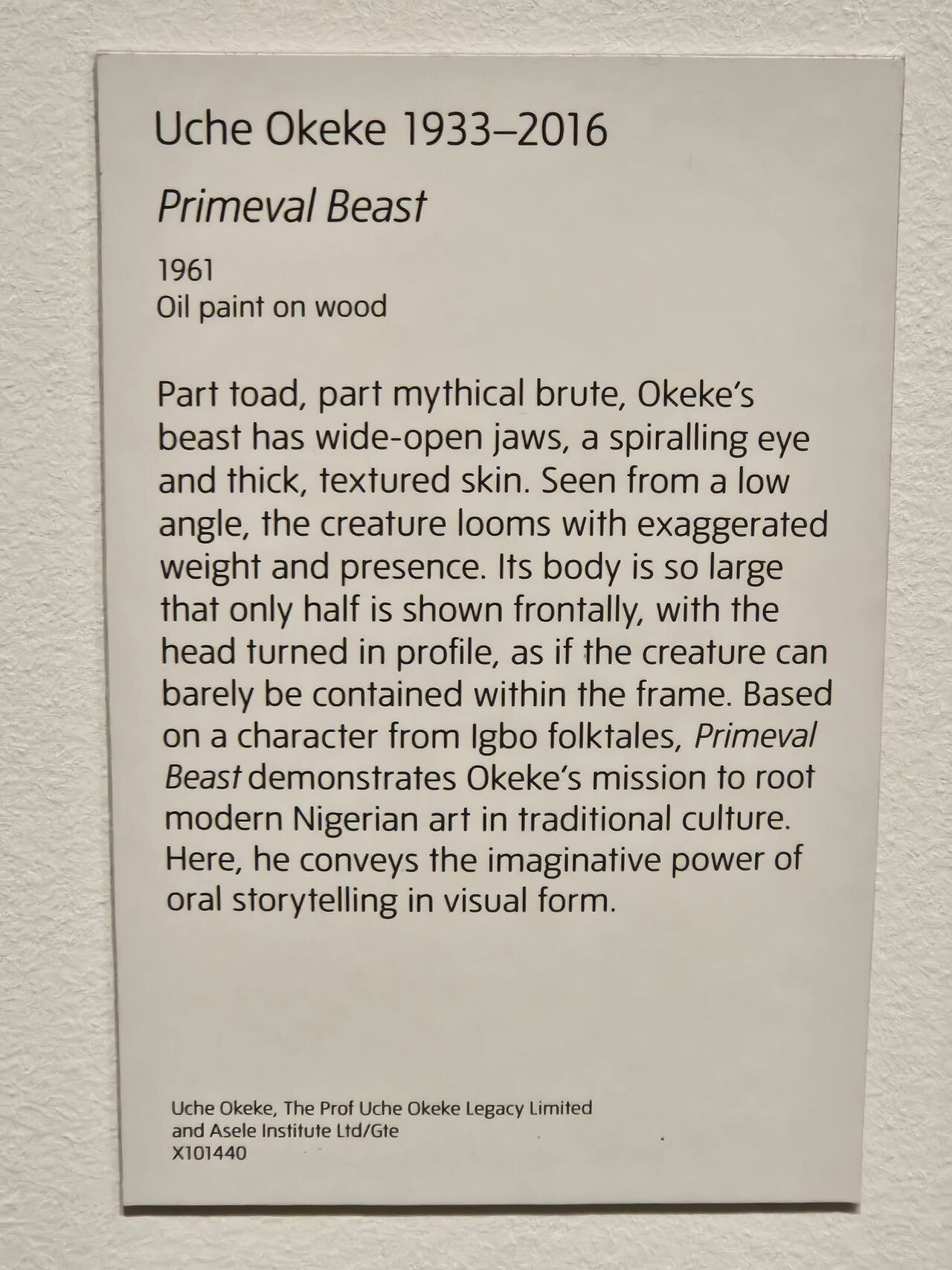
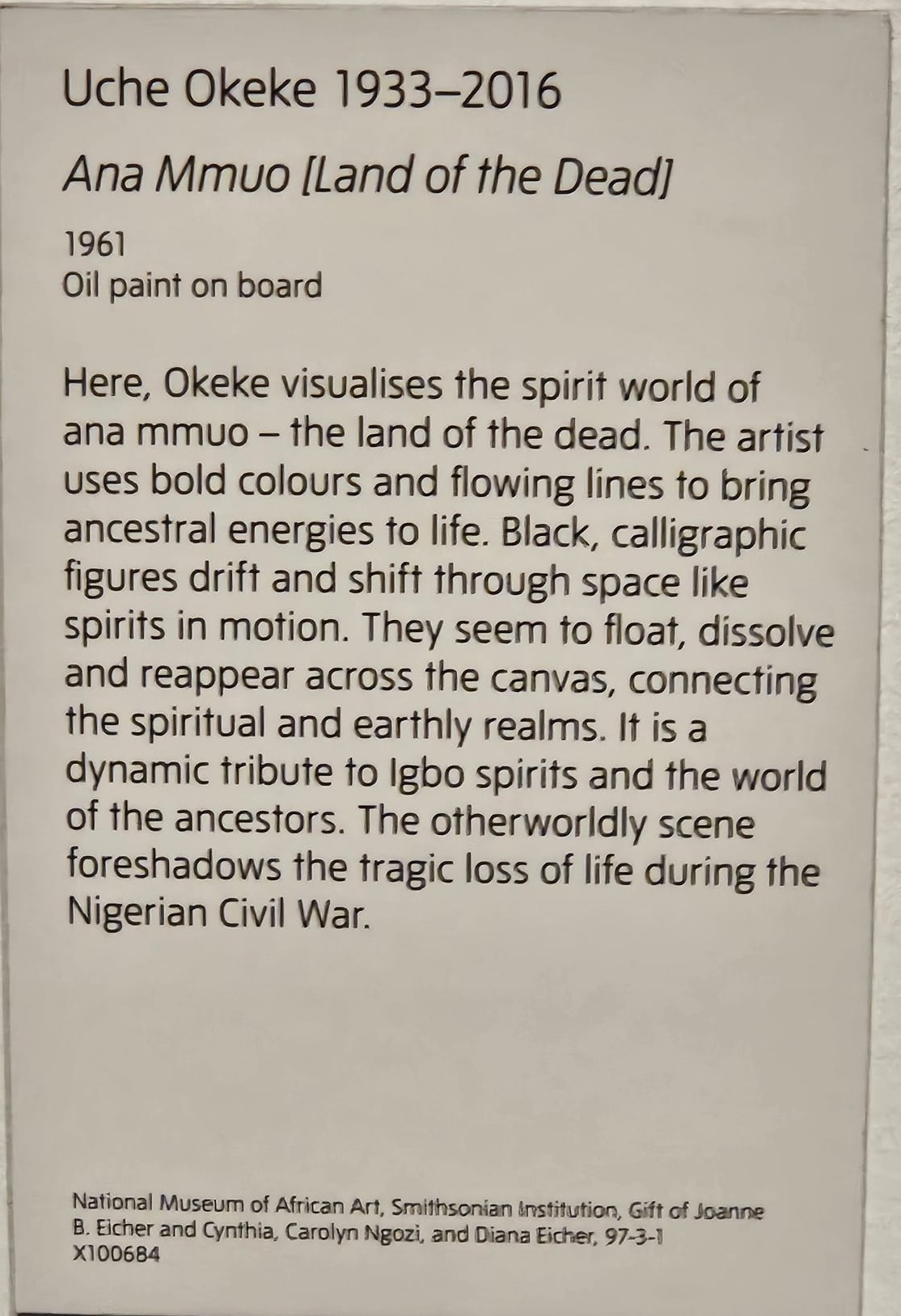
Okeke first encountered Igbo folktales as a child and later used them as inspiration in his art. In some drawings, he depicted heroic mythological figures to highlight his Igbo heritage. The Igbo cultural area lies east of the Niger River, west of the Cross River, and west of the Great Niger waterway in southeastern Nigeria, and shows evidence of an ancient artistic culture. The traditional Igbo art form is Uli drawing, which Okeke described as an attempt to enhance the beauty of the human body. Traditionally, a female Uli artist paints patterns on the body and sometimes on the walls of sacred places, a process called Ide Uli or Ise Uli. The motifs and symbols in Uli remain consistent, but the ordering of design elements challenges the ingenuity of traditional Igbo artists. Many Uli design elements come from nature, such as striped and spotted animals like pythons and jaguars. Uli patterns include geometric, plant, and animal motifs, and the colors an artist chooses carry significance. The medium for Uli drawings is extracted from the pods of plants named Uli Oba, Uli Nkilisi, and Uli Ede Eji. Art in Igboland is attributed to the earth goddess Ala, springing from nature and seen as a way to foster the spiritual and physical well-being of communities. Uli also has lyrical qualities inspired by songs in Igbo folklore.
Okeke was influenced by his mother, who created Uli designs, and believed that drawing and line-work were fundamental to his career. This practice is evident in his work *Savannah Landscape*. His artistic productivity was backed by aesthetic considerations. His early writings engaged with Pan-Africanism and Négritude, and the compelling style of his essays earned his group of young students at Ahmadu Bello University the title "Zaria rebels." In later reflections, he focused on the political role artists should cultivate.
Okeke opened a cultural centre at 30 Ibadan Street, Kafanchan, which later became the Asele Institute in Nimo. In 1996, part of the Smithsonian Institution-sponsored educational film *Nigerian Art - Kindred Spirits* was shot there. The institute holds a collection of artifacts, objects, and artwork Okeke acquired during his travels across Nigeria, and remains an important repository of documents, artifacts, and mid-20th century African art. He served as lecturer and acting head of the Fine Arts Department at the University of Nigeria, Nsukka, from 1971 to 1985, transforming the curriculum to focus more on African indigenous art and design. In 1973, he also redesigned the curriculum of the Department of Fine and Applied Arts at the Institute of Management and Technology, Enugu, and initiated postgraduate courses in the Department of Fine Arts at Nsukka. He later became director of the Institute of African Studies at the University of Nigeria, Nsukka, and a visiting professor.
- born
- April 30, 1933
- died
- January 5, 2016
- field
- Illustrator, painter, sculptor, teacher, art theorist
- nationality
- Nigerian
- known_for
- Founding member of Zaria Art Society; key figure in Nsukka School; promoter of U
Verified Timeline
Lore & Background
Christopher Uchefuna Okeke was born on 30 April 1933 in Nimo, Njikoka Local Government Area of Anambra State, Nigeria, to Isaac Okonkwo Okeke and Monica Mgboye Okeke (née Okoye). Between 1940 and 1953, he attended St. Peter Claver's (Primary) School, Kafanchan, Metropolitan College, Onitsha, and Bishop Shanahan College, Orlu, Nigeria, during which time he had already begun to demonstrate an avid interest in drawing and painting. Before being admitted to read Fine Art at Nigerian College of Arts, Science and Technology (NCAST), now Ahmadu Bello University, Zaria, Okeke had already exhibited taxidermy work during the Field Society meeting in Jos Museum, participated in the preparation and presentation of Nigerian Drawings and Paintings with Bernard Fagg as curator and had a solo exhibition of drawings and paintings, in Jos and Kaduna with Sir Ahmadu Bello in attendance. As a young artist, Okeke was a founding member of the Zaria Art Society in 1958. The group opposed the imposition of European art school ideas on young artists in Africa. In school, Okeke studied the Igbo, Yoruba, and Hausa ethnic groups, looking for a way to express his Nigerian self. Ancient Nigerian symbols are most commonly found on pottery or in body paintings. Igbo designs are called Uli Patterns.
Reader's Guide
Uche Okeke's significance lies in his role as a founder of the Zaria Art Society and a leading figure of the Nsukka School, which developed a modern idiom rooted in indigenous African art, especially Igbo Uli drawing. In 1971, Okeke joined the Department of Fine and Applied Arts at the University of Nigeria in Nsukka as a professor. Together with colleagues and students he developed a unique style which became characteristic for the called 'Nsukka School'. With Chike Aniakor and Obiora Udechukwu he established the formation of art and aesthetics of Nigerian modernism in the seventies. He transformed curricula at the University of Nigeria, Nsukka, and the Institute of Management and Technology, Enugu, to emphasize African indigenous art and design. His Asele Institute, Nimo, became a major repository of mid-20th-century African art and documents. Okeke's early writings seized on the ideas of Pan-Africanism and Négritude. Among others it was the compelling style of his essays that earned the group of young students at the Ahmadu Bello University the title 'Zaria rebels'. In his later reflections he focused on the political role artists should cultivate. He carried the Uli experiment beyond the walls of Zaria and stood in the forefront of its transformation into a modern idiom in the 1970s, from the studios at Nsukka.
Did You Know?
- Okeke exhibited taxidermy work during a Field Society meeting at Jos Museum before studying Fine Art.
- He co-founded the Zaria Art Society in 1958, a group that opposed the imposition of European art school ideas on young African artists.
- Okeke's mother created Uli designs, and he believed drawing and line-work were fundamental to his career as an artist.
- He opened a cultural centre at 30 Ibadan Street, Kafanchan, which later became the Asele Institute, Nimo.
- A part of the Smithsonian Institution-sponsored educational film 'Nigerian Art - Kindred Spirits' was shot at the Asele Institute in 1996.
Roots in Nimo and Early Artistic Awakening
Christopher Uchefuna Okeke was born on April 30, 1933, in Nimo, a community in Anambra State's Njikoka Local Government Area in southeastern Nigeria. His parents, Isaac Okonkwo Okeke and Monica Mgboye Okeke, raised him in a household where visual culture was part of daily life—his mother practiced Uli, the traditional Igbo art of painting geometric and nature-derived patterns on the human body. This early immersion in line-work left a permanent mark on his artistic sensibility, a connection he would later trace in works like Savannah Landscape. Between 1940 and 1953, he attended St. Peter Claver's Primary School in Kafanchan, Metropolitan College in Onitsha, and Bishop Shanahan College in Orlu, during which time his passion for drawing and painting grew steadily. Remarkably, before matriculating at the Nigerian College of Arts, Science and Technology in Zaria, he had already mounted a solo exhibition of drawings and paintings in Jos and Kaduna—an event attended by Sir Ahmadu Bello—and contributed to a curated group show under Bernard Fagg's direction. His creative range extended beyond two dimensions; he also presented taxidermy work at a Field Society meeting at the Jos Museum.
The Zaria Rebels and the Fight for an African Aesthetic
In 1958, a young Okeke became a founding member of the Zaria Art Society, a collective born from the political ferment of a Nigeria on the cusp of independence. Alongside luminaries such as Yusuf Grillo, Bruce Onobrakpeya, Oseloka Osadebe, and Demas Nwoko, the group mounted a pointed challenge to the dominance of European art-school pedagogy. Most of their professors at the Nigerian College were British and taught Western techniques, yet the Society insisted that young African artists should not be forced to channel their creativity through a foreign aesthetic framework. Okeke spent his student years studying the visual vocabularies of the Igbo, Yoruba, and Hausa ethnic groups, searching for a language that could express his Nigerian self. Ancient Nigerian symbols—found on pottery and in body paintings—became a wellspring of inspiration. His compelling essays, which seized on the ideas of Pan-Africanism and Négritude, earned the cohort of young students at Ahmadu Bello University the nickname "Zaria rebels." In his later reflections, Okeke turned his critical pen toward the political responsibilities that artists should cultivate in the service of their communities.
Nsukka and the Forging of a New School
In 1971, Okeke crossed a threshold that would define the next phase of his career: he joined the Department of Fine and Applied Arts at the University of Nigeria in Nsukka as a professor. There, working alongside colleagues and students, he helped forge a distinctive visual language that came to be known as the Nsukka School. Together with Chike Aniakor and Obiora Udechukwu, he laid the groundwork for what would become a coherent articulation of art and aesthetics within Nigerian modernism during the 1970s. His influence extended well beyond the studio. As lecturer and acting head of the Fine Arts Department from 1971 to 1985, he overhauled the curriculum to place greater emphasis on African indigenous art and design, convinced that such a foundation would strengthen the development of modern and contemporary African art. In 1973, he redesigned the fine arts curriculum at the Institute of Management and Technology in Enugu and initiated postgraduate courses at Nsukka. He also served as director of the Institute of African Studies at the university and held visiting and honorary positions at institutions including the University of Port Harcourt and the International Biographical Centre in Cambridge.
The Asele Institute and a Lasting Cultural Repository
Beyond the studio and the lecture hall, Okeke devoted himself to building a physical space where Nigerian artistic heritage could be preserved and shared. He opened a cultural centre at 30 Ibadan Street in Kafanchan, which evolved into the Asele Institute in Nimo. The institute houses a collection of artifacts, objects, and artwork that Okeke gathered during his travels across different parts of Nigeria, and it has come to be regarded as one of the most important repositories of documents, artifacts, and mid-twentieth-century African art. In 1996, a portion of the Smithsonian Institution-sponsored educational film Nigerian Art – Kindred Spirits was shot on its premises, lending the institute an international visibility. Okeke's broader institutional footprint was equally significant: he held roles as visiting professor, honorary deputy director-general for Africa at the International Biographical Centre in Cambridge, and director of the Institute of African Studies. His life's work—carrying the Uli experiment beyond the walls of Zaria and standing at the forefront of its transformation into a modern idiom from the studios at Nsukka—remains a defining thread in the story of Nigerian modernism.
Gallery
Frequently Asked Questions
Who is Uche Okeke?
Uche Okeke (1933–2016) was a Nigerian illustrator, painter, sculptor, and art theorist widely regarded as a cornerstone of Nigerian modernism. His full name was Christopher Uchefuna Okeke, and he worked across multiple media while also shaping art discourse through writing and teaching.
What is Uche Okeke most famous for?
He is best known as a founding member of the Zaria Art Society in 1958 and as a key architect of the Nsukka School at the University of Nigeria, Nsukka. He also championed the traditional Igbo Uli drawing tradition, pushing it into the realm of contemporary fine art.
What was Uche Okeke's role at the University of Nigeria, Nsukka?
Okeke served as a professor there and helped build the Nsukka School, an approach that deliberately wove indigenous Igbo visual languages—especially Uli motifs—into a modernist studio curriculum. His teaching shaped a generation of Nigerian artists who saw local heritage as a foundation rather than a limitation.
Why is Uche Okeke considered important to African art history?
He is credited with giving Nigerian modernism both a theoretical framework and a practical institutional home, bridging pre-colonial aesthetics with contemporary practice. His dual identity as maker and thinker made him a reference point for how African artists could define their own modernist vocabulary.
When did Uche Okeke live and what was his nationality?
He was born on April 30, 1933, in Nigeria and passed away on January 5, 2016. Throughout his life he remained a Nigerian national, working and teaching primarily within the country's academic and cultural institutions.
More in Painters & Visual Artists 1-23
Spotted an error? Know more?
This is a living reference — every entry is fact-audited, and reader corrections feed straight into our audit queue. Suggest an edit · See this site's audit record