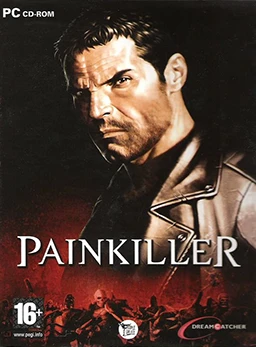
Pain
When the guns go silent, the fists still remember how to hurt.
Pain is the melee weapon in the Painkiller franchise, representing the player's bare fists as wielded by Daniel Dax, the last living Painkiller. It is the most primal and immediate tool in an arsenal otherwise built around firearms and heavy ordnance, serving as the player's first and last line of defense when ammunition runs dry or when a demon closes to point-blank range.
Across the series, Pain occupies the lowest slot in the weapon rotation and requires no pickup or unlock—it is always available. Its role is to deliver fast, high-impact close-quarters takedowns, letting the player shatter demonic flesh with raw kinetic force in a genre that otherwise leans heavily on ranged firepower.
Quick Facts
- Type
- Melee (fists)
- User
- Daniel Dax
- Range
- Contact; very short
- Availability
- Always equipped; no pickup required
- Role
- Close-quarters demon takedown; emergency fallback
- Franchise
- Painkiller (multiple titles)
Lore & Background
In the mythology of the Painkiller universe, Daniel Dax was forged in Hell itself, his body tempered by demonic fire into something that is only partially human. His fists carry the residual heat of that forging, and every strike against a demon's hide sends a shockwave of searing force through its flesh. The weapon is called Pain not because it inflicts it passively, but because each blow is a concentrated discharge of the suffering Daniel endured in the underworld—reclaimed and redirected.
The Painkillers who came before him were said to have fought with their hands long before they were issued armaments, and the tradition persists: a Painkiller who cannot punch a demon in the jaw is no Painkiller at all. In the games, this translates to a rapid two-hit combo—left, right—followed by a heavier overhead strike that staggers larger enemies. The animation is deliberately brutal, with the camera lurching forward on impact and the demon's body recoiling as if struck by a sledgehammer.
Thematically, Pain anchors the player to the physical, visceral core of the franchise. While the Hellfire, the Saw, and the Minigun are spectacle, the fists are intimacy. You are not firing a projectile; you are reaching into a demon's face and breaking it. That proximity is what makes the weapon feel earned, even when it is the simplest option on the HUD.
Reader's Guide
Pain is the weapon you never have to find. It sits in the first slot of the weapon wheel, always ready, always free. You cycle to it with a single keypress or a flick of the mouse wheel, and the camera drops slightly as Daniel's hands rise into frame, knuckles white, tendons standing out under scarred skin.
The feel is snappy. Two quick jabs land in under a second, each one punching the demon's model backward with a satisfying physics wobble. The third hit—the overhead—carries more weight: a longer wind-up, a deeper camera shake, and a crunching audio cue that sits lower in the mix than the rapid jabs. Against smaller enemies like Wraiths or Imps, the combo finishes them in two or three strikes. Against larger foes, it staggers them long enough to reposition or line up a headshot with your next firearm.
Audio design is key to Pain's identity. Each hit layers a wet, dense thud with a short metallic ring, as if the demon's hide has a faint carapace beneath the flesh. The overhead crack adds a deeper sub-bass hit that you feel more than hear on headphones.
In the combat rhythm, Pain is your reset button. You burst-fire the SMG, the demon closes, you swap to Pain for two or three hits, then swap back. It keeps the player moving, keeps the camera close to the action, and prevents the game from ever feeling like a pure gun-turret exercise. It is the weapon players underestimate until they are out of ammo and a Hellhound is on them, and then it becomes the only thing standing between them and a death screen.
Did You Know?
- Pain requires no ammunition, no pickup, and no cooldown—it is the one weapon in the Painkiller arsenal that can never be depleted or locked behind a progression gate.
- The overhead finishing strike in the melee combo triggers a distinct, lower-frequency audio layer compared to the rapid jabs, giving the three-hit sequence a clear rhythmic arc.
- In the Painkiller lore, the title 'Painkiller' refers to Daniel Dax's role as a weapon against Hell's forces; the melee weapon named 'Pain' inverts that title, making the player the source of pain rather than its cure.
- Because Pain is always available, it functions as a failsafe in level design: even a player who has exhausted every magazine and dropped every pickup retains a viable means of defense.
More in Weapons & Equipment
Elsewhere in Painkiller
Spotted an error? Know more?
Reader corrections go straight into our review queue. Suggest an edit · How this site is sourced