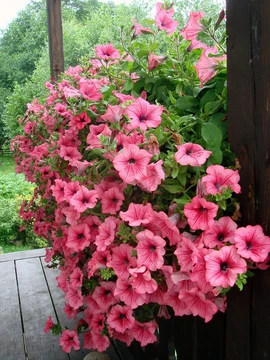
Fuchsia
A genus of flowering shrubs and trees with pendulous blooms.

Fuchsia is a genus of flowering plants, primarily shrubs or small trees. Of the nearly 110 recognized species, the vast majority are native to South America, with a smaller number found north through Central America to Mexico, and several more from New Zealand to Tahiti. One species, *F. magellanica*, reaches the cool temperate zone at the southern tip of South America on Tierra del Fuego, but most species are tropical or subtropical.
The first species to be scientifically described, *Fuchsia triphylla*, was discovered on the Caribbean island of Hispaniola around 1696–1697 by French Minim friar and botanist Charles Plumier during his third expedition to the Greater Antilles. He named the new genus after German botanist Leonhart Fuchs. Fuchsias are most closely related to the northern hemisphere genus *Circaea*, the two lineages having diverged about 41 million years ago. The presence of *Fuchsia* in both the Neotropics and the islands of New Zealand and Tahiti likely results from several dispersal events across the Antarctic land bridge during the Late Eocene.
Fuchsias thrive in climates with cool temperatures year-round and no frost; elsewhere, they prefer partial shade and warm morning temperatures. They require plenty of water. Most fuchsias are shrubs 0.2 to 4 m tall, but one New Zealand species, the kōtukutuku (*F. excorticata*), is unusual in being a tree, reaching 12–15 m. Leaves are opposite or in whorls of three to five, simple and lanceolate, usually with serrated margins (entire in some species), 1–25 cm long, and can be deciduous or evergreen depending on the species. The decorative, pendulous teardrop-shaped flowers appear profusely from late spring through summer and early autumn for about 12 weeks, or year-round in tropical species. They have four long, slender sepals and four shorter, broader petals; in many species, sepals are bright red and petals purple (colors that attract hummingbird pollinators), but colors range from white to dark red, purple-blue, orange, or salmon, with a few having yellowish tones. The ovary is inferior. The fruit is a small (5–25 mm) dark reddish green, deep red, or deep purple berry containing many tiny seeds. The berry of *F. splendens* is reportedly among the best-tasting, with a flavor reminiscent of citrus and black pepper, and can be made into jam. *F. excorticata* fruit has a pleasant sweet taste with slight astringency, while fruit of some other fuchsias is flavorless or leaves a bad aftertaste. In most species, flowers are bird-pollinated and seeds dispersed by birds.
The majority of *Fuchsia* species are native to Central and South America, with a small number on Hispaniola (two species), New Zealand (three species), and Tahiti (one species). Philip A. Munz’s *A Revision of the Genus Fuchsia* classified the genus into seven sections of 100 species. More recent work by botanists Dennis E. Breedlove and Paul E. Berry recognizes 108 species and 122 taxa, organized into 12 sections. In New Zealand and Tahiti, section *Skinnera* now consists of only three species, as *F. × colensoi* was determined to be a naturally occurring hybrid between *F. excorticata* and *F. perscandens*. *F. procumbens* has been placed into its own section, *Procumbentes*. Two other new sections are *Pachyrrhiza* and *Verrucosa*, each with one species. The Plant List, a cooperative effort by leading botanical institutions, lists most currently accepted *Fuchsia* species and synonyms. The vast majority of garden hybrids have descended from a few parent species.
Section *Ellobium* (Mexico and Costa Rica) contains three species: *F. decidua*, *F. fulgens*, and *F. splendens*. Section *Encliandra* (Mexico to Panama) has six species with flat petals, short stamens reflexed into the tube, and fruits with few seeds. Section *Fuchsia* (syn. *Eufuchsia*), from northern Argentina to Colombia and Venezuela, and Hispaniola, is the largest section with 64 species; its flowers are perfect with convolute petals, erect stamens (some exserted), and fruits with many seeds. Section *Hemsleyella* (Venezuela to Bolivia) has fifteen species characterized by a nectary fused with the base of the flower tube and petals partly or completely lacking. Section *Jimenezia* (Panama and Costa Rica) contains *F. jimenezii*. Section *Kierschlegeria* (coastal central Chile) has a single species, *F. lycioides*, with pendulous axillary pedicels, sparse leaves, and reflexed sepals slightly shorter than the tube. Section *Pachyrrhiza* (Peru) contains *F. pachyrrhiza*. Section *Procumbentes* (New Zealand) contains *F. procumbens*. Section *Quelusia* (southern Argentina and Chile, and southeastern Brazil) has nine species with a nectary fused to the base of the tube or hypanthium; the hypanthium is cylindrical and generally no longer than the sepals, and stamens are long and exserted. Section *Schufia* (Mexico to Panama) has two species with erect, corymb-like panicles: *F. arborescens* and *F. paniculata* (with subspecies *mixensis* and *paniculata*); the name *Schufia* is a taxonomic anagram of *Fuchsia*. Section *Skinnera* is found in New Zealand and Tahiti.
- field
- Botany
- known_for
- Ornamental pendulous flowers and diverse species
- native_range
- South America, Central America, Mexico, New Zealand, Tahiti
- first_described_by
- Charles Plumier
- named_after
- Leonhart Fuchs
Lore & Background
He named the new genus after German botanist Leonhart Fuchs. The fuchsias are most closely related to the northern hemisphere genus Circaea, the two lineages having diverged around 41 million years ago. The presence of Fuchsia in both the Neotropics and the islands of New Zealand and Tahiti likely owes to several dispersal events across the Antarctic land bridge during the Late Eocene. Most fuchsias are shrubs from 0.2 to 4 m tall, but one New Zealand species, the kōtukutuku (F. excorticata), is unusual in being a tree, growing up to 12–15 m tall. Fuchsia flowers are very decorative, with a pendulous teardrop shape, four long slender sepals and four shorter broader petals. In many species, the sepals are bright red and the petals purple, colors that attract hummingbirds that pollinate them. The fruit is a small berry containing numerous very small seeds. The fruit of F. splendens is reportedly among the best-tasting, with a flavor reminiscent of citrus and black pepper, and can be made into jam.
Reader's Guide
Fuchsias are popular garden shrubs, valued for their showy, pendulous flowers that bloom from late spring through summer and early autumn, and all year in tropical species. They prefer climates with cool temperatures all year round with no frost, partial shade, and plenty of watering. The genus has been classified into multiple sections, with the largest section, Fuchsia, containing 64 currently recognized species. Horticultural fuchsias may be categorized as upright and bushy or trailing, and some can be trained as hedges. Hardy species from sections Quelusia, Encliandra, Skinnera, and Procumbentes have proven to survive winters in Britain, Ireland, New Zealand, and the Pacific Northwest region of the United States and Canada. In the UK, 60 cultivated varieties have gained the Royal Horticultural Society's Award of Garden Merit. The British Fuchsia Society and the Northwest Fuchsia Society maintain lists of hardy fuchsias that have survived multiple winters in their respective regions. Fuchsias grow abundantly in the mild temperate climate of West Kerry and West Cork in Ireland and the Isles of Scilly, even colonizing wild areas there.
Did You Know?
- The genus was named after German botanist Leonhart Fuchs, whose surname is pronounced [fʊks].
- One New Zealand species, F. excorticata, grows as a tree up to 12–15 m tall, unlike most shrubby fuchsias.
- The fruit of F. splendens is reportedly among the best-tasting, with a flavor reminiscent of citrus and black pepper.
More in Ornamental & Garden Plants 1-24
Spotted an error? Know more?
This is a living reference — every entry is fact-audited, and reader corrections feed straight into our audit queue. Suggest an edit · See this site's audit record