
Diels–Alder reaction
A [4+2] cycloaddition forming six-membered rings with stereochemical control.

Alderdiels · CC BY-SA 4.0
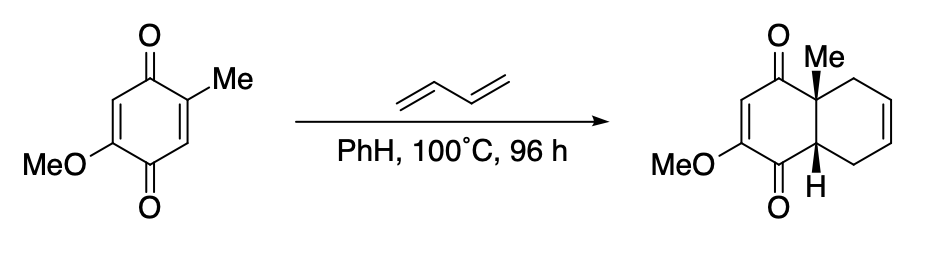
The Diels–Alder reaction joins a conjugated diene with a substituted alkene (called a dienophile) to produce a substituted cyclohexene. It is the classic example of a pericyclic reaction, proceeding through a concerted mechanism—specifically, a thermally allowed [4+2] cycloaddition with the Woodward–Hoffmann symbol [π4s + π2s]. Because it forms two new carbon–carbon bonds at once, it reliably constructs six-membered rings with good control over regiochemistry and stereochemistry, making it a widely used tool for building complexity in natural product synthesis and materials science.
Otto Diels and Kurt Alder first described the reaction in 1928, earning them the 1950 Nobel Prize in Chemistry. The concept has been extended in several ways. In the hetero-Diels–Alder reaction, π-systems containing heteroatoms like carbonyls or imines yield heterocycles. Diels–Alder-like reactions exist for other ring sizes, but none match the [4+2] version in scope and versatility. Because both ΔH° and ΔS° are negative for a typical Diels–Alder reaction, the reverse process—the retro-Diels–Alder—becomes favorable at high temperatures; this reversal is synthetically useful only for a limited set of adducts with special structural features.
The reaction is concerted, occurring through a single cyclic transition state with no intermediates. Orbital symmetry governs it: it is a [π4s + π2s] cycloaddition, meaning the 4π-electron diene and the 2π-electron dienophile interact suprafacially, producing a transition state without an orbital-symmetry barrier. Frontier molecular orbital (FMO) analysis explains this. In the common “normal” electron-demand case, the key interaction is between the diene’s highest occupied molecular orbital (HOMO, ψ2) and the dienophile’s lowest unoccupied molecular orbital (LUMO, π*). The HOMO–LUMO gap is small enough that substituent effects can reverse the roles: in an inverse electron-demand Diels–Alder, electron-withdrawing groups on the diene lower its empty ψ3 orbital, while electron-donating groups on the dienophile raise its filled π orbital, making that interaction dominant. In either case, the orbitals are in phase, leading to a bonding interaction. Since the reactants are in their ground state, the reaction is thermally initiated and does not require light.
Other factors beyond frontier orbital interactions also influence the reaction rate. Not all donor–acceptor complexes undergo the Diels–Alder reaction, even though the same HOMO–LUMO interactions apply. In practice, most additional effects are captured by the reaction enthalpy, and the orbital interaction can be estimated from geometry and ionization energies. An empirical formula for the uncatalyzed reaction rate is: log(k·mol·s) = (290 ± 10 − (60.8 ± 2.8) Å⁻¹·R) (eV/(I_D − E_A)) − (5.05 ± 0.39) (mol/kJ)·ΔH − 28.2, where k is the rate, R the distance between the diene’s ends, I_D the diene’s ionization potential, E_A the dienophile’s electron affinity, and ΔH the reaction enthalpy.
The prevailing view is that most Diels–Alder reactions are concerted, but this has been debated. Although the vast majority show stereospecific, syn addition of the two components, a diradical intermediate has been proposed and supported by computational evidence.
- field
- Organic chemistry
- known_for
- Discovery of the Diels–Alder reaction
- nobel_prize
- 1950
Lore & Background
The Diels–Alder reaction is a chemical transformation between a conjugated diene and a substituted alkene, known as the dienophile, which produces a substituted cyclohexene derivative. It is the classic example of a pericyclic reaction with a concerted mechanism, specifically a thermally-allowed [4+2] cycloaddition. The reaction reliably forms six-membered rings while simultaneously creating two new carbon–carbon bonds, offering good control over regiochemistry and stereochemistry, making it a widely used tool in the synthesis of natural products and new materials. Otto Diels and Kurt Alder first described the reaction in 1928, earning them the Nobel Prize in Chemistry in 1950. The concept has been generalized, notably in the hetero-Diels–Alder reaction where π-systems containing heteroatoms like carbonyls and imines yield heterocycles. Because both the enthalpy and entropy changes are negative for a typical Diels–Alder reaction, the reverse process, the retro-Diels–Alder reaction, becomes favorable at high temperatures, though it is synthetically useful only for a limited range of adducts with special structural features. The reaction is believed to proceed through a single, cyclic transition state with no intermediates, governed by orbital symmetry considerations as a [π4s + π2s] cycloaddition. Frontier molecular orbital analysis explains the reaction: for normal electron demand, the electron-rich diene's HOMO interacts with the electron-deficient dienophile's LUMO; for inverse electron demand, the roles reverse due to substituent effects. The reaction is initiated thermally and does not require light. The geometry of the diene and dienophile influences the stereochemistry of the product, and for intermolecular reactions, electronic effects control the positional and stereochemical relationship of substituents.
Reader's Guide
The Diels–Alder reaction is a powerful tool in organic synthesis, reliably forming six-membered rings with good regio- and stereochemical control. It simultaneously constructs two new carbon–carbon bonds and is widely applied to introduce chemical complexity in the synthesis of natural products and new materials. The underlying concept has been generalized in several directions, including the hetero-Diels–Alder reaction involving heteroatoms. The reverse reaction, the retro-Diels–Alder reaction, becomes favorable at high temperatures due to negative ΔH° and ΔS°, but is synthetically important only for a limited range of adducts. The reaction rate is affected by solvent choice, with notable rate enhancements in polar organic solvents and water. The mechanism, though generally considered concerted, has been contested with evidence for a possible diradical intermediate. Regioselectivity follows the ortho-para rule, predicted by frontier molecular orbital coefficients.
Did You Know?
- The Diels–Alder reaction is a thermally-allowed [4+2] cycloaddition with Woodward–Hoffmann symbol [π4s + π2s].
- The reverse reaction, retro-Diels–Alder, is favorable at high temperatures but synthetically useful only for adducts with special structural features.
- The mechanism has been contested; a diradical intermediate has been postulated with computational evidence.
From a 1928 Paper to the Nobel Podium
The Diels–Alder reaction entered the chemical literature in 1928, when Otto Diels and Kurt Alder described what would become one of the most consequential transformations in organic synthesis. Their work demonstrated that a conjugated diene could unite with a substituted alkene—what the field now calls the dienophile—to yield a substituted cyclohexene derivative, a six-membered ring bearing two newly formed carbon–carbon bonds. The elegance of the process was immediately apparent: both bonds form in a single step, and the product carries predictable regiochemical and stereochemical information. Decades later, the scientific community formally recognized the magnitude of their contribution. In 1950, Diels and Alder were awarded the Nobel Prize in Chemistry for the discovery. That twenty-two-year gap between publication and prize underscores how the reaction's full synthetic potential unfolded gradually, as chemists recognized its capacity to introduce structural complexity into natural-product and materials syntheses. Today the reaction stands as the prototypical example of a pericyclic process, the benchmark against which orbital-symmetry rules are taught and tested.
A Single Transition State and the Language of Orbitals
The prevailing view holds that the Diels–Alder reaction proceeds through a single, cyclic transition state with no discrete intermediates. This concerted pathway is governed by orbital symmetry: the Woodward–Hoffmann classification [π4s + π2s] tells us that a four-electron π system (the diene) interacts suprafacially with a two-electron π system (the dienophile), producing a transition state free of any additional symmetry-imposed energy barrier. Frontier molecular orbital analysis makes the origin of this ease explicit. In the more common normal electron-demand variant, the dominant stabilizing interaction pairs the electron-rich diene's HOMO (ψ2) with the electron-deficient dienophile's LUMO (π*). Yet the energy gap is narrow enough that swapping substituent electronics can reverse the roles: electron-withdrawing groups on the diene lower its empty ψ3 orbital, while electron-donating groups on the dienophile raise its filled π orbital, creating an inverse electron-demand scenario. In either case the orbitals meet in phase, a bonding interaction forms, and because both reactants sit in their ground states, thermal energy alone initiates the process—no photochemical activation is required.
Building Rings, Heterocycles, and Entire Molecules
The practical power of the Diels–Alder reaction lies in its ability to forge two new carbon–carbon bonds simultaneously while delivering a six-membered ring with reliable regiochemical and stereochemical control. This combination makes it an indispensable tool for introducing structural complexity in the synthesis of natural products and novel materials. The concept has also been extended well beyond the classic all-carbon framework. In the hetero-Diels–Alder variant, π-systems that incorporate heteroatoms—carbonyl groups and imines being prominent examples—lead to the corresponding heterocyclic products, broadening the reaction's reach into nitrogen- and oxygen-containing ring systems. Diels–Alder-like cycloadditions have been documented for other ring sizes as well, though none have matched the [4+2] process in either scope or versatility. The reaction's stereochemical fidelity, expressed as stereospecific syn addition of the two components, means that the three-dimensional architecture of the starting materials is faithfully transferred into the product, a feature synthetic chemists exploit to build densely functionalized, stereochemically defined frameworks in a single operation.
Thermodynamic Reversibility, Solvent Surprises, and Contested Mechanisms
Because both the enthalpy (ΔH°) and entropy (ΔS°) changes for a typical Diels–Alder reaction are negative, the equilibrium shifts in the reverse direction at elevated temperatures. This retro-Diels–Alder process is synthetically useful, however, only for a limited subset of adducts that possess particular structural features. On the kinetic side, an empirical rate expression links the uncatalyzed reaction rate to the diene's ionization potential, the dienophile's electron affinity, the distance between the diene's termini, and the reaction enthalpy—capturing phenomena that go beyond simple frontier-orbital interactions. A striking practical observation is the dramatic rate acceleration in polar media: the cyclopentadiene–butenone reaction, for instance, runs roughly 700 times faster in water than in nonpolar solvents, and similar enhancements appear in dimethylformamide and ethylene glycol. The mechanism itself, while widely accepted as concerted, has been thoroughly contested; a diradical intermediate has been proposed and supported computationally, on the reasoning that the observed stereospecificity does not strictly exclude a two-step pathway in which the intermediate collapses before it can rotate and invert stereochemistry.
Gallery

Frequently Asked Questions
Who is Diels–Alder reaction?
Diels–Alder reaction is the foundational pericyclic process in organic chemistry in which a conjugated diene joins a substituted alkene (the dienophile) in a single concerted step. It stands as the textbook example of a thermally allowed [4+2] cycloaddition.
What are Diels–Alder reaction's powers/role?
Its signature ability is constructing six-membered rings in one shot while faithfully transferring the stereochemical information of the starting materials into the product. Because every new bond forms simultaneously in a single cyclic transition state, chemists gain precise geometric control that stepwise routes simply cannot match.
How does Diels–Alder reaction's story end?
The reaction resolves into a substituted cyclohexene derivative, with the diene's two original double bonds converted into one remaining double bond plus two new sigma bonds. The dienophile's double bond is consumed in the process, leaving a single ring as the final product.
Why is Diels–Alder reaction important?
It earned Otto Diels and Kurt Alder the 1950 Nobel Prize because it gave synthetic chemists a reliable, one-pot route to six-membered rings with predictable stereochemistry. Its status as the prototypical pericyclic reaction makes it the benchmark against which all other concerted cycloadditions are measured.
What's Diels–Alder reaction's origin story?
The reaction was first reported in 1928 when Diels and Alder observed that butadiene and maleic anhydride combined under mild thermal conditions to yield a cyclohexene adduct. That discovery launched the entire field of pericyclic chemistry and established the [4+2] cycloaddition as a core tool in organic synthesis.
More in Organic Chemistry And Reaction Mechanisms 1-22
Spotted an error? Know more?
This is a living reference — every entry is fact-audited, and reader corrections feed straight into our audit queue. Suggest an edit · See this site's audit record