
Chirality (chemistry)
Geometric property where a molecule cannot be superposed on its mirror image.

Wikimedia Commons · Public domain
Chirality in chemistry describes a geometric property where a molecule or ion cannot be superimposed onto its mirror image through any combination of rotations, translations, or certain conformational changes. The term originates from the Ancient Greek word for "hand," as a hand is the classic example of an object with this property. A chiral molecule exists as two mirror-image stereoisomers called enantiomers, often distinguished as "right-handed" or "left-handed" based on their absolute configuration. These enantiomers share identical chemical properties except when interacting with other chiral compounds, and they have the same physical properties except for often opposite optical activity. A racemic mixture, containing equal parts of both enantiomers, exhibits different chemical and physical properties from the pure enantiomers.
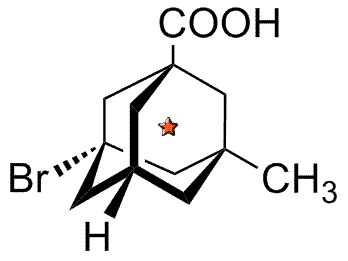
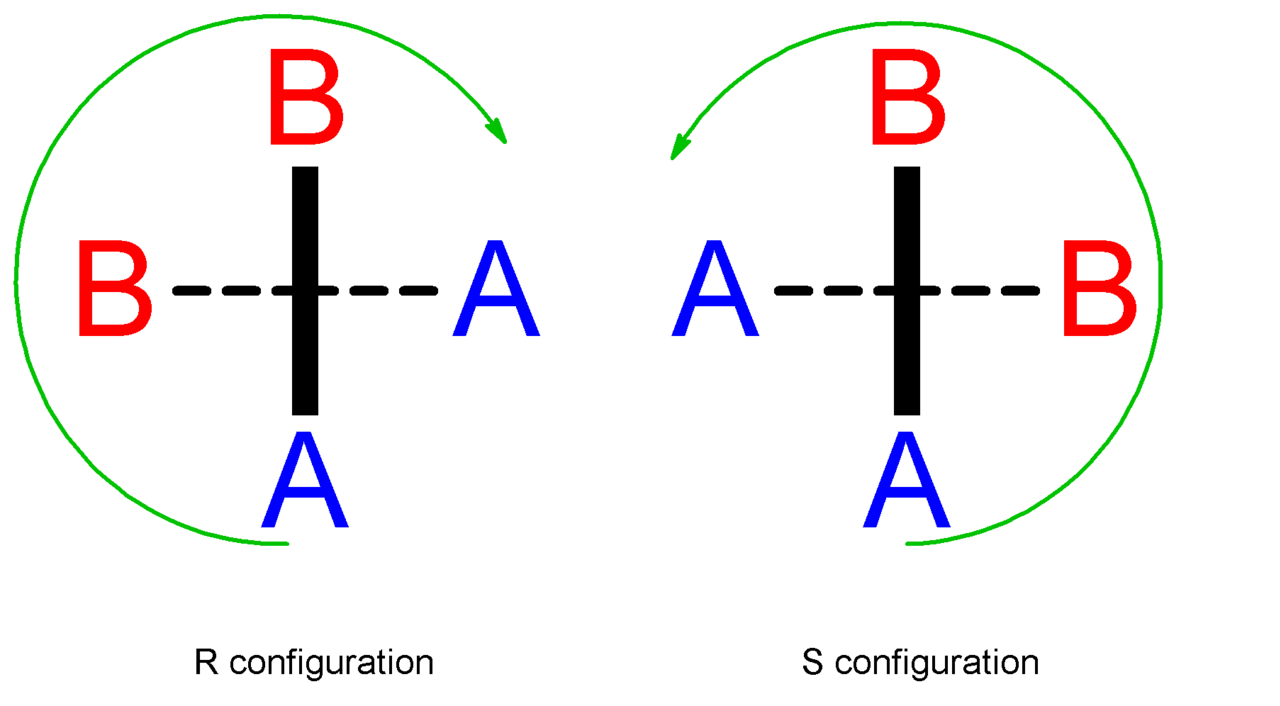
Chirality typically arises from a stereogenic element, most commonly a stereocenter—often a carbon atom bonded to four distinct groups in a tetrahedral arrangement. Other atoms such as nitrogen, phosphorus, sulfur, or silicon can also serve as stereocenters if they have four distinct substituents, including lone pairs. A stereocenter has two possible configurations (R and S), and in molecules with multiple stereocenters, the enantiomer is the stereoisomer where every stereocenter has the opposite configuration. An organic compound with a single stereogenic carbon is always chiral, but those with multiple stereocenters may be achiral if a conformation with a plane of symmetry or inversion point exists, forming a meso compound.
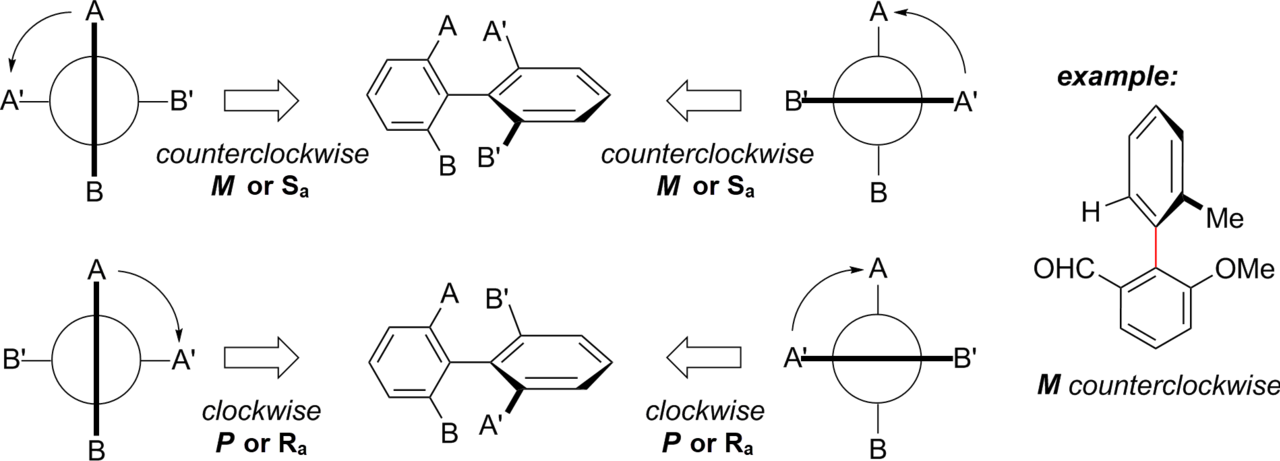
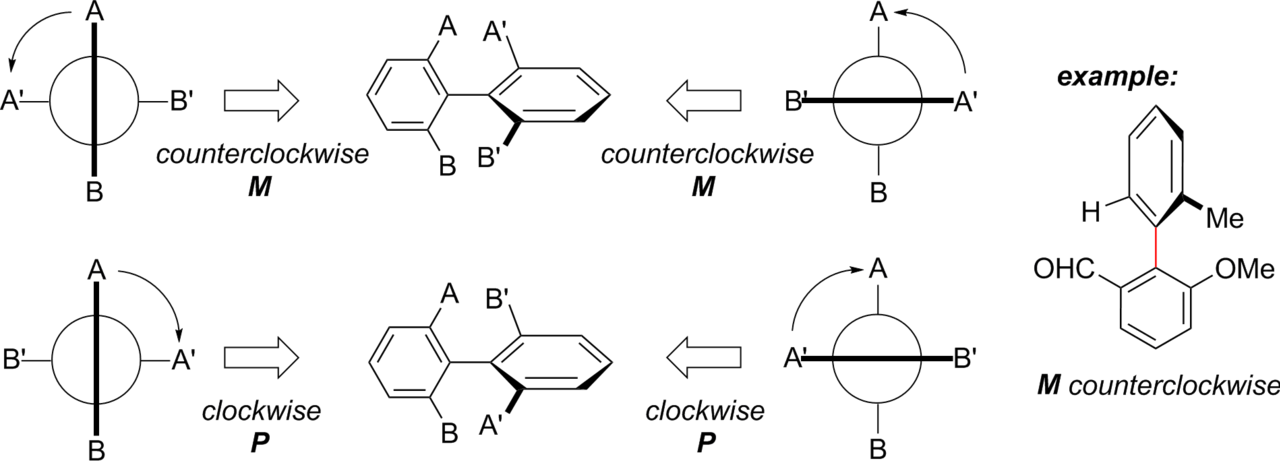
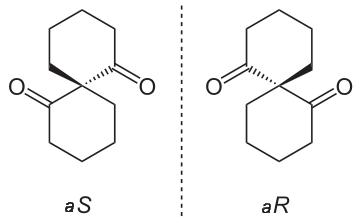
Beyond central chirality from stereocenters, molecules can exhibit axial chirality from a stereogenic axis, planar chirality from a stereogenic plane, or inherent chirality from molecular curvature. Examples include BINOL (axially chiral), trans-cyclooctene (planar chiral), and helicene (inherently chiral). Chirality is crucial in biochemistry, as most biological molecules—such as carbohydrates, amino acids (except one), and nucleic acids—are chiral. Living organisms typically use only one enantiomer, so they can metabolize only that form, and the effects of chiral pharmaceuticals can differ sharply between enantiomers.
- field
- Chemistry
- subfield
- Stereochemistry
- key_concept
- Chirality
- origin_term
- Ancient Greek χείρ (cheir) 'hand'
- common_example
- Hand (canonical object with chirality)
- related_terms
- Enantiomers, racemic mixture, stereocenter
Lore & Background
Chirality in chemistry is a geometric property where a molecule or ion cannot be superimposed on its mirror image through any combination of rotations, translations, or certain conformational changes. The term derives from the Ancient Greek word for "hand," as hands are the classic example of such objects. A chiral species exists as two mirror-image stereoisomers called enantiomers, often distinguished as right-handed or left-handed based on absolute configuration. These enantiomers share identical chemical properties except when interacting with other chiral compounds, and identical physical properties except for often opposite optical activities. A racemic mixture contains equal parts of both enantiomers and differs chemically and physically from the pure forms. Chirality most commonly arises from a stereogenic center, such as a carbon atom bonded to four distinct groups in a tetrahedral arrangement. Other atoms like nitrogen, phosphorus, sulfur, and silicon can also serve as stereocenters if they have four distinct substituents, including lone pairs. A molecule with a single stereogenic carbon is always chiral, but those with multiple stereocenters may be achiral if they possess a plane of symmetry or inversion point, forming a meso compound. Beyond central chirality, molecules can exhibit axial chirality from a stereogenic axis, planar chirality from a stereogenic plane, or inherent chirality from molecular curvature; examples include BINOL for axial chirality, trans-cyclooctene for planar chirality, and helicene for helical chirality. Chirality is crucial in biochemistry, as most biological molecules—such as carbohydrates, all but one amino acid, and nucleic acids—are chiral, and organisms typically metabolize only one enantiomer of a chiral compound, leading to differing potencies or effects for pharmaceutical enantiomers.
Reader's Guide
Chirality is crucial for understanding the behavior of biological molecules and pharmaceuticals. In living organisms, typically only one enantiomer of a chiral compound is found, and organisms can metabolize only that enantiomer. This has profound implications for drug design, as the potencies or effects of enantiomers can differ sharply. The concept extends beyond central chirality to axial, planar, and inherent chirality, though these are less common. The classification of a molecule as chiral depends on whether its chiral conformations are persistent isomers that can be isolated, or whether they rapidly interconvert at a given temperature and timescale, with a 1000-second threshold sometimes used for practical separation.
Did You Know?
- A chiral molecule or ion exists in two mirror-image stereoisomers called enantiomers, often distinguished as 'right-handed' or 'left-handed'.
- A homogeneous mixture of two enantiomers in equal parts is called a racemic mixture and differs chemically and physically from the pure enantiomers.
- Molecules with chirality from stereocenters are classified as having central chirality; other types include axial, planar, and inherent chirality.
- Chiral molecules are always dissymmetric (lacking an improper axis of rotation) but not always asymmetric.
Origins and the Bridge Between Disciplines
The label "physical organic chemistry" entered scientific vocabulary in 1940, when Louis Hammett adopted the phrase as the title of his textbook. That single act of naming crystallized a discipline that had been developing informally for years. At its core, the field asks a deceptively simple question: how does the three-dimensional architecture of an organic molecule dictate what it can do, how fast it does it, and how stable it remains along the way? Rather than cataloging new compounds, physical organic chemists dissect existing ones, probing the rates at which reactions proceed, the relative stabilities of starting materials, reactive intermediates, transition states, and final products. They also examine the subtler, non-covalent forces of solvation and molecular interaction that quietly steer reactivity in solution or in the solid state. The result is a theoretical and practical framework that connects structural changes to mechanistic outcomes, effectively serving as the bridge where organic chemistry meets the quantitative rigor of physical chemistry.
A Toolkit Spanning Theory and Experiment
Physical organic chemistry draws on an unusually broad arsenal of methods. On the theoretical side, practitioners employ classical and statistical thermodynamic calculations alongside quantum mechanical theory and modern computational chemistry to model molecular behavior. On the experimental side, the field relies heavily on spectroscopy such as nuclear magnetic resonance, spectrometry including mass spectrometry, and crystallographic techniques to observe structure at the atomic level. This dual commitment to calculation and measurement gives the discipline a reach that extends far beyond the bench. Its findings feed directly into electrochemistry, photochemistry, polymer and supramolecular chemistry, bioorganic chemistry, enzymology, and chemical biology. In the commercial world, the same principles underpin process chemistry, chemical engineering, materials science, nanotechnology, and the design-by-computation approach to pharmacology and drug discovery. In short, the field functions as a foundational layer beneath an enormous range of applied and specialized chemical sciences.
Thermochemistry and the Energetics of Reactivity
Understanding why a molecule is stable—or why it will react—often begins with thermodynamic bookkeeping. Physical organic chemists measure or calculate the enthalpy, entropy, and Gibbs free energy changes accompanying a reaction, transformation, or isomerization, frequently using tools like the Van 't Hoff plot to extract these values from experimental data. Empirical constants such as bond dissociation energies, standard heats of formation, and heats of combustion provide quick estimates of molecular stability and the enthalpy change along a reaction pathway. When a full heat-of-formation value is unavailable for a complex molecule, chemists turn to Benson group increment theory, a framework developed over a career by Sidney Benson, which assembles estimates from smaller molecular fragments with known energetics. The same thermochemical lens extends to reactive intermediates: radical stabilities can be assessed through group increment data, carbocation stability through hydride ion affinities, and carbanion stability through pKa measurements.
Conformation, Strain, and the Invisible Forces
Conformational analysis sits at the heart of predicting both stability and product distribution. By cataloging the various strains a molecule can experience—torsional, allylic, ring, and syn-pentane strain—chemists can anticipate which three-dimensional arrangement a molecule will favor. For substituted cyclohexanes, the A-value offers a quantitative yardstick: it is the Gibbs free energy difference between axial and equatorial placements, and summing A-values across multiple substituents lets one predict the preferred conformation with numerical precision. The same logic guides reaction prediction, as in the E2 elimination, where the nucleophile must attack antiperiplanar to the leaving group; molecular orbital analysis shows this geometry maximizes overlap between the R–H σ bonding orbital and the R–X σ* antibonding orbital. Beyond single molecules, bond rotation barriers in ethane, butane, and more substituted systems have been dissected to weigh the relative roles of steric, electrostatic, and hyperconjugative effects. Finally, non-covalent interactions—hydrogen bonding, dipole-dipole forces, cation-π and polar-π contacts, and π-stacking—add another layer of reactivity control that physical organic chemists continue to map.
Gallery
Frequently Asked Questions
What is Chirality (chemistry)?
Chirality is a geometric property in stereochemistry where a molecule or ion simply cannot be overlaid onto its mirror image, no matter how you rotate, shift, or flex it. It is the foundational concept that gives rise to stereoisomers and makes three-dimensional molecular structure a meaningful field of study.
Where does the name 'Chirality' come from?
The term traces back to the Ancient Greek word χείρ (cheir), meaning 'hand.' The hand was picked as the canonical illustration because your left and right palms are perfect non-superposable mirror images of one another.
What are Chirality's key allies and related concepts in the canon?
The most important related terms are enantiomers (the mirror-image pair), stereocenters (the specific atoms where chirality is anchored), and racemic mixtures (a 50/50 blend of both enantiomers). Together they form the core vocabulary every stereochemistry student must master.
Why is Chirality so important in biochemistry?
Most biological molecules—amino acids, sugars, nucleic acids—are chiral, meaning living systems are built around this property at every level. A drug that is therapeutic in one enantiomeric form can be inert or even toxic in its mirror-image twin, which is why chirality sits at the heart of pharmacology and medicine.
What's the go-to real-world example fans use to explain Chirality?
The human hand is the canonical illustration: your left hand and right hand are mirror images, yet you cannot stack them perfectly on top of each other. Chemists introduce this everyday object before moving to actual molecular structures to make the abstract idea click.
More in Organic Chemistry And Reaction Mechanisms 1-22
Spotted an error? Know more?
This is a living reference — every entry is fact-audited, and reader corrections feed straight into our audit queue. Suggest an edit · See this site's audit record