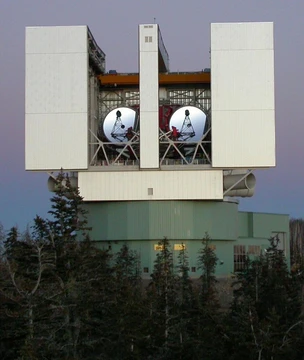
Canada–France–Hawaii Telescope
3.58-meter optical/infrared telescope on Mauna Kea since 1979.
Last updated
The Canada–France–Hawaii Telescope (CFHT) is a 3.58-meter optical/infrared telescope located near the summit of Mauna Kea on the Big Island of Hawaiʻi at an altitude of 4,204 meters, within the Maunakea Observatories. It has been in operation since 1979 and uses a Prime Focus/Cassegrain configuration. The telescope is notable for its role in the discovery of 128 new moons of Saturn in March 2025, bringing the gas giant's total confirmed satellites to 274.
Quick Facts
- Aperture
- 3.58 m (11.7 ft)
- Location
- Mauna Kea, Big Island of Hawaiʻi
- Altitude
- 4,204 m (13,793 ft)
- Configuration
- Prime Focus/Cassegrain
- Year of first light
- 1979
- Number of instruments
- 5
Facts from the source article.
Background
The Canada–France–Hawaii Telescope is operated by a corporation bound by a tripartite agreement between the University of Hawaii at Manoa, the National Research Council (NRC) in Canada, and the Centre National de la Recherche Scientifique (CNRS) in France. It also has partnerships with the National Astronomical Observatory of China (NAOC), the Academia Sinica Institute of Astronomy and Astrophysics (ASIAA) in Taiwan, the National Laboratory of Astrophysics (LNA) in Brazil, and the Korea Astronomy and Space Science Institute (KASI) in Korea. Observing time is offered to scientists from all seven partner countries, and astronomers from the European Union can submit proposals through the OPTICON access program.
CFHT had proposed redeveloping its summit facility into the Maunakea Spectroscopic Explorer, replacing the existing telescope with an 11.25-meter segmented telescope while reusing much of the existing infrastructure, including the foundation, telescope pier, and portions of the support building. As of 2026, however, the project remains on hold pending review of governance and leasing of observatories at this site. In the interim, the existing telescope will remain operating into the 2030s.
The telescope currently operates five instruments: MegaPrime/MegaCam (a one-square-degree field high-resolution CCD mosaic of 40 CCDs totalling 378 megapixels), WIRCam (a wide-field infrared camera optimized for J, H, and K bands), ESPaDOnS (an echelle spectropolarimeter), SITELLE (a wide-field Fourier transform spectrograph), and SPIRou (a near-infrared spectropolarimeter).
Frequently Asked Questions
What are the CFHT's key specifications?
The telescope features a 3.58-meter (11.7-foot) primary mirror and currently carries five instruments for optical and infrared observations. It sits at 4,204 meters (13,793 feet) near the summit of Mauna Kea, and it uses a Prime Focus/Cassegrain optical configuration.
What was the CFHT's role in the March 2025 Saturn moon discovery?
In March 2025, the CFHT played a key role in identifying 128 previously unknown moons orbiting Saturn. That single finding brought the gas giant's confirmed satellite total to 274.
More in Optical Telescopes
Sources
Compiled from Wikipedia and the sources listed below. Text from Wikipedia is available under CC BY-SA 4.0; this entry is adapted from it.
- Wikipedia: Canada–France–Hawaii Telescope (CC BY-SA 4.0).
Spotted an error? Know more?
Reader corrections go straight into our review queue. Suggest an edit · How this site is sourced