Wide Field Survey Telescope
Chinese time-domain survey telescope with a 2.5-metre mirror.
Last updated
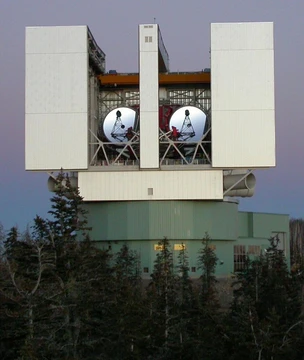
The Wide Field Survey Telescope (WFST) is a Chinese observatory with a 2.5-meter primary mirror, built to monitor astronomical objects that change over time, like supernovae. It achieved first light on September 17, 2023, by capturing an image of the Andromeda Galaxy. The telescope covers six wavelength bands from 320 to 1028 nanometers, has a 3-degree field of view, and can detect objects down to 23rd magnitude. Nicknamed Mozi after an ancient Chinese philosopher and optics pioneer, it sits at an altitude of 4,200 meters on the Tibetan Plateau near Lenghu Town in Qinghai Province.
Construction began in 2017, led by the University of Science and Technology of China in Hefei and the Purple Mountain Observatory of the Chinese Academy of Sciences in Nanjing. Following a three-month pilot survey, the WFST is expected to start a six-year mission in 2024. Its location helps fill a gap in the global network of high-altitude observatories, which are mostly concentrated in the Western Hemisphere—such as Maunakea in Hawaii, Cerro Paranal in Chile, and La Palma in the Canary Islands—enabling more consistent tracking of fast-changing celestial events.
Quick Facts
- Primary mirror diameter
- 2.5 metres
- First light date
- 17 September 2023
- First light target
- Andromeda Galaxy
- Wavelength bands
- six bands spanning 320 to 1028 nm
- Field of view
- 3°
- Limiting magnitude
- 23rd magnitude
- Location
- Tibetan Plateau, near Lenghu Town, Qinghai Province, at 4200 metres altitude
- Nickname
- Mozi
Facts from the source article.
Frequently Asked Questions
What is the Wide Field Survey Telescope?
The WFST is a Chinese time-domain observatory built to track transient and variable celestial events such as supernovae. It features a 2.5-metre primary mirror and is colloquially called "Mozi," a nod to the ancient Chinese thinker known for early work on optics.
Where is the Wide Field Survey Telescope situated?
The facility is perched at roughly 4,200 metres elevation on the Tibetan Plateau, near Lenghu Town in Qinghai Province, China. The high, dry site minimises atmospheric interference for optical observations.
More in Optical Telescopes
Sources
Compiled from Wikipedia and the sources listed below. Text from Wikipedia is available under CC BY-SA 4.0; this entry is adapted from it.
- Wikipedia: Wide Field Survey Telescope (CC BY-SA 4.0).
Spotted an error? Know more?
Reader corrections go straight into our review queue. Suggest an edit · How this site is sourced