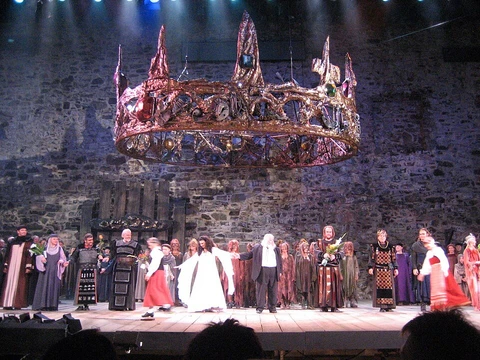
Birgit Nilsson
Swedish dramatic soprano renowned for Wagner and Strauss roles.

Märta Birgit Nilsson, a Swedish dramatic soprano, lived from 17 May 1918 to 25 December 2005. While her repertoire was broad, covering many operatic and vocal works, she became most famous for singing the operas of Richard Wagner and Richard Strauss. Critics and audiences alike praised her voice for its tremendous force, seemingly endless power reserves, and a bright, clear upper register that gleamed.
Born on a farm in Västra Karup, Skåne, to Nils and Justina Svensson, she was picking out tunes on a toy piano by age three. She once claimed she could sing before she could walk, even singing in her dreams. Her vocal talent first drew notice in her church choir, and a local choirmaster advised her to take lessons. After six months of study with Ragnar Blennow in Åstorp, she auditioned at the Royal Swedish Academy of Music in Stockholm, placing first among 47 singers and winning the Christina Nilsson scholarship. Her teachers there were Joseph Hislop and Arne Sunnegårdh, though she later considered herself self-taught, insisting the stage was the best teacher. She criticized her early instruction, saying her first teacher nearly ruined her and the second was almost as bad, crediting her success to native talent.
Her professional debut came in 1946 at the Royal Swedish Opera in Stockholm, stepping in on three days’ notice for an ailing singer as Agathe in Weber’s *Der Freischütz*. Conductor Leo Blech treated her harshly; she later wrote that she considered suicide after the performance. The following year, she gained national attention singing Verdi’s Lady Macbeth under Fritz Busch. She then built a steady repertoire in Stockholm of lyric-dramatic roles—Donna Anna, Aida, Lisa, Tosca, Venus, Sieglinde, Senta, and the Marschallin (a favorite)—all performed in Swedish. In 1949, she appeared in *Ariadne auf Naxos* alongside Hjördis Schymberg and Elisabeth Söderström.
Under Busch’s guidance, her career expanded. He helped secure her first major international engagement: Electra in Mozart’s *Idomeneo* at the 1951 Glyndebourne Festival. A 1953 debut at the Vienna State Opera proved a turning point; she performed there regularly for over 25 years. In 1954, she sang Elsa in Wagner’s *Lohengrin* at the Bayreuth Festival, followed by her first Brünnhilde in a complete *Ring* at the Munich Opera Festival. She returned to Bayreuth as Sieglinde, Brünnhilde, and Isolde until 1969. She took the title role of *Turandot*—a short part demanding an unusually large sound—to La Scala in 1958, then to the rest of Italy. Her American debut came in 1956 as Brünnhilde in *Die Walküre* with the San Francisco Opera. International stardom arrived after a 1959 Metropolitan Opera performance as Isolde, which made front-page news. She considered the invitation to open La Scala’s 180th season as Turandot in 1958 the single biggest event of her life. She performed at major houses worldwide, including Vienna, Berlin, Covent Garden, Tokyo, Paris, Buenos Aires, Chicago, and Hamburg. In 1973, she sang with the Sydney Symphony Orchestra in an all-Wagner concert that opened the Sydney Opera House’s Concert Hall.
From the 1960s through the 1980s, Nilsson was widely regarded as the leading Wagnerian soprano of her era, succeeding Kirsten Flagstad, especially as Brünnhilde. Yet she also sang Leonore, Aida, Turandot, Tosca, Elektra, and Salome. *The New York Times* described her voice as possessing “impeccable trueness and impregnable stamina.” Conductor Erich Leinsdorf linked her long career, like Flagstad’s, to her Scandinavian heritage, arguing Wagner required “thoughtful, patient and methodical people.” Nilsson herself credited no special lifestyle: she didn’t smoke, drank a little wine and beer, and said she was simply born with the right parents. Her high notes, in sheer power, were sometimes compared to Broadway belter Ethel Merman. But Nilsson felt her “explosive” high notes—her biggest stage asset—were never captured properly in recordings. She lamented that many people told her she sang better live than on records, which saddened her, knowing recordings would be all that remained after she stopped singing.
Twice at the Met, injuries sidelined her. In February 1971, she sprained an ankle during *Elektra*, forcing one cancellation (replaced by *Fidelio* with Christa Ludwig), though she recovered to sing the broadcast performance later that month. More seriously, in March 1974, she dislocated a shoulder during a *Götterdämmerung* rehearsal. While recuperating at Roosevelt Hospital, she remarked that aside from her bruises and injuries, she was fine.
- born
- 17 May 1918
- died
- 25 December 2005
- nationality
- Swedish
- known_for
- Wagnerian and Strauss soprano roles
Verified Timeline
Lore & Background
Birgit Nilsson was born on a farm at Västra Karup in Skåne. At age three she began picking out melodies on a toy piano her mother bought for her. She once told an interviewer she could sing before she could walk, adding, 'I even sang in my dreams.' Her vocal talent was first noticed when she began to sing in her church choir. She studied with Ragnar Blennow in Åstorp for six months to prepare for an audition at the Royal Swedish Academy of Music in Stockholm, where she came in first out of 47 singers and was awarded the Christina Nilsson scholarship. Her teachers at the academy were Joseph Hislop and Arne Sunnegårdh, but she considered herself self-taught: 'The best teacher is the stage,' she told an interviewer in 1981. 'You walk out onto it, and you have to learn to project.' She deplored her early instruction, saying 'My first voice teacher [Hislop] almost killed me ... [T]he second was almost as bad.'
In 1946, Nilsson made her debut at the Royal Swedish Opera in Stockholm with only three days' notice, replacing the ailing singer scheduled for the role of Agathe in Carl Maria von Weber's Der Freischütz. Conductor Leo Blech was not very kind to her, and she even contemplated suicide after the performance. In 1947 she claimed national attention in Verdi's Lady Macbeth conducted by Fritz Busch. Under Busch's tutelage, her career took wing. He secured her first important engagement outside Sweden, as Electra in Mozart's Idomeneo at the Glyndebourne Festival in 1951. Her debut at the Vienna State Opera in 1953 was a turning point; she would be a regular performer there for more than 25 years. It was followed by Elsa in Wagner's Lohengrin at the Bayreuth Festival in 1954, then her first Brünnhilde in a complete Ring at the Bavarian State Opera, at the Munich Opera Festival of 1954. She took the title role of Turandot to La Scala in Milan in 1958. Nilsson made her American debut as Brünnhilde in Wagner's Die Walküre in 1956 with the San Francisco Opera. She attained international stardom after a performance as Isolde at the Metropolitan Opera in New York City in 1959, which made front-page news. She said the single biggest event in her life was being asked to perform at the opening of the 180th season at La Scala as Turandot in 1958. From the 1960s through to the 1980s, Nilsson was widely known as the leading Wagnerian soprano of her time, the successor to Kirsten Flagstad, particularly as Brünnhilde. She also sang roles including Leonore, Aida, Turandot, Tosca, Elektra, and Salome. The conductor Erich Leinsdorf thought her longevity had something to do with her Scandinavian heritage. Nilsson attributed her long career to no particular lifestyle or regimen: 'I do nothing special,' she once said. 'I don't smoke. I drink a little wine and beer. I was born with the right set of parents.' Twice at the Met, Nilsson sustained injuries that kept her from performing. In February 1971, she sprained her ankle during a performance of Elektra. More seriously, in March 1974 she fell and dislocated her shoulder during a rehearsal of Götterdämmerung. Beginning in the summer of 1968 at the Bayreuth Festival, Nilsson was obsessively stalked by a much younger American actress and model, Nell Theobald, until Theobald's suicide nine years later in 1977. Nilsson recounted her experiences with Theobald at length in her memoir, La Nilsson, in which she referred to Theobald solely as 'Miss N.'
Reader's Guide
Birgit Nilsson's significance lies in her dominance as a dramatic soprano in the mid-to-late 20th century, particularly in the demanding operas of Wagner and Strauss. Her voice, described by The New York Times as having 'impeccable trueness and impregnable stamina,' set a standard for Wagnerian singing. In sheer power, her high notes were sometimes compared to those of Broadway belter Ethel Merman. However, Nilsson claimed her 'explosive' high notes 'have not been recorded like they should have been' in the studio. She later lamented: 'It always made me a little bit sad when I heard my own recordings. And many people told me that I sang much better in person than I do on the recordings! That didn't flatter me at all, because I know what's going to be left when I am no longer singing.'
Nilsson was also known for her sharp wit. She did not get along with conductor Herbert von Karajan. Once when rehearsing at the Vienna Staatsoper, her string of pearls broke. While helping her retrieve them, Karajan asked, 'Are these real pearls bought with your La Scala fees?' Nilsson replied, 'No, these are fake pearls bought with your Vienna Staatsoper fees.' When Karajan sent her a long cable proposing projects, Nilsson cabled back: 'Busy. Birgit.' There was a healthy competition between Nilsson and tenor Franco Corelli as to who could hold the high C the longest in act 2 of Turandot. After one tour performance where she outlasted him, Corelli stormed off to Rudolf Bing. Bing suggested Corelli retaliate by biting Nilsson on the neck when Calaf kisses Turandot in act 3. Corelli didn't bite her but told her about Bing's suggestion. She then cabled Bing, informing him she had to cancel the next two performances because she had contracted rabies. The secret to singing Isolde, she said, was 'comfortable shoes.' Once, asked what was her favourite role, she answered: 'Isolde made me famous. Turandot made me rich.' When long-time Metropolitan Opera director Sir Rudolf Bing was asked if she was difficult, he reportedly said 'Not at all. You put enough money in, and a glorious voice comes out.' When Nilsson was preparing her taxes and was asked if she had any dependents, she replied, 'Yes, just one, Rudolf Bing.'
Did You Know?
- Nilsson could sing before she could walk, and told an interviewer 'I even sang in my dreams.'
- She placed first out of 47 singers in her audition at the Royal Swedish Academy of Music and was awarded the Christina Nilsson scholarship.
- Her 1959 Metropolitan Opera performance as Isolde made front-page news and established her international stardom.
- She was stalked for nine years by an American woman, Nell Theobald, whom she referred to as 'Miss N.' in her memoir.
- When asked about her favourite roles, Nilsson said: 'Isolde made me famous. Turandot made me rich.'
More in Opera Singers 1-24
Related in Opera Singers
Links follow this subject's own source article.
Spotted an error? Know more?
This is a living reference — every entry is fact-audited, and reader corrections feed straight into our audit queue. Suggest an edit · See this site's audit record