Stadium Australia
Sydney's Olympic stadium, now a major sports and events venue.
Last updated

via Wikipedia: Stadium Australia · see source
Where it is
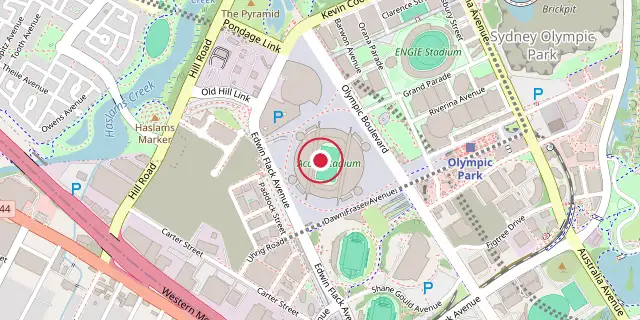
Coordinates: 33°50′49″S 151°03′47″E (-33.8470, 151.0630) · Open in OpenStreetMap
Connected teams and clubs
Coordinates and connected clubs: the infobox of Wikipedia: Stadium Australia (CC BY-SA 4.0). Map: drawn by Codexery from OpenStreetMap tiles.
Stadium Australia (known under naming rights as Accor Stadium) is a multi-purpose stadium located in the Sydney Olympic Park in Sydney. It opened in 1999, in time for its use as a primary venue in the 2000 Summer Olympics.
At the time of opening the stadium featured a capacity of 115,000 spectators, making it the largest Olympic Stadium ever built and the largest stadium in Australia at the time. The stadium now has a capacity of 80,000 spectators and is primarily used for rugby league as the home ground of the South Sydney Rabbitohs and Canterbury-Bankstown Bulldogs, as well as the venue for the NRL Grand Final. It also frequently hosts the Australia national rugby union team, Australia men's national soccer team, and Australia women's national soccer team.
History
The first sporting event at the stadium was a rugby league double-header on 6 March 1999, drawing a then-record crowd of 104,583. The first concert was the Bee Gees on 27 March 1999, with 66,285 attending. The stadium was officially opened on 12 June 1999 when the Australian national soccer team beat a FIFA All Stars side 3–2 before 88,101 spectators. A 1999 Bledisloe Cup rugby union match between Australia and New Zealand set a world record rugby union crowd of 107,042; this was surpassed in 2000 when 109,874 saw the All Blacks win 39–35.
The stadium hosted its first State of Origin game on 9 June 1999, with 88,336 watching New South Wales defeat Queensland 12–8. An American Bowl exhibition game between the Denver Broncos and San Diego Chargers took place on 7 August 1999, drawing 73,811. In November 2005, a World Cup qualifying playoff win over Uruguay attracted 82,698.
Development
In October 2001, major reconfiguration began to allow cricket and Australian rules football, removing the wing stands and athletics track and adding movable seating. New roofs were built over the two ends, and seats with poor views were removed. The work, costing $80 million and carried out by Multiplex, reduced capacity to 84,000 for rectangular fields and 82,500 for oval fields.
It was completed in October 2003 in time for the 2003 Rugby World Cup. In 2022, a 120-metre-wide scoreboard was installed at the southern end, and LED sports lights replaced the previous lighting. In 2023, upgrades to match day change rooms and media facilities were completed at a cost of $81.4 million ahead of the 2023 FIFA Women's World Cup.
Proposed renovations
In September 2015, the New South Wales Government announced plans to upgrade the stadium and install a retractable roof. On 23 November 2017, the government revealed the stadium would be demolished and rebuilt as a 75,000-seat rectangular venue, with demolition starting in 2019 and completion by 2021. On 29 March 2018, Premier Gladys Berejiklian reversed this plan, opting instead for a refurbishment and permanent rectangular reconfiguration at a cost of $800 million, compared to the $1.3 billion rebuild. On 31 May 2020, the renovation plans were cancelled due to budget shifts from the COVID-19 pandemic, leaving the stadium capable of hosting oval-shaped sports and retaining a capacity of 83,500.
Uses
The National Rugby League is the most regular tenant. Canterbury-Bankstown Bulldogs and South Sydney Rabbitohs play most home games there. Parramatta Eels used the stadium as a temporary home from 2017 to April 2019 while their regular ground was rebuilt. Wests Tigers used it for Easter Monday home games in 2021 and 2023.
St George Illawarra Dragons used it as their Sydney home in 2008 and for two games a year between 2014 and 2017. The stadium hosted seven matches in the 2003 Rugby World Cup, including the opener, both semifinals, and the final. On 6 July 2013, the last test of the 2013 British & Irish Lions tour was played there, with the Lions winning 41–16 to win the series.
Did You Know?
- During the 2000 Olympics, the evening athletics sessions on day 11 attracted 112,524 spectators, which remains the world record attendance for any athletics event as of 2014.
- The highest attendance for any event in modern Olympic Games history was recorded with 114,714 at the stadium for the closing ceremony of the 2000 Summer Olympics.
- The penalty spot where John Aloisi's spot kick secured Australia's 2006 FIFA World Cup qualification has been permanently preserved and is on public display at the stadium.
Frequently Asked Questions
Who designed Stadium Australia?
Stadium Australia was designed by HOK Sport.
Who owns Stadium Australia?
Stadium Australia is owned by Venues NSW via Government of New South Wales.
Who operates Stadium Australia?
Stadium Australia is operated by VenuesLive Management Services.
More in Olympic Athletics Venues
Sources
Compiled from Wikipedia and the sources listed below. Text from Wikipedia is available under CC BY-SA 4.0; this entry is adapted from it.
- Wikipedia: Stadium Australia (CC BY-SA 4.0).
- Currency conversion: European Central Bank euro reference rates, rates of 23 October 2026.
Spotted an error? Know more?
Reader corrections go straight into our review queue. Suggest an edit · How this site is sourced