Venice, Los Angeles
Seaside resort neighborhood with canals and a famous boardwalk.
Last updated

via Wikipedia: Venice, Los Angeles · see source
Where it is
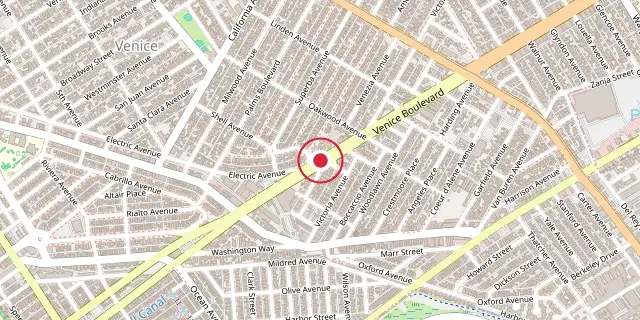
Coordinates: 33°59′28″N 118°27′32″W (33.9910, -118.4590) · Open in OpenStreetMap
Coordinates and connected clubs: the infobox of Wikipedia: Venice, Los Angeles (CC BY-SA 4.0). Map: drawn by Codexery from OpenStreetMap tiles.
Venice is a neighborhood of the City of Los Angeles within the Westside region of Los Angeles County, California. It was founded by Abbot Kinney in 1905 as a seaside resort town and was an independent city until 1926, when it was annexed by the city of Los Angeles. Venice is known for its canals, a beach, and Ocean Front Walk, a 2+1/2 mi pedestrian promenade that features performers, fortune-tellers, and vendors.
History
In 1839, the Mexican government granted a region called La Ballona, which included southern parts of Venice, to Ygnacio and Augustin Machado and Felipe and Tomas Talamantes as Rancho La Ballona; this later became part of Port Ballona. Venice, originally called Venice of America, was founded by wealthy developer Abbot Kinney in 1905 as a beach resort town 14 miles west of Los Angeles. Kinney and his partner Francis Ryan had bought two miles of ocean-front property south of Santa Monica in 1891, building a resort called Ocean Park on the north end, which was soon annexed to Santa Monica.
After Ryan died, Kinney and new partners continued building south of Navy Street. When the partnership dissolved in 1904, Kinney won the marshy land on the south end in a coin flip with his former partners and began building a seaside resort modeled after the Italian city. When Venice of America opened on July 4, 1905, Kinney had dug several miles of canals, built a 1200-foot pier with an auditorium, ship restaurant, and dance hall, constructed a hot salt-water plunge, and built a block-long arcaded business street with Venetian architecture designed by artist Felix Peano.
The population grew from 3,119 in 1910 to over 10,000, and the town drew 50,000 to 150,000 tourists on weekends. By 1910 the pier became more amusement-oriented with rides and games. After Kinney died in November 1920, the town became harder to govern; the amusement pier burned in December 1920, and Prohibition severely affected tax revenue.
Geography
Venice is bounded on the northwest by the Santa Monica city line, with its northern apex at Walgrove Avenue and Rose Avenue abutting the Santa Monica Airport. On the east, the boundary runs north-south on Walgrove Avenue to Zanja Street, including Penmar Golf Course but excluding Venice High School, then runs on Lincoln Boulevard to Admiralty Way, excluding Marina del Rey, south to Ballona Creek. Abbott Kinney Boulevard is a principal attraction with stores, restaurants, bars, and art galleries; it was originally a derelict strip called West Washington Boulevard, and in the late 1980s community groups pushed for renaming a portion to honor Abbot Kinney as a marketing strategy. 72 Market Street Oyster Bar and Grill was located on Market Street, one of the first streets designated for commerce in 1905; during the Depression, Upton Sinclair had an office there while running for governor, and the same building housed the first Ace/Venice Gallery in the early 1970s.
The Venice Post Office, a 1939 New Deal building designed by Louis A. Simon on Windward Circle, features a 1941 mural by Edward Biberman depicting Abbot Kinney surrounded by beachgoers and oil derricks.
Arts and culture
Venice has been a preferred location for creative artists. In the 1950s and 1960s it became a center for the Beat generation, with an explosion of poetry and art that continues. Major writers and artists have included Stuart Perkoff, John Thomas, Frank T. Rios, Tony Scibella, Lawrence Lipton, John Haag, Saul White, Millicent Borges Accardi, Robert Farrington, Philomene Long, and Tom Sewell. Originally a planned city imitating Venice, Italy, it has many early 1900s buildings in Italian Renaissance style, particularly along Windward Avenue with an arched arcade covering sidewalks.
Similar buildings originally formed a continuous arcade from the boardwalk to the former lagoon, but were condemned after annexation; only through preservationists were a few buildings saved, though many were modified. The public sculpture Giant Binoculars by Claes Oldenburg and Coosje van Bruggen fronts the Binoculars Building at 340 Main Street, designed by Frank Gehry and listed as a Los Angeles Historic Resource. Designers Charles and Ray Eames had offices at the Bay Cities Garage on Abbot Kinney Boulevard from 1943; the brick building was redesigned by Frank Israel in 1990.
The Architecture Gallery, founded by Pritzker Prize-winning architect Thom Mayne, existed for ten weeks in 1979. Frank Gehry designed several Venice houses, including the Jane Spiller House and the Norton House. In 1994, sculptor Robert Graham built a fortress-like studio and residence for himself and actress Anjelica Huston on Windward Avenue.
In popular culture
Venice has been the location of numerous movies, TV shows, and video games, with common filming sites including the piers, skate park, restaurant, canals, boardwalk, and schools. Notable productions include the 1914 Charlie Chaplin film Kid Auto Races at Venice, which featured the first appearance of the Little Tramp character. Orson Welles shot Touch of Evil entirely in Venice in 1958, using it as a stand-in for a fictional Mexican border town. The 1961 film Night Tide was shot entirely in Venice and shows the area's deteriorated nature in the 1950s.
Other films include The Doors (1991), White Men Can't Jump (1992), Falling Down (1993), Speed (1994), The Big Lebowski (1998), and American History X (1998). Television series such as Californication (2007), Wilfred (2011), and Sam & Cat (2013–2014) have been set or filmed there. Video games Grand Theft Auto: San Andreas (2004) featured Venice as Verona Beach, and Grand Theft Auto V (2013) included it as Vespucci Beach. The reality competition American Ninja Warrior aired from 2009 to 2015 with Venice locations.
Did You Know?
- The Venice treasurer James T. Peasgood was convicted of embezzling thousands of dollars from the city government in 1922.
- In 1929, oil was discovered on the Venice Peninsula; within two years, 450 oil wells covered the area.
- By the 1950s, neglect had led to Venice being labeled the 'Slum by the Sea'.
More in Olympic Athletics Venues
Sources
Compiled from Wikipedia and the sources listed below. Text from Wikipedia is available under CC BY-SA 4.0; this entry is adapted from it.
- Wikipedia: Venice, Los Angeles (CC BY-SA 4.0).
Spotted an error? Know more?
Reader corrections go straight into our review queue. Suggest an edit · How this site is sourced