Olympiastadion (Munich)
Munich's Olympic stadium with a revolutionary tent roof.
Last updated
Where it is
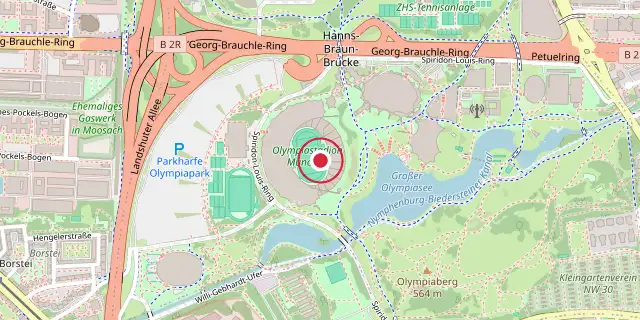
Coordinates: 48°10′23″N 11°32′49″E (48.1730, 11.5470) · Open in OpenStreetMap
Connected teams and clubs
Coordinates and connected clubs: the infobox of Wikipedia: Olympiastadion (Munich) (CC BY-SA 4.0). Map: drawn by Codexery from OpenStreetMap tiles.
The Olympiastadion is a stadium in Munich, Germany, built as the main venue for the 1972 Summer Olympics. It is located at the heart of the Olympiapark München in northern Munich. The stadium is notable for its lightweight tent roof and for hosting major football finals, including the 1974 FIFA World Cup Final.
History
After World War I, plans for a large stadium on Oberwiesenfeld failed in 1919 due to a Bavarian state objection. In 1921, the Teutoniaplatz opened with a capacity of 12,000; shortly after, about 20,000 guests attended a game, nearly double the allowed capacity. FC Bayern used it from 1923 to 1925. TSV 1860 played at Grünwalder Straße from 1911, and that stadium became Munich's largest after expansion to 40,000 in 1926.
A 1926 Germany–Switzerland match showed demand exceeding capacity. A 1928 fight course on Dantestraße did not meet expectations. During the Weimar Republic, a large stadium on Oberwiesenfeld was discussed but not built. In early Nazi Germany, NSDAP politicians planned a 60,000–80,000 capacity stadium west of Munich-Riem Airport, but airport administration resisted and the Generalbaurat did not pursue it; the outbreak of World War II ended the plans.
After the war, crowds returned: in 1948, 58,200 attended a TSV 1860 vs. 1. FC Nürnberg match at Grünwalder Straße, intended for 45,000. The postwar period is considered the "golden age" of German football.
Design
The stadium was designed by architect Günther Behnisch and engineer Frei Otto, with assistance from John Argyris. Its lightweight tent construction featured large sweeping canopies of acrylic glass stabilized by steel cables, used on a large scale for the first time. The official motto was "The cheerful Games" ("Die Heiteren Spiele").
Other uses
The stadium was the setting for a Monty Python's Flying Circus skit in 1972, "The Philosophers' Football Match", though it was filmed at Grünwalder Stadion. Parts of the 1975 film Rollerball were shot at the site. It hosted the 1989 Motorcycle speedway World Final on 2 September 1989, won by Denmark's Hans Nielsen with a 15-point maximum.
Guns N' Roses filmed parts of their Estranged video there in June 1993. In 2021, the stadium appeared in the fourth episode of the ninth season of the Belgian series De Mol. It is also used for American football.
Frequently Asked Questions
When did Olympiastadion (Munich) open?
Olympiastadion opened on 26 May 1972.
What is the capacity of Olympiastadion (Munich)?
Olympiastadion has a capacity of 63,118.
Who designed Olympiastadion (Munich)?
Olympiastadion was designed by Frei Otto, Günter Behnisch, Leonhardt and Andrä und Partner.
Who owns Olympiastadion (Munich)?
Olympiastadion is owned by City of Munich.
More in Olympic Athletics Venues
Sources
Compiled from Wikipedia and the sources listed below. Text from Wikipedia is available under CC BY-SA 4.0; this entry is adapted from it.
- Wikipedia: Olympiastadion (Munich) (CC BY-SA 4.0).
Spotted an error? Know more?
Reader corrections go straight into our review queue. Suggest an edit · How this site is sourced