Montreal Botanical Garden
A 75-hectare botanical garden and National Historic Site of Canada.
Last updated

via Wikipedia: Montreal Botanical Garden · see source
Where it is
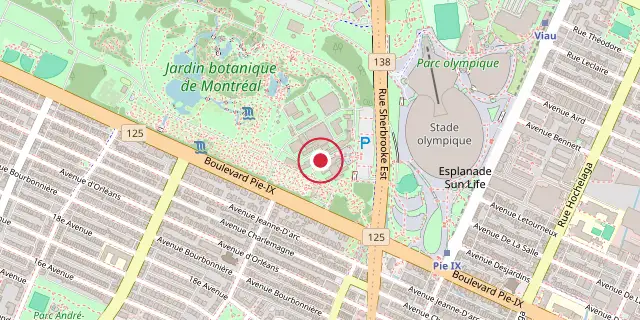
Coordinates: 45°33′25″N 73°33′25″W (45.5570, -73.5570) · Open in OpenStreetMap
Coordinates and connected clubs: the infobox of Wikipedia: Montreal Botanical Garden (CC BY-SA 4.0). Map: drawn by Codexery from OpenStreetMap tiles.
Spanning 75 hectares of themed gardens and greenhouses, the Montreal Botanical Garden in Quebec, Canada earned National Historic Site status in 2008. Its vast collections and facilities place it among the world's most significant botanical gardens. Located at 4101 Sherbrooke Street East, it faces Montreal's Olympic Stadium and is part of the Space for Life museum district, alongside the Biodome, the Insectarium, and the Rio Tinto Alcan Planetarium.
Background
Tucked into Maisonneuve Park in the Rosemont–La Petite-Patrie borough, the Montreal Botanical Garden sits at 4101 Sherbrooke Street East, across from the Olympic Stadium. It features a greenhouse complex filled with plants from around the globe and several large outdoor gardens, each with its own theme. From roughly November to April, the outdoor gardens lie bare under snow, but the greenhouses stay open all year, hosting the annual Butterflies Go Free exhibit from February to April.
Founded in 1931 during the Great Depression by Mayor Camillien Houde, the garden was the result of years of advocacy by Fr. Marie-Victorin, who wrote the Flore laurentienne. Henry Teuscher laid out the grounds, while architect Lucien F. Kéroack designed the Art Deco administration building. The garden aims to educate the public and horticulture students, and to protect endangered plant species. On-site, it also houses a botanical research institution, the Société d'astronomie de Montréal, and the Montreal Insectarium; offsite, staff run the Ferme Angrignon educational farm and petting zoo.
While admission is charged, city residents can get a pass for free entry to the outdoor gardens, making it a regular spot for many to simply sit under the trees. The nearest metro station is Pie-IX, at the corner of the Olympic Stadium. The garden is one of four nature-focused attractions in Montreal’s Space for Life museum district, alongside the Biodome, the Insectarium, and the Rio Tinto Alcan Planetarium, all near the Olympic Stadium.
Gardens
The Montreal Botanical Garden features several distinct themed spaces. The Chinese Garden, built over two years starting in 1990, follows the design of a Ming dynasty garden. It spans 2.5 hectares and includes winding paths, an artificial mountain, and a Chinese-style building that holds a donated collection of bonsai and penjing. Chinese plants fill the garden, which was constructed by 50 artisans from the Shanghai Institute of Landscape Design and Architecture under the direction of Le Weizhong.
The project used 120 containers of materials shipped from Shanghai, including 500 tonnes of stone from Lake Tai in Jiangsu province. The Japanese Garden, created in 1988 and designed by Ken Nakajima, also covers 2.5 hectares. It is planted with Japanese species and contains a Japanese-style building with a tea exhibit. During summer, the Japanese tea ceremony is performed there, and classes are offered.
Other traditional Japanese arts like Iaido and Ikebana are sometimes demonstrated. The garden has a large koi pond where visitors often feed the fish, and it holds an annual Hiroshima memorial ceremony on August 5th, featuring the hourly ringing of a Japanese Peace Bell made in Hiroshima. The First Nations Garden opened in 2001 to honor the cultures of Canada’s indigenous peoples. It features plants native to Quebec and other North American regions, with maple, birch, and pine trees shading the paths, and highlights medicinal and food plants used by First Nations.
Several totem poles and exhibits of traditional artwork and construction methods are on display. The Alpine Garden has paths winding over a rocky outcrop covered with small, delicate alpine plants. Other sections include a poisonous plants garden with samples and dosage information, an economic plants exhibit, a flowery brook, an arboretum, a maple and hickory forest at Quebec Corner showcasing local species, the yearly replanted Garden of Innovations, a Monastery Garden, and a Medicinal Plants Garden. Wildlife such as squirrels, ducks, turtles, and herons also live in the gardens.
Lion de la Feuillée
The Lion de la Feuillée is a monument and sculpture located inside the Montreal Botanical Garden, at the entrance to the rose garden. It was donated by the city of Lyon on the occasion of Montreal's 350th anniversary in 1992. The lion is one of four castings of an original work by René Dardel, originally placed on the first bridge over the Feuillée in Lyon, France, which opened on 28 September 1831. During the bridge's reconstruction in 1910, the four lions were relocated, and one was brought to Montreal in 1992.
More in Olympic Athletics Venues
Sources
Compiled from Wikipedia and the sources listed below. Text from Wikipedia is available under CC BY-SA 4.0; this entry is adapted from it.
- Wikipedia: Montreal Botanical Garden (CC BY-SA 4.0).
Spotted an error? Know more?
Reader corrections go straight into our review queue. Suggest an edit · How this site is sourced