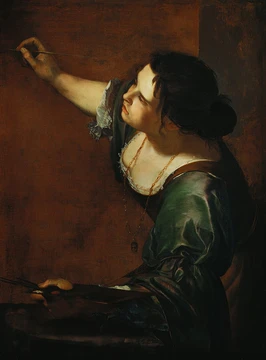
Lavinia Fontana
First female career artist in Western Europe.

Lavinia Fontana (24 August 1552 – 11 August 1614) was an Italian Mannerist painter who worked in Bologna and Rome. She is known for her portraits, as well as mythological and religious works. Her father, Prospero Fontana, trained her. She is considered the first woman in Western Europe to support herself as a professional artist, earning her living through commissions. Her entire household depended on her painting income; her husband acted as her agent and raised their eleven children. Art historians debate whether she was also the first female artist to depict female nudes.
Born in Bologna to Antonia de' Bonardis and the painter Prospero Fontana, she was baptized on 24 August 1552 at San Pietro cathedral. Her older sister Emilia died in 1568, when Lavinia was sixteen. Prospero, a prominent painter of the School of Bologna, taught her; scholar Caroline P. Murphy suggests financial hardship may have motivated this training. She later studied under the Netherlandish artist Denis Calvaert, a former pupil of her father who ran a well-known painting school in Bologna. Her earliest known work, *Child of the Monkey*, dates to 1575, when she was 23, but is now lost. Another early painting, *Christ with the Symbols of the Passion* (1576), is held by the El Paso Museum of Art.
Being a painter’s daughter gave Fontana entry into a profession that was largely closed to women. Bolognese society supported her career, offering opportunities unavailable elsewhere. She began selling small devotional paintings on copper, popular as diplomatic and papal gifts due to the metal’s value and shine. In June 1577, she married Gian Paolo Zappi (also spelled Giovan or Fappi), a count of Imola and one of her father’s pupils. Unusually for the time, their marriage contract allowed her to keep working and freed her from housekeeping. Instead of a dowry, she painted to earn income. The couple lived in Prospero’s house in Bologna, and Lavinia added Zappi to her signature. She had eleven children, but only three—Flaminio, Orazio, and Prospero—outlived her. Zappi managed the household, served as her agent, and assisted with minor painting details like draperies. Fontana attended classes at the University of Bologna and was listed among the city’s *Donne addottrinate* (women with doctorates) in 1580.
During the 1580s, she became a sought-after portraitist for Bolognese noblewomen, who competed for her services. The high demand is reflected in the large fees she earned. She often formed warm relationships with her female clients; several, such as Costanza Sforza, Duchess of Sora, became namesakes or godmothers to her children.
Fontana moved to Rome in 1604 at the invitation of Pope Clement VIII. She gained the patronage of the House of Boncompagni, which included Pope Gregory XIII, and was appointed Portraitist in Ordinary at the Vatican. She thrived there, painting Pope Paul V among others. In addition to portraits, she produced many large altarpieces and may have been one of the first women to do so. She followed Cardinal Gabriele Paleotti’s Counter-Reformation art principles. In 1593, Paleotti commissioned her *Assumption of the Virgin* for the chapel altarpiece of Bologna Cathedral. That same year, the Bentivoglio family commissioned another *Assumption of the Virgin* for the church of San Francesco Oltre Reno at Pieve di Cento. She also received commissions from Popes Gregory XIII and Clement VIII. She painted mythological allegories, sometimes including female nudes—a risky subject no female artist had attempted before.
She was the first woman elected to the Accademia di San Luca in Rome and received many honors, including a bronze portrait medallion cast in 1611 by sculptor and architect Felice Antonio Casoni. According to Jean Owens Schaefer, the reverse of the medal shows Pittura, an allegorical figure of painting, and may be the first visual representation of Cesare Ripa’s 1603 description of that figure. Fontana died in Rome on 11 August 1614, at age 61, and was buried at Santa Maria sopra Minerva.
Her early style resembled her father’s. As a student of Ludovico Carracci, she adopted a Carracciesque manner with strong, quasi-Venetian coloring. Sofonisba Anguissola, Caterina Vigri, and Properzia de’ Rossi may have influenced her. The Counter-Reformation and the Council of Trent’s guidelines shaped her treatment of religious subjects. Because of the moral standards of the time, she needed an excellent reputation as a daughter, wife, and mother to pursue her career. The Catholic Church’s emphasis on family values increased demand for portraits of families and children. Mannerist influence appears in her careful attention to detail and the importance she placed on materials surrounding her subjects.
- died
- 11 August 1614, Rome
- field
- Painting
- nationality
- Italian
- known_for
- Successful portraiture; first female career artist in Western Europe; possibly first female artist to paint female nudes
Lore & Background
She later studied under Denis Calvaert. Her earliest known work, Child of the Monkey, was painted in 1575. She began her commercial practice by painting small devotional works on copper. She gave birth to 11 children, though only three outlived her. Zappi served as her agent and painting assistant. In the 1580s she gained renown as a portraitist of Bolognese noblewomen. She attended classes at the University of Bologna and was listed among the city's Donne addottrinate in 1580. She produced altarpieces and mythological paintings, sometimes with female nude figures—a venture no female artist had permitted herself to attempt. She was the first female elected into the Accademia di San Luca of Rome and received numerous honors, including a bronze portrait medallion cast in 1611.
Reader's Guide
Lavinia Fontana is significant as the first female career artist in Western Europe, supporting her family through commissions. Her oeuvre includes portraits, religious works, and mythological paintings with nude figures, a controversial topic among art historians regarding whether she used live models. She was perhaps the first female artist to paint female nudes, though this is disputed. Her mythology paintings with nude figures are increasingly studied and are said to have paved the way for Artemisia Gentileschi. Her self-portraiture balances presenting the artist as a distinguished lady and as a professional, a common theme for sixteenth-century women artists.
Did You Know?
- She was the first female elected into the Accademia di San Luca of Rome.
- Her husband served as her agent and raised their 11 children while she painted.
- She may have been the first female artist to paint female nudes, though this is controversial among art historians.
The Founding Masterwork: A Gift That Shaped a Collection
John Carty made a gift that would set the entire trajectory of an institution's collecting history. Their donation of Lavinia Fontana's painting, The Dead Christ with Symbols of the Passion, marked the arrival of the very first old master work to the Rollins College collection in Winter Park, Florida. This single act of generosity planted the seed from which a broader fine arts program would eventually grow. Kress Foundation contributed two Italian Renaissance paintings, formally inaugurating the college's fine art collecting mission. Fontana's canvas thus stands as the original cornerstone, the work that opened the door for what would become a collection spanning over five hundred paintings from the fourteenth through the twenty-first centuries. Her image of Christ's death, rendered with the symbolic language of the Passion, has anchored the institution's old master holdings for nearly nine decades.
A Home for Her Canvas: The Museum in Winter Park
Lavinia Fontana's The Dead Christ with Symbols of the Passion finds its permanent home in what is now the Rollins Museum of Art, the sole teaching museum serving the greater Orlando area. Situated on the Winter Park campus of Rollins College, the institution has evolved considerably since its origins. With more than five thousand objects in its care ranging from antiquity to the contemporary, Fontana's painting occupies a distinguished position within a collection that also holds over fifteen hundred prints, drawings, and photographs. The museum's rotating temporary exhibitions and permanent displays ensure that her work continues to engage new audiences of students and visitors each season.
Her Place Among the Selected Artists
Within the Rollins Museum of Art's roster of selected artists, Lavinia Fontana's name appears alongside a remarkable constellation of figures spanning five centuries of visual art. She shares the collection's honors with Renaissance masters such as Cosimo Roselli, as well as twentieth-century giants including Pablo Picasso, Andy Warhol, Jean-Michel Basquiat, and Francis Bacon. The list extends to contemporary voices like Kara Walker, Tracey Emin, and Vik Munik, and to American luminaries such as Winslow Homer, Jacob Lawrence, and Maya Lin. This extraordinary breadth, from the fourteenth century through the present, underscores the ambition of a collection that has drawn works from donors across generations. She is, in a sense, the artist to whom all others in the collection were subsequently added, making her position not merely one of artistic merit but of institutional origin.
A Living Pedagogical Resource
The significance of Lavinia Fontana's work extends beyond its aesthetic qualities into the realm of education. As a painting housed in the only teaching museum in the greater Orlando area, The Dead Christ with Symbols of the Passion serves not merely as an object of contemplation but as a tool of instruction for students at Rollins College. In this context, Fontana's canvas becomes a living pedagogical resource, a window into the devotional and symbolic traditions of early modern painting that students can study, analyze, and discuss. Her work, donated by General and Mrs. Carty, continues to fulfill an educational purpose that transcends the simple act of display.
Frequently Asked Questions
Why is Lavinia Fontana considered so important in art history?
She is widely recognized as the first female career artist in Western Europe, meaning she built her entire income around painting commissions rather than treating art as a pastime. Her professional success also made her the main financial pillar of her household, with her husband handling the business side of her career.
What was Lavinia Fontana best known for?
Her portraiture was her signature strength and the source of most of her commissions. She may also have been the first woman in the Western tradition to paint female nudes, a notable distinction for the period.
How did Lavinia Fontana support her family?
Her family depended on the income she earned from painting, and her husband took on the role of her business agent while she focused on creating work. Together they raised eleven children, making her household one of the largest sustained by a single working artist of that era.
More in Old Masters 1-22
Spotted an error? Know more?
This is a living reference — every entry is fact-audited, and reader corrections feed straight into our audit queue. Suggest an edit · See this site's audit record