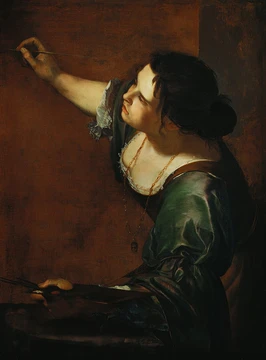
Artemisia Gentileschi
Italian Baroque painter and first woman in Florence's Accademia delle Arti del Disegno.

Artemisia Lomi Gentileschi, born on 8 July 1593, was an Italian Baroque painter who ranks among the most accomplished artists of the 17th century. She began working professionally at age 15, initially following the style of Caravaggio. At a time when women rarely received artistic training or worked as professionals, she became the first woman admitted to the Accademia di Arte del Disegno in Florence and built an international clientele. From 1638 to 1642, she worked as an expatriate painter at the court of Charles I of England, but likely fled during the early stages of the English Civil War. Her whereabouts for the next several years are unknown; she reappeared in Naples in 1649. A letter from 1650 to a mentor confirms she was still painting. The exact date of her death is uncertain, but her last known commission was in January 1654.
Her paintings often depict women from myths, allegories, and the Bible—victims, suicides, and warriors. Notable works include *Susanna and the Elders* (1610 version at Schloss Weißenstein, Pommersfelden), *Judith Slaying Holofernes* (1614–1620 version in the Uffizi), and *Judith and Her Maidservant* (1625 version at the Detroit Institute of Arts). She was recognized for her naturalistic portrayal of the female figure and her skill with color to convey dimension and drama.
For many years, her artistic achievements were overshadowed by the story of her rape at around age 18 by Agostino Tassi and her torture during the subsequent trial. She was long viewed as a curiosity, but 20th- and 21st-century scholarship has reexamined her life and work, leading to major exhibitions at prestigious institutions like the National Gallery in London.
Born in Rome on 8 July 1593 (though her birth certificate lists 1590), she was the eldest child of Prudenzia di Ottaviano Montoni and the Tuscan painter Orazio Gentileschi. After moving to Rome, Orazio’s painting reached its expressive peak, inspired by Caravaggio’s innovations—painting real models without idealization, transforming them into figures of powerful, realistic drama. Baptized two days after birth at San Lorenzo in Lucina, she was raised primarily by her father after her mother died in 1605. She likely began painting around this time, learning in her father’s workshop, where she showed more enthusiasm and talent than her brothers. She learned to mix colors and paint. By 1612, around age 19, she was known for her exceptional talent; her father boasted that, despite only three years of practice, she was peerless.
Her early work drew from her father’s style, itself heavily influenced by Caravaggio, but her approach to subject matter differed—she took a highly naturalistic approach, while her father’s works were more idealized. Her training in the workshop reflects the typical early 17th-century Italian artistic education: most artists learned through apprenticeships, but women were rarely allowed into formal apprenticeships or guilds. Female artists often learned through family members already in the profession. Art historian Mary D. Garrard notes that Gentileschi developed technical skill early and worked independently while still in her father’s household, though social and institutional barriers limited women’s professional participation. Her earliest surviving work, completed at age 17, is *Susanna and the Elders* (1610, Schönborn collection, Pommersfelden), which depicts the biblical story. It shows her assimilation of Caravaggio’s realism and effects, while also drawing on the classicism of Annibale Carracci and the Bolognese School.
In 1611, Orazio worked with Agostino Tassi on the vaults of Casino delle Muse in Rome. Around this time, Orazio rented the upstairs apartment to a female tenant, Donna Tuzia, who was meant to chaperone Gentileschi. Tuzia allowed Tassi and his friend Cosimo Quorli, a minor papal official, to visit Gentileschi multiple times. Tuzia later testified that Tassi, initially devoted to Gentileschi, grew increasingly obsessed. One day in May, Tassi visited when alone with Gentileschi and raped her. Quorli, who had likely previously attempted to rape her, was accused of acting as Tassi’s accomplice. Gentileschi later testified that she fought back, scratching Tassi’s face and trying to attack him with a knife, and cried out to Tuzia for help, which went unanswered.
- born
- 8 July 1593
- field
- Baroque painting
- nationality
- Italian
- known_for
- Depicting women from myths, allegories, and the Bible; skill in handling colour
Quick Facts
- Birth Name
- Artemisia Lomi Gentileschi
- Birth Date
- 1593-07-08
- Birth Place
- Rome, Papal States
- Death Date
- 1654 · 1593 · 07 · 08
- Death Place
- Naples, Kingdom of Naples
- Notable Works
- Susanna and the Elders / Judith and Her Maidservant / Judith Slaying Holofernes / Self-Portrait as the Allegory of Painting
- Known For
- Painting
- Style
- Italian Baroque · Caravaggisti (early)
- Movement
- Accademia delle Arti del Disegno
- Spouse
- Pierantonio Stiattesi · 1612 · 1623 · end=sep
- Partner
- Francesco Maria Maringhi (16161620)
- Father
- Orazio Gentileschi
Facts from the source article.
Lore & Background
Artemisia Gentileschi was born in Rome in 1593, the eldest child of the Tuscan painter Orazio Gentileschi. By 1612, aged around 19, she was known for her exemplary talents, with her father boasting that despite only three years of practice, she was peerless. She later testified that she fought back, scratching his face and attempting to attack him with a knife. After Tassi reneged on a promise to marry her, her father pressed charges. During the trial, Gentileschi was tortured with cords wrapped around her fingers to verify her testimony. Tassi was convicted and sentenced to exile from Rome, though the punishment was never carried out and he spent less than a year in prison.
Reader's Guide
Gentileschi's achievements as an artist were long overshadowed by the story of her rape and trial. Many of her paintings feature women from myths, allegories, and the Bible, including victims, suicides, and warriors. She was known for depicting the female figure with great naturalism and for her skill in handling colour to express dimension and drama. Her training in her father's workshop reflects the typical structure of artistic education in early 17th-century Italy, where female artists often learned through family members due to social and institutional barriers. Art historian Mary D. Garrard notes that Gentileschi developed technical skill at an early age and was able to work independently while still living in her father's household.
Did You Know?
- Gentileschi became a member of the Accademia delle Arti del Disegno in 1616.
- A defaced replica of the Penitent Magdalene was found in a cellar in Germany in 2011.
- The painting is signed 'Artemisia Lomi' on the wooden upright of the chair, though this signature may be by a later hand.
- The mirror in the painting is inscribed with the Latin phrase 'Optimam partem elegit' from Luke 10:41–42.
- Gentileschi's father Orazio was acquainted with Caravaggio, who fled Rome in 1606.
The Canvas and Its Florentine Setting
Painted between 1616 and 1618 and now housed in Florence's Pitti Palace, the Penitent Magdalene captures a woman in a gown of yellow silk, her figure rendered with an intensity that sets it apart from the saint's more conventional portrayals. There is no pastoral landscape behind her, no crucifix anchoring the scene—only the stark drama of her conversion. The work is assembled from three separate pieces of canvas, and the wooden chair bearing the signature 'Artemisia Lomi' may have been added by a later hand. Stylistically, the painting announces its Florentine origins through exaggerated gestures, sumptuous material rendering, and a palette dominated by gold, red, and green—hallmarks of the local Baroque idiom that Raymond Ward Bissell identified as defining characteristics. Gentileschi's admission to the Accademia delle Arti del Disegno in 1616, the very year she began this work, underscores how her Florentine period marked a professional turning point. The painting's afterlife extends beyond the gallery: in 2011, a defaced copy was discovered hidden in a cellar in Germany, a ghostly echo of the original's power.
Two Women in One: The Blended Iconography
Gentileschi wove together the stories of two biblical women into a single, unified figure. The jar of ointment at the saint's feet identifies her as Mary Magdalene, while the mirror she pushes aside—inscribed with the Latin phrase 'Optimam partem elegit,' drawn from Luke 10:41–42—points to Mary, the sister of Lazarus, who chose to sit at Jesus's feet rather than serve. By the sixth century, church tradition had already merged these two characters, so the conflation felt natural to a seventeenth-century viewer. Yet Gentileschi's rendering is deliberate: the gown has slipped off one shoulder, hinting at Magdalene's sensual past, yet no body is exposed. The woman's left arm flings away from a jewelry box, and her gaze lifts heavenward, enacting a refusal of vanity in real time. Scholars note the inscription likely appeared after Gentileschi's hand, suggested by its placement in the canvas's gloss. The result is a portrait of transformation—less a static saint than a woman caught mid-turn, leaving one life behind and reaching toward another.
Caravaggio's Light and a Woman's Path to Mastery
Born in Rome in 1593, Artemisia Gentileschi grew up in the orbit of her father Orazio, a painter who was himself acquainted with Caravaggio. The two men likely crossed paths before 1606, the year Caravaggio fled Rome, and young Artemisia may have caught a glimpse of the master during those early years. Though her gender barred her from workshops, academies, and free travel, she was not cut off from Caravaggio's visual legacy. Later in life she could study his paintings at the church of Santa Maria del Popolo in her neighborhood, absorbing the dramatic interplay of light and shadow that defined his work. That chiaroscuro became her own signature: in the Penitent Magdalene, the figure blazes against a dark ground, and the folds of her silk gown catch highlights that make the fabric almost tangible. Critics have long credited Artemisia with surpassing her father in raw talent, and her election to the Accademia delle Arti del Disegno in 1616 confirmed that her mastery was no accident of lineage but the product of a mind that learned, adapted, and ultimately outshone the tradition that shaped her.
Reading the Magdalene: Self-Portrait, Revenge, or Something Larger
For decades, scholars such as Mary Garrard have read the Penitent Magdalene as a coded self-portrait, arguing that both the saint and the painter carried the stigma of sexual transgression—Magdalene for her past as a prostitute, Gentileschi for the 1612 rape trial that scarred her public life. Under this reading, the inscription 'you have chosen the best part' becomes a quiet declaration: she took the worst that happened to her and forged a career from it. Yet more recent voices, including Rebecca Mead, push back against reducing Gentileschi's output to a single narrative of assault and retribution. They urge viewers to see her as a mother, a shrewd businesswoman, and an artist with a full erotic and intellectual life that extended far beyond trauma. The painting, on this view, draws on a rich tradition of source material available to any competent Baroque painter, not merely on the artist's own suffering. Gentileschi's true innovation was bringing a woman's perspective to stories of female heroism in a field long shaped by male hands, and the Magdalene stands as one thread in that broader, more complex tapestry.
Frequently Asked Questions
Who is Artemisia Gentileschi?
An Italian painter active during the Baroque period, born in 1593, who achieved professional recognition by her mid-teens. She worked in the dramatic, light-and-shadow style associated with Caravaggio and built a client base that spanned multiple countries.
What was Artemisia Gentileschi's role in the art world?
She was a working professional artist in a time when women were largely excluded from formal training and studio commissions. Her admission to Florence's Accademia di Arte del Disegno made her the first woman to hold that position.
How does Artemisia Gentileschi's story end?
The historical record confirms she was still living after January 1654, but her precise date of death remains a matter of debate among scholars. What happened in her final years is not well documented.
Why is Artemisia Gentileschi important?
She proved that a woman could compete at the highest professional level in 17th-century European painting, a field that was overwhelmingly male. Her command of colour for creating spatial depth and theatrical drama set her apart among her contemporaries.
What subjects and techniques is Artemisia Gentileschi known for?
Her canvases frequently feature women drawn from scripture, classical mythology, and allegorical tradition, rendered with a striking use of colour to suggest volume and emotional tension. She began her career in the Caravaggesque manner before refining a personal visual language.
More in Old Masters 1-22
Spotted an error? Know more?
This is a living reference — every entry is fact-audited, and reader corrections feed straight into our audit queue. Suggest an edit · See this site's audit record