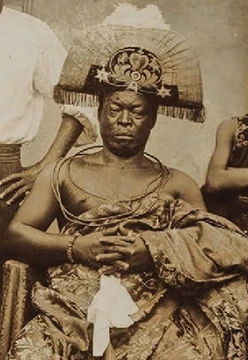
Eweka dynasty
Royal lineage beginning with Eweka I as first Oba of Benin.
The Eweka dynasty, also called the Oba dynasty or second dynasty of Benin, is the royal lineage that began with Eweka I as the first Oba of the Kingdom of Benin after the Ogiso period and a subsequent interval of political instability. Its foundation account involves Oranmiyan traveling from Ile-Ife to Benin, fathering Eweka by a Benin woman, and departing, leaving his locally born son to succeed. Scholars disagree over the historical interpretation of this tradition, including Oranmiyan's genealogy, the direction of cultural influence, the political circumstances of the dynastic change, and the date of the new royal line's establishment.
Quick Facts
- Country
- Kingdom of Benin
- Titles
- bin, Oba
- Founded
- Traditionally c. 1200
- Founder
- Eweka I
Facts from the source article.
Did You Know?
- The interregnum before the dynasty featured Evian, who gained prominence by driving away a creature called Osogan that attacked people on market days at Okedo near the Ikpoba River.
- Evian received the praise-name Evian nu rie ebe, translated as 'Evian, the preventer of danger', and an associated acrobatic display known as Amufi was subsequently performed each year.
Oranmiyan and the dynastic transition
Oranmiyan, a son of Odudua of Ife, arrived in Benin with a group that included a medicine man named Ogiefa. Although Ogiamwen opposed his coming, the people wanted a ruler and ignored this resistance, so Oranmiyan settled in a palace the elders built for him at Usama. Some traditions of invitation and violent resistance can be seen as compatible: one faction of chiefs may have invited him, while another group tied to Ogiamwen fought his authority, and this conflict later became part of the Oba's enthronement rites. Another version credits Oliha and the kingmakers with the invitation, with Oranmiyan defeating Ogiamwen's followers before relying on their support. His time in Benin is linked to the arrival of the first horses and the name Ile-Ibinu, meaning "Land of Troubles." Oranmiyan married Erinmwinde, daughter of Osanego, the ninth Onogie of Ego, and she bore him a son. That child, Eweka, was born at Ego and raised at Use. One account says Oranmiyan fathered a child with the daughter of an Edo village chief and left followers to raise the boy, while another names the mother as Erinmwinde, a Bini woman and daughter of Egor's ruler, noting that both mother and son stayed in Benin after Oranmiyan left.
Royal institutions
Eweka I is traditionally credited with establishing the council of state and kingmakers that became known as the Uzama Nihinron. He appointed Oliha, Edohen, Ezomo, Ero, Eholo n'Ire, and Oloton to this body, making their positions hereditary. Oliha served as its head and was given the duty of crowning future Obas. Later, Oba Ewuare added the Edaiken, or crown prince, bringing the total to seven. Another account describes a pre-existing council called the Edionnisen, which grew from five to six members with the addition of Oloton and later evolved into the Uzama. These chiefs held hereditary lands, palaces, and retainers, dressed in a manner comparable to the Oba, and held considerable sway over royal succession. Some historians say Eweka expanded this council from five to six members and shared power so evenly that the early Oba was essentially a first among equals. A different view holds that Eweka revived an existing kingmakers' association, with only Oloton being an immigrant linked to Oranmiyan's arrival from Ife. The title Oba is tied to the start of Eweka's reign, though its etymology remains unsettled. Royal regalia were sent from Ife for his coronation.
Origin traditions and historiography
According to the standard dynastic account, the Ogiso monarchy ended, and Benin’s elders asked for a prince from Uhe, the Edo name for Ile-Ife. Oranmiyan came to Benin but decided an outsider unfamiliar with Edo language and customs could not rule effectively, so his son Eweka, born locally, became Oba. The link between this dynasty and Ife is seen as historically strong, though other traditions describe the line’s founding as more violent, with its position only becoming secure after Ewedo moved to the later palace site. The story has been interpreted as a dynastic myth: kingship came from outside but was established through Edo initiative and absorbed into Edo culture. It combines two sources of legitimacy—the authority of a royal lineage tied to other kingdoms and the authority of Edo elders, whose collective will supposedly brought kingship into being.
In Yoruba traditions, Oduduwa founded Ife and sent sons to establish other cities and ruling houses. Oranmiyan is the founder of the Benin dynasty, and Eweka is his son. A less common Ife account says Oduduwa traveled to Benin with Oranmiyan and left him there to rule. Other Yoruba versions connect Oranmiyan to the thrones of both Ife and Oyo, identifying the early Oyo rulers Ajaka and Shango as his sons and paternal half-brothers of Eweka.
Chronology and king lists
Historians disagree on when the Eweka dynasty began. One estimate puts Oranmiyan’s arrival near 1170 and Eweka’s coronation around 1200, with Uwakhuahen succeeding about 1230. Another view places the monarchy’s start in the early 1300s. Using average reign lengths, a date near 1320 seems more likely than 1200 or 1220. Benin’s historical memory works through dynastic time, linking events to specific Obas without a fixed calendar to pin down exact years. The king list of thirty-eight Obas looks precise, but written records only support it from the mid-1800s onward; earlier dates depend heavily on one scholar’s work. Converting the list into a strict chronology has drawn criticism. Early attempts assumed very long reigns and a consistent system of primogeniture, but oral and written evidence offers weak support for those assumptions.
Spotted an error? Know more?
Reader corrections go straight into our review queue. Suggest an edit · How this site is sourced