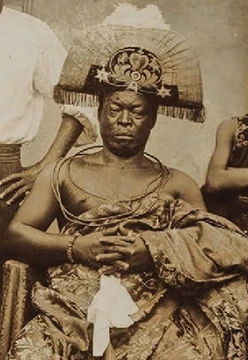
Ogbebo
Thirty-second Oba of Benin, reigned briefly amid civil war.
Ogbebo was the thirty-second Oba of Benin, ruling briefly around 1816 during a succession dispute following the death of his father, Obanosa. He contested the throne with his brother Eredia-Uwa, initially driving him into exile before being defeated after about eight months. His reign is notable for the civil war, destruction of palace treasures, and his reported suicide by hanging.
Quick Facts
- Reign
- 1816 (for about eight months)
- Coronation
- Disputed between usurpation and coronation
- Predecessor
- Obanosa
- Successor
- Osemwede
- Died
- 1816
- Place of death
- Royal palace, Benin capital
- Cause of death
- Suicide by hanging
Facts from the source article.
Background and accession
Ogbebo was a son of Oba Obanosa, who became Oba in 1804 after the death of his father Akengbuda, who had reigned for fifty-four years. Before his accession, Obanosa was known as Osifo and was already elderly; an oral account relates that he regularly sent strands of his grey hair to Akengbuda as a reminder of his age and expected succession. Obanosa's own accession faced opposition from Osopakharha of Ugbague village, a conflict that reportedly caused about one thousand deaths, and he later extended Benin territory by conquering Ute in the Owo division. The date and circumstances of Obanosa's death are disputed: historians Jacob Egharevba and Toyin Falola et al. date the succession crisis to 1816, art historian Barbara Blackmun places Obanosa's death at about 1815, and historian Osarhieme Osadolor characterizes it as an assassination in 1815, interpreting the ensuing war as the culmination of wider political instability. Benin royal succession operated through primogeniture, but the number of wives maintained by each Oba could complicate matters, and Obanosa's death left unresolved whether Ogbebo or Eredia-Uwa held the stronger claim. Egharevba identifies Ogbebo and Eredia-Uwa as Obanosa's two eldest sons, while Roese and Bondarenko identify Eredia-Uwa as the elder brother and Ogbebo as the younger contender, and Blackmun describes them as half-brothers. After Obanosa died, both asserted claims, leading to civil war; Ogbebo prevailed initially, forcing Eredia-Uwa to take refuge in Ishan at a place called Evbokhinmwi or Ewokhimi. His initial success was attributed to support from his mother's influential relatives and enslaved dependants. Sources differ on the formal character of his accession: Egharevba and Falola et al. state that he declared himself Oba without customary ceremonies and compelled chiefs to swear allegiance, while Blackmun records that elders consulted and selected him as heir before crowning him. Anthropologist Flora Kaplan later described Ogbebo as a usurper who took the throne in 1816.
Reign
The messengers were instructed to arrange Eredia-Uwa's death, return his severed head in one box, and deliver it to Ogbebo, who intended to spit on it each morning. Ogie, Eredia-Uwa's cousin, intercepted the party, ambushed the messengers, and shot some; the survivors fled. Egharevba's narrative links the Ishan response to efforts by local magicians to bring Erebo, the Ezomo of Uzebu, and the people of Uselu into the conflict against Ogbebo. Historian J.O. Ahazuem characterizes Ogie's intervention as shifting the balance in Eredia-Uwa's favor. Ogbebo assembled troops from his maternal kin network under Eyen and Eboide. The soldiers backing Eredia-Uwa sang a war song demanding punishment for Eyen and Eboide and denouncing the replacement of a firstborn by a younger brother. The fighting caused casualties and property damage, with Ahazuem characterizing the contest as a prolonged and destructive civil war.
Defeat, death and succession
Ogbebo’s rule lasted roughly eight months before he was overthrown by forces loyal to Eredia-Uwa. After losing, he is said to have smashed valuable items inside the royal palace and set part of it ablaze. According to the official Edo account relayed by Blackmun, Ogbebo then hanged himself, though Blackmun also raises the possibility that Eredia-Uwa had a hand in the palace fire. Following Ogbebo’s death, two individuals named Eyen and Eboide reportedly took their own lives. A European visitor from the 1820s, cited by Blackmun, noted that Ogbebo enjoyed popular support among Benin’s inhabitants before his overthrow, a conflict that left many chiefs dead and led to the execution of defeated opponents. Historians Peter Roese and Dmitri Bondarenko point to Lieutenant John King and an anonymous report in the Royal Gold Coast Gazette as confirming details of the aftermath. King, who reached the Benin capital in 1820, saw sections of the palace walls in ruins and reported that the civil war had cut the town’s population. After Ogbebo’s defeat, messengers went to Ishan to retrieve Eredia-Uwa, who was then crowned Oba under the regnal name Osemwede, meaning “my time has come.”
Legacy
When Ogbebo was defeated, the main material consequence discussed is a fire in the palace. European records and Edo oral stories say that part of the palace and at least some of its valuable items were destroyed. This conflict is linked to the royal ancestral altars and Benin’s tradition of carving ivory. If later Edo customs matched earlier ones, Ogbebo’s first duty as ruler would have been to order the Igbesanmwan carvers to make tusks for an altar honoring his father Obanosa. The altar had to be set up and dedicated before Ogbebo’s kingship could be ritually secure. It is possible that these newly carved altar tusks, which supported his spiritual and political claim to rule, were burned along with the palace treasures. Another scholar connects a noticeable shift between earlier and later Benin queen mother heads to the reported burning of the royal palace by Ogbebo.
Archaeological work at the Clerks’ Quarters site in Benin City gives physical evidence for these stories about palace destruction. In 1963, after technical improvements the year before, Graham Connah examined another part of a room in what he called the nineteenth-century palace. He found more of a pink floor, surrounded by an outer wall with horizontal grooves typical of high-status Benin buildings. Next to it was a mud wall with grooves on both sides, linked to a group of four thinner mud walls. Inside the rooms were decorated brass and pottery pieces, many beads, and imported European objects from the 1800s. Connah first suggested that these structures might have been built after an earlier palace was burned in 1816 during Ogbebo’s fight with the future Oba Osemwede. But he warned that a fire would not necessarily force a complete rebuild of thick mud walls, and he allowed that the walls could be from an earlier time. The site was used during the 1800s and stayed in use until it was burned in the British Benin Expedition of 1897, though exactly when it was built is unknown.
More in Obas of Benin
Spotted an error? Know more?
Reader corrections go straight into our review queue. Suggest an edit · How this site is sourced