Altered Carbon
A cyberpunk novel about immortality and murder.

FR · CC BY-SA 4.0
Altered Carbon, a cyberpunk novel published in 2002, was written by the English author Richard K. Morgan. Its setting is a future where people achieve near-immortality by transferring their consciousness between different bodies, called "sleeves." The story follows Takeshi Kovacs, a former elite soldier for the U.N. who now works as a private investigator, as he looks into the death of a wealthy man. Two sequels, *Broken Angels* and *Woken Furies*, continue the series. A Netflix television adaptation with the same title premiered in 2018, and a graphic novel based on the book was released in 2019 through Dynamite Comics.
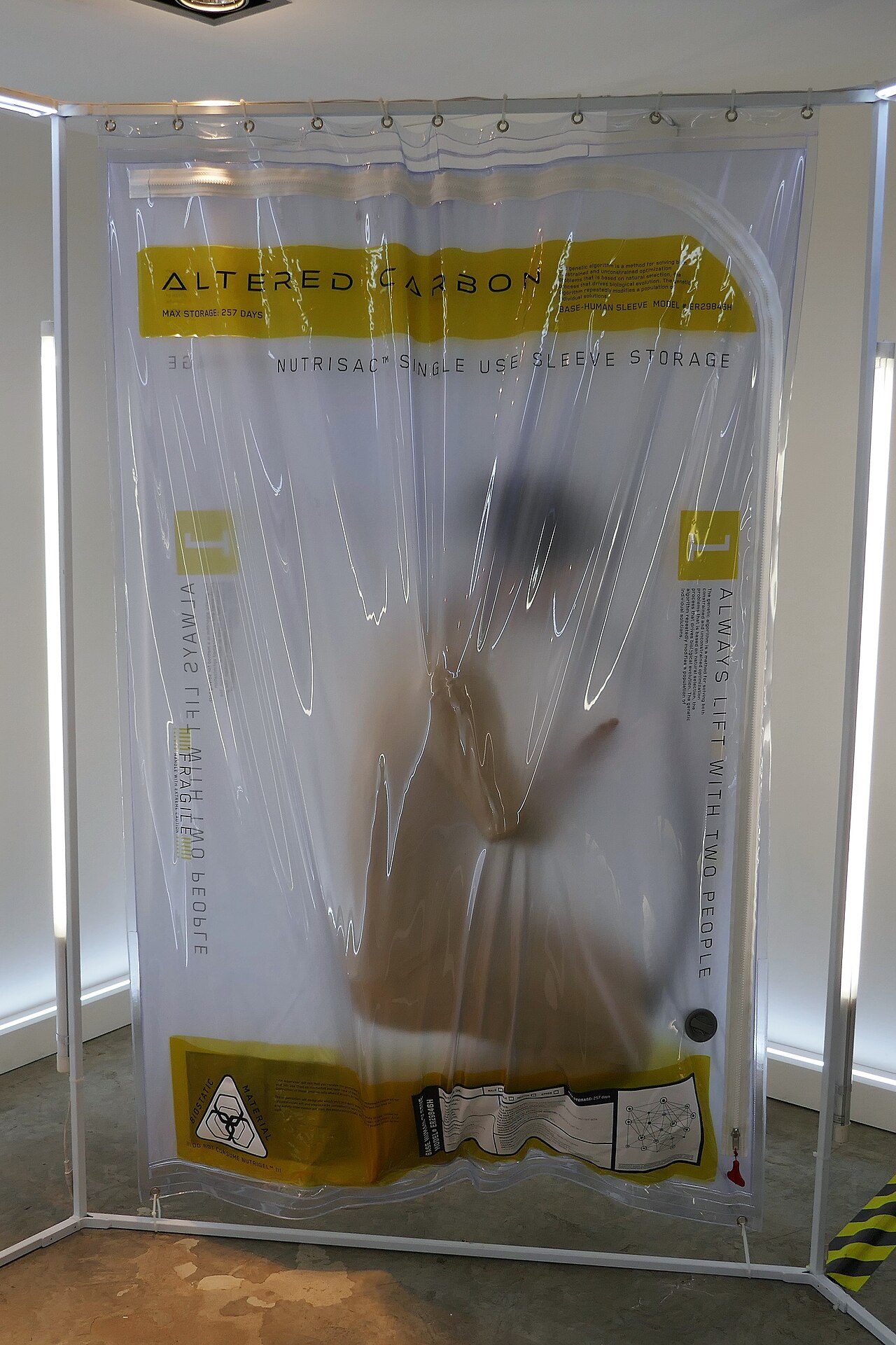
In this world, human consciousness is stored in a cortical stack implanted in the spine. If a body dies, the stack can be preserved indefinitely and later downloaded into a new sleeve. The only exception is death by an energy weapon, which destroys the stack permanently. Roman Catholics refuse re-sleeving after death, believing their soul goes to Heaven, which makes them vulnerable to murder since killers know the victim cannot be revived to testify. At the novel's start, U.N. Resolution 653 is under debate; it would allow authorities to temporarily re-sleeve a deceased Catholic woman to give testimony in a murder trial, reversing previous policy. Dual-sleeving—controlling two bodies with one mind—is banned by U.N. law.
Most people can afford to be resleeved once or twice, but they must endure the full aging process each time, which discourages frequent re-sleeving. Only the wealthy can continuously acquire new bodies. Those who have lived for multiple lifetimes are called Meths, after the biblical Methuselah. The very rich also keep updated copies of their minds in remote storage, so even if their stack is destroyed, they can be revived. Serious criminals are imprisoned "on stack": their consciousness is stored virtually, sometimes for decades, while their body is sold for re-sleeving. Numerous colony planets exist beyond Earth, many once inhabited by an extinct alien race called the Elders. To handle interspace warfare, the U.N. created the Envoys, an elite military group trained in re-sleeving, psychological modification, and combat. Envoys are so effective and dangerous that they are banned from holding elected office on any world.
Quick Facts
- Author
- Richard K. Morgan
- Country
- United Kingdom
- Language
- English
- Series
- Takeshi Kovacs
- Genre
- Science fiction, mystery
- Publisher
- Victor Gollancz Ltd
- Release Date
- 28 February 2002
- Media Type
- Print (hardback & paperback)
- Pages
- 416 pp (hardback), / 375 (paperback)
- Isbn
- 0-575-07321-7
- Oclc
- 48236269
- Followed By
- Broken Angels
Facts from the source article.
Lore & Background
In the future, humans achieve virtual immortality through cortical stacks that store consciousness. If the body dies, the stack can be downloaded into a new 'sleeve,' except when killed by an energy weapon, which destroys the stack permanently. Roman Catholics refuse re-sleeving, believing the soul goes to Heaven, making them easy targets for murder. The novel opens with UN Resolution 653, which would allow temporary re-sleeving of a deceased Catholic woman to testify. Dual-sleeving—controlling two bodies with one personality—is strictly prohibited. Most people can afford only one or two re-sleevings due to the full aging process each time; only the wealthy, called Meths, acquire bodies continually. The very rich keep remote mind backups updated regularly. Serious criminals are imprisoned 'on stack,' their consciousness stored virtually while their body is sold. Numerous colony planets exist, many once inhabited by an extinct alien civilization called the Elders. The U.N. created the Envoys, an elite military group trained in re-sleeving and psychological modification, who are prohibited from holding elected office.
Reader's Guide
Altered Carbon is significant for its gritty, noir-infused cyberpunk world and its exploration of immortality, class inequality, and identity. The novel's premise—where consciousness can be stored and transferred—raises questions about the soul, memory, and the value of life when death is no longer permanent. The book won the Philip K. Dick Award, cementing its place in science fiction. Its adaptation into a Netflix series in 2018 brought the story to a wider audience, though the series made extensive changes to the source material, including reimagining the Envoys as revolutionaries rather than elite government forces. The graphic novel adaptation in 2019 further expanded the franchise. The novel's legacy lies in its unflinching portrayal of a future where the rich can live forever while the poor are exploited, and its influence on subsequent cyberpunk works.
Did You Know?
- The novel won the Philip K. Dick Award for Best Novel in 2003.
- Roman Catholics in the novel refuse re-sleeving because they believe the soul goes to Heaven.
- The wealthy who live multiple lifespans are called Meths, after the Biblical figure Methuselah.
- The Netflix adaptation made extensive and significant changes to the source material.
The Architecture of Immortality
The series constructs its universe around a single technological premise: human consciousness, labeled digital human freight, can be captured on a disk-shaped cortical stack implanted in the vertebrae at the back of the neck. These devices originate from alien technology that humanity reverse-engineered, though they can only be manufactured using a material sourced exclusively from Harlan's World. When a body—called a sleeve, whether organic or synthetic—fails, the stack can be transplanted into a fresh one, effectively granting a second life. Yet the system is not invulnerable; destroying the stack without a backup kills the person permanently. At the top of this hierarchy sit the Meths, a term nodding to Methuselah, who afford continuous resleeving through cloned bodies and satellite-based consciousness storage, effectively bypassing aging. The story unfolds 360 years ahead, with the first season anchored in the year 2384 within the sprawling metropolis of Bay City, a world stratified by who can afford to keep living.
The Envoy's Long Game
Takeshi Kovacs enters the narrative as the sole surviving member of the Envoys, an elite rebel faction crushed in an uprising against the prevailing world order. By the time the first season opens, 250 years have passed since that defeat, and his cortical stack sits in a prison until a 300-year-old Meth named Laurens Bancroft extracts it, offering Kovacs a deal: solve Bancroft's own murder and earn a fresh chance at existence. The first season's ten episodes unfold across this investigation in Bay City, while the second season jumps roughly three decades forward into the early 2410s. There, Kovacs inhabits a new sleeve and continues his quest to locate Quellcrist Falconer, the master strategist and scientist who created the stack technology and led the Envoys. She was believed killed during the rebellion's suppression, yet she lingers in Kovacs's flashbacks and hallucinations, driving his search across both seasons. An anime film released in March 2020 extends the timeline further back, depicting events that precede the television series.
From Novel to Netflix
Laeta Kalogridis first optioned Richard K. Morgan's 2002 novel with the goal of adapting it as a feature film, but the project sat for fifteen years before Netflix greenlit a series in January 2016. Kalogridis attributed the long delay to the novel's complexity and its R-rated content, which made it difficult to pitch to traditional studios. Once Netflix committed to the adaptation—part of a broader push that saw the platform spend five billion dollars on original programming—Kalogridis wrote the script and served as showrunner alongside co-showrunner Steve Blackman. Morgan himself consulted on the production. The pilot was directed by Miguel Sapochnik, and the series reportedly became the most expensive Netflix production at the time, with Joel Kinnaman noting the budget exceeded that of the first three seasons of Game of Thrones. Costume designer Ann Foley and her team fitted roughly 2,000 performers and custom-built at least 500 pieces for the show.
One Man, Many Faces
The role of Takeshi Kovacs is distributed across multiple actors, reflecting the show's central conceit that consciousness can inhabit different physical vessels. Joel Kinnaman provides the face and body for season one, while also playing Elias Ryker, the Bay City police officer whose sleeve Kovacs occupies. In season two, Anthony Mackie becomes the new host body for Kovacs, and Ray Chase portrays the character in the anime film Resleeved. This casting strategy mirrors the narrative logic of resleeving. The ensemble around Kovacs is equally layered: James Purefoy embodies the ruthless Meth Laurens Bancroft, who dwells in a skyscraper above the clouds; Martha Higareda brings toughness to Kristin Ortega, a Bay City police lieutenant from a religious Mexican American family of officers; and Renée Elise Goldsberry appears as Quellcrist Falconer across both seasons. Chris Conner voices Edgar Poe, an AI modeled on the poet who operates the hotel serving as Kovacs's base. Dichen Lachman and Elizabeth Maxwell both portray Reileen Kawahara, Kovacs's sister and fellow Envoy.
Gallery


More in Novels set in the future 1-24
Spotted an error? Know more?
Reader corrections go straight into our review queue. Suggest an edit · How this site is sourced