
Fathers and Sons (novel)

Turgenev, Ivan Sergeevich, 1818-1883; Garnett, Constance, 1861-1946 · Public domain
Published in Moscow in 1862, *Fathers and Sons* is one of the most acclaimed Russian novels of the 19th century. The story centers on the conflict between generations and the rise of nihilism in mid-19th-century Russia. It follows Arkady Kirsanov, a recent university graduate, who returns to his father’s modest estate, Marino, bringing his friend Yevgeny Bazarov, a medical student and self-proclaimed nihilist. Arkady’s father, Nikolay, a liberal widower in his early forties, warmly welcomes them, but his brother Pavel is soon disturbed by the young men’s radical philosophy. Nikolay, who has tried to stay current by visiting his son at school, feels his beliefs grow outdated next to Arkady’s views, influenced heavily by Bazarov. Complicating matters, Nikolay has taken a servant, Fenechka, into his home and fathered a son, Mitya, though Arkady is delighted by this. The young men visit a relative, where they meet the elegant, independent Madame Anna Sergevna Odintsova. Both are attracted to her, and she invites them to her estate, Nikolskoye. There, Arkady becomes more independent of Bazarov’s influence, while Bazarov, distressed by falling in love, confesses his feelings to Odintsova, who rejects him due to his disdain for emotion and aesthetics. Afterward, Bazarov returns to his adoring parents’ home, with Arkady accompanying him. Tensions rise between Bazarov and Pavel, culminating in a duel after Bazarov kisses Fenechka. Pavel is wounded, and Bazarov leaves for his parents’ home. Arkady, meanwhile, realizes he loves Odintsova’s sister Katya and becomes engaged. Bazarov, helping his father as a country doctor, contracts an infection during an autopsy and dies, with Odintsova visiting him on his deathbed. The novel closes with Arkady marrying Katya and managing his father’s estate, while Nikolay marries Fenechka, and Bazarov’s parents pray by his grave.
- publisher
- Grachev & Co, Moscow
- author
- Ivan Turgenev
- original_language
- Russian
- genre
- Novel
- notable_for
- Introduction of the term 'nihilism' in Russian literature
Lore & Background
The novel *Fathers and Sons* (1862) by Ivan Turgenev follows university graduate Arkady Kirsanov as he returns to his father’s modest estate, Marino, bringing his friend Yevgeny Bazarov. Bazarov, a medical student and self-proclaimed nihilist, challenges the liberal ideas of Arkady’s father, Nikolay, and his uncle, Pavel. The young men’s radical views create tension, especially with Pavel, who detests Bazarov. Arkady’s father, initially delighted, feels his own beliefs dated. Complicating matters, Nikolay has taken a servant, Fenechka, into his house and fathered a son, Mitya, which Arkady welcomes. The group visits a relative, meeting the elegant, independent widow Madame Anna Sergevna Odintsova, who intrigues both young men. At her estate, Nikolskoye, Bazarov confesses his love for her, but she rejects him, finding his devaluation of feelings unattractive. Arkady falls for her sister, Katya. Bazarov kisses Fenechka against her will, leading Pavel to challenge him to a duel, in which Pavel is wounded. Bazarov returns to his parents’ home, where he helps his father as a country doctor. While performing an autopsy, he cuts himself, contracts pyaemia, and dies, having sent for Odintsova on his deathbed. Arkady marries Katya and manages Marino; Nikolay marries Fenechka. The novel closes with Bazarov’s parents praying by his grave.
Reader's Guide
The narrative explores the clash between the older generation's traditional values and the younger generation's nihilistic rejection of established norms. Bazarov's philosophy leads him to deny love and aesthetics, yet he falls for the wealthy widow Anna Sergeyevna Odintsova, who rejects him. Arkady, initially influenced by Bazarov, gradually asserts independence and marries Odintsova's sister Katya. Bazarov returns to his parents' home, where he dies from an infection contracted during an autopsy. The novel ends with Bazarov's parents praying at his grave, while Arkady and his father find domestic happiness. Fathers and Sons remains significant for its nuanced portrayal of ideological conflict and its enduring influence on Russian literature.
Did You Know?
- The title literally translates to 'Fathers and Children' in English.
- Bazarov dies of pyaemia contracted during a medical examination.
- Arkady marries Katya, the younger sister of Madame Odintsova.
Publication & Literary Standing
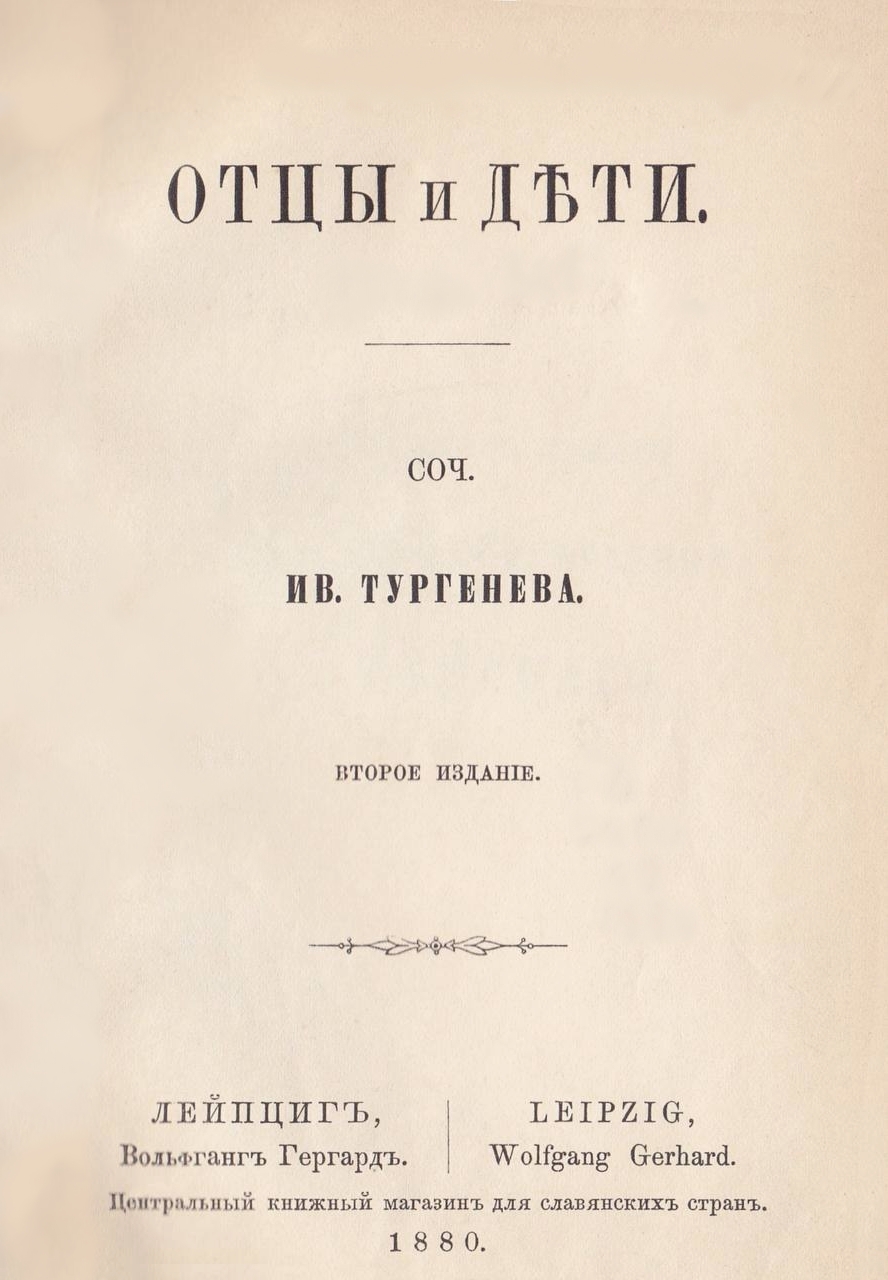
Fathers and Sons (Russian: «Отцы и дети») is an 1862 novel by Ivan Turgenev that stands as one of the most acclaimed Russian novels of the nineteenth century. Published in Moscow by Grachev & Co on 23 February 1862, the work carries the literal translation "Fathers and Children" from its Russian title, Otcy i deti. The pre-1918 spelling rendered the second word with a yat letter (дѣти), a small typographical detail that anchors the text in its specific historical moment. Turgenev crafted a narrative that would resonate far beyond its initial readership, embedding a generational and philosophical debate into the fabric of Russian literary tradition. The novel's title itself signals its central preoccupation: the tension between inherited values and emerging ideologies, a conflict that Turgenev dramatized through the Kirsanov family and their circle. Its lasting reputation as a cornerstone of 19th-century Russian fiction testifies to the universality of the questions it raises about how one generation relates to the next.
The Generational Clash & Nihilism
The novel's engine is the friction between two generations of Russian men. Nikolay Kirsanov, a liberal democrat in his early forties who owns the modest estate of Marino with a couple of hundred serfs, initially welcomes his son Arkady home from St. Petersburg University with genuine delight. But the young man's companion, Yevgeny Bazarov, carries a philosophy called nihilism that upsets Pavel Kirsanov, Nikolay's brother, almost immediately. Nikolay, who has always tried to stay current by visiting his son at school, finds his own beliefs suddenly feeling dated beside Arkady's radical views. The awkwardness deepens when Nikolay's private life—his relationship with the servant Fenechka and their son Mitya—collides with the younger generation's expectations. Pavel, with his perfumed mustaches and clean-cut features, represents the older liberal establishment that Bazarov's blunt materialism dismantles. The result is a household where affection and ideological hostility coexist, and where a father watches his son drift toward a worldview he cannot fully comprehend.
Bazarov's Tragic Arc
Yevgeny Bazarov, a medical student with a long thin face, broad forehead, large greenish eyes, and drooping sandy whiskers, functions as the novel's most electrifying presence. His nihilism is not mere rebellion but a systematic rejection of aesthetic feeling, tradition, and inherited authority. He mentors Arkady, challenges the Kirsanov brothers, and provokes his own adoring parents with social cynicism. Yet his philosophy cracks when he falls in love with Madame Anna Sergevna Odintsova, an elegant woman of independent means whose cautious attraction to him ultimately leads her to reject his declaration. She finds his devaluation of feelings unattractive and sees no future with him. The final blow comes not from ideology but from carelessness: while assisting his father as a country doctor, Bazarov cuts himself during an autopsy and contracts a fatal infection. On his deathbed, he summons Odintsova, tells her how beautiful she is, and dies the following day, accepting his fate with calm resignation. His parents are left praying at his graveside.
Resolution & the Human Cost of Ideology
The novel's closing movements reveal what remains when the philosophical storm passes. Arkady, who adopted nihilism more from Bazarov's influence than from genuine conviction, sheds his friend's ideology and falls in love with Katya, Madame Odintsova's quiet, modest sister. He marries her and assumes management of his father's estate at Marino. Nikolay, the widower who had once felt his beliefs growing stale, marries Fenechka and is delighted to have Arkady home with him, completing a domestic circle that includes the young son Mitya. Bazarov's death, contracted during a medical examination, removes the novel's most disruptive force and leaves his parents in a scene of grief and prayer by his grave. The duel between Bazarov and Pavel—sparked by Pavel witnessing Bazarov kiss Fenechka against her will—wounds Pavel in the leg and forces Bazarov to leave Marino, accelerating the tragedy. In the end, the fathers find peace in family and continuity, while the son who challenged everything is buried, his parents' devotion the only monument to a life spent in intellectual combat.
Gallery
Frequently Asked Questions
Who is the main character in Fathers and Sons?
Evgeny Bazarov is the central figure: a young medical student who dismisses tradition, art, and authority in favor of practical science. His sharp clashes with the older household members drive the novel's core tension.
Why is Fathers and Sons famous for introducing the term 'nihilism'?
Turgenev used Bazarov's worldview to bring the word 'nihilism' into Russian literary conversation for the first time. The novel presents the philosophy with genuine sympathy before letting its internal contradictions surface through the characters' relationships and choices.
How does Fathers and Sons end?
Bazarov dies from a small wound that becomes infected, an unheroic and quiet death that subverts conventional literary expectations. His passing strips the younger characters of their guiding voice and leaves the novel's generational question deliberately unresolved.
More in Novels & Major Fiction 1-24
Spotted an error? Know more?
This is a living reference — every entry is fact-audited, and reader corrections feed straight into our audit queue. Suggest an edit · See this site's audit record