624 Hektor
Largest Jupiter trojan, elongated contact binary with a moon.
Last updated
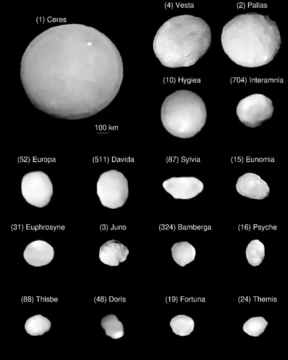
624 Hektor is the largest Jupiter trojan asteroid and the namesake of the Hektor family.[1] The asteroid has a highly elongated shape and a small satellite named Skamandrios.[1] August Kopff made the discovery of 624 Hektor at Heidelberg on 10 February 1907.[2]
Key facts and history
624 Hektor was named after the Trojan prince Hector from Greek mythology.[1] Its longest dimension is approximately 403 km, while its other dimensions average around 201 km.[3] The asteroid's volume is equivalent to a sphere of about 225 to 250 km in diameter.[1] Its estimated mass is 7.9, giving a density of 1.0 g/cm³.[3]
Hektor is thought to be a contact binary composed of two lobes with mean diameters of 220 and 183 km.[3] On 17 July 2006, the Keck 10-meter-II telescope with adaptive optics revealed a bilobate shape.[4] The rotation period of Hektor is 6.9205 hours, determined from multiple historical lightcurves.[4] A moon with a diameter estimated at about 15 km, designated S/2006 (624) 1, was found orbiting Hektor in 2006.[5]
Observations from the Keck telescope in November 2011 confirmed the moon's existence, and it received the name Skamandrios on 12 March 2017.[6]
What the research sources say
The Minor Planet Center records show 624 Hektor was discovered at Heidelberg on 1907-02-10 by A. Kopff.[2] The IAUC 8732 circular reports that Marchis et al. discovered the satellite using the Keck-II telescope with its Laser Guide Star Adaptive Optics system.[5] Based on an integrated brightness ratio of about 6.5, the satellite's diameter was estimated to be about 15 km.[5] Johnson's Archive notes that Hektor's primary is a contact binary accompanied by a smaller secondary.[7]
The same source states that Hektor is the second identified binary trojan asteroid.[7]
References
- Wikipedia, "624 Hektor" (CC BY-SA 4.0), which cites: "624 Hektor (1907 XM)", Minor Planet Center; Schmadel, "Dictionary of Minor Planet Names", Springer Berlin Heidelberg, 2007, p. 63; Marchis, "The Puzzling Mutual Orbit of the Binary Trojan Asteroid (624) Hektor", The Astrophysical Journal Letters, March 2014, p. 6 (we also read that source) en.wikipedia.org
- "624 Hektor (1907 XM)", Minor Planet Center. facts only, no text reused. minorplanetcenter.net
- Wikipedia, "624 Hektor" (CC BY-SA 4.0), which cites: Marchis, "The Puzzling Mutual Orbit of the Binary Trojan Asteroid (624) Hektor", The Astrophysical Journal Letters, March 2014, p. 6 (original not read by us) en.wikipedia.org
- Wikipedia, "624 Hektor" (CC BY-SA 4.0), which cites: Franck Marchis, "Searching and Characterizing Multiple Trojan Asteroids with LGS AO Systems", November 2005; Marchis, "The Puzzling Mutual Orbit of the Binary Trojan Asteroid (624) Hektor", The Astrophysical Journal Letters, March 2014, p. 6 (original not read by us) en.wikipedia.org
- "IAUC 8732: S/2006 (624) 1 (Satellite Discovery)", Central Bureau for Astronomical Telegrams, 21 July 2006. facts only, no text reused. cbat.eps.harvard.edu
- Wikipedia, "624 Hektor" (CC BY-SA 4.0), which cites: "IAUC 8732: S/2006 (624) 1 (Satellite Discovery)", Central Bureau for Astronomical Telegrams, 21 July 2006; Marchis, "The Puzzling Mutual Orbit of the Binary Trojan Asteroid (624) Hektor", The Astrophysical Journal Letters, March 2014, p. 6; "Dome closed, Keck telescope is...", 11 November 2011; "M.P.C. 103967", Minor Planet Circular, 12 March 2017 (we also read that source) en.wikipedia.org
- "Johnson's Archive - asteroids with satellites". facts only, no text reused. johnstonsarchive.net
Each numbered sentence above was checked against the source it cites before publication. Sentences citing Wikipedia adapt text from the English Wikipedia article 624 Hektor (contributors), used under CC BY-SA 4.0; this entry is available under the same licence. Other sources were used for facts only; no text or images are copied from them.
Ranked in
More in Notable Asteroids
Sources
Compiled from Wikipedia and the sources listed below. Text from Wikipedia is available under CC BY-SA 4.0; this entry is adapted from it.
- Wikipedia: 624 Hektor (CC BY-SA 4.0).
- Word definitions: the Codexery glossary, each quoted from its Wikipedia article.
Spotted an error? Know more?
Reader corrections go straight into our review queue. Suggest an edit · How this site is sourced