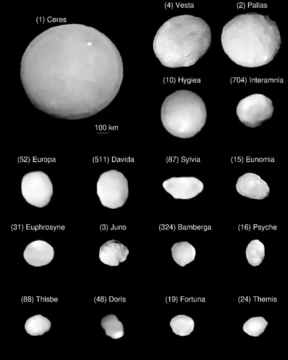
617 Patroclus
First binary trojan asteroid, icy like a comet.
Last updated
It was the first binary trojan asteroid discovered, with the larger component named Patroclus and the smaller named Menoetius.[1] August Kopff discovered 617 Patroclus on 17 October 1906 at the Heidelberg Observatory.[2][3]
Key facts and history
Austrian astronomer Johann Palisa proposed the name, and the official citation appeared in Paul Herget's 1955 publication.[4] Patroclus was the second trojan asteroid discovered and the only member of the Trojan camp named after a Greek figure.[2] In 2001, astronomers using the Gemini North Telescope discovered a companion, designated S/2001 (617) 1, later named Menoetius.[5][6] The minor planet received its name from the Greek hero Patroclus, who was Achilles' friend and was slain by Hector in the Trojan War.[4]
With a solar distance ranging from 4.5 to 5.9 AU, the system completes one orbit in 11 years and 11 months, having an eccentricity of 0.14 and an inclination of 22°.[7]
What the research sources say
A UC Berkeley press release reported that Marchis and colleagues determined the system's density at 0.8 grams per cubic centimeter, about one third that of rock.[8][9] The press release noted that Menoetius is about 112 kilometers in diameter, while Patroclus is about 122 kilometers wide.[8][9] The Minor Planet Center record confirms the discovery date of 1906 October 17 by A. Kopff at Heidelberg.[3] Marchis and his team found that the two components revolve around their common center of mass once every 4.3 days, separated by 680 kilometers.[8][9]
References
- Wikipedia, "617 Patroclus" (CC BY-SA 4.0), which cites: Johnston, "(617) Patroclus and Menoetius", johnstonsarchive.net, 21 September 2014 (we also read that source) en.wikipedia.org
- Wikipedia, "617 Patroclus" (CC BY-SA 4.0), which cites: "617 Patroclus (1906 VY)", Minor Planet Center; Schmadel, "Dictionary of Minor Planet Names", Springer Berlin Heidelberg, 2007, p. 62 (we also read that source) en.wikipedia.org
- "617 Patroclus (1906 VY)", Minor Planet Center. facts only, no text reused. minorplanetcenter.net
- Wikipedia, "617 Patroclus" (CC BY-SA 4.0), which cites: Schmadel, "Dictionary of Minor Planet Names", Springer Berlin Heidelberg, 2007, p. 62 (we also read that source) en.wikipedia.org
- Johnston, "(617) Patroclus and Menoetius", johnstonsarchive.net, 21 September 2014. facts only, no text reused. johnstonsarchive.net
- Merline, "IAUC 7741: 2001fc; S/2001 (617) 1; C/2001 T1, C/2001 T2", 2001. facts only, no text reused. cbat.eps.harvard.edu
- Wikipedia, "617 Patroclus" (CC BY-SA 4.0), which cites: "617 Patroclus (1906 VY)", Minor Planet Center (we also read that source) en.wikipedia.org
- Sanders, "Binary asteroid in Jupiter's orbit may be icy comet from solar system's infancy", University of California, Berkeley, 2006. facts only, no text reused. berkeley.edu
- Sanders, "Trojan Binary Asteroid – Patroclus & Menoetius", UC Berkeley. facts only, no text reused. franckmarchis.com
Each numbered sentence above was checked against the source it cites before publication. Sentences citing Wikipedia adapt text from the English Wikipedia article 617 Patroclus (contributors), used under CC BY-SA 4.0; this entry is available under the same licence. Other sources were used for facts only; no text or images are copied from them.
Ranked in
More in Notable Asteroids
Sources
Compiled from Wikipedia and the sources listed below. Text from Wikipedia is available under CC BY-SA 4.0; this entry is adapted from it.
- Wikipedia: 617 Patroclus (CC BY-SA 4.0).
- Word definitions: the , each quoted from its Wikipedia article.
Spotted an error? Know more?
Reader corrections go straight into our review queue. Suggest an edit · How this site is sourced