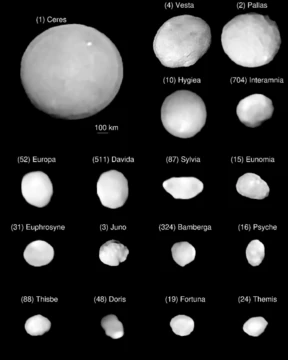
Hygiea family
Dark carbonaceous family dominated by the giant 10 Hygiea.

The Hygiea family is a grouping of dark, carbonaceous C-type and B-type asteroids located in the outer asteroid belt. Its largest member, 10 Hygiea, is the fourth-largest asteroid in the belt, with a diameter of approximately 400 km, and contains an estimated 94–98% of the family's total mass. The family is notable for its origin in a catastrophic disruptive impact, after which Hygiea re-accumulated, and for containing a significant number of the otherwise rare B spectral type asteroids.
- Largest member
- 10 Hygiea (400 km diameter, C-type)
- Mass contribution of largest member
- 94–98%
- Next largest members
- 333 Badenia and 538 Friederike (both just over 70 km diameter)
- Remaining members diameter
- less than 30 km
- Core members identified 1995
- 103
- Objects in family region 2005
- 1043
- Proportion of all asteroids
- about 1%
Lore & Background
The Hygiea family is thought to have formed from a catastrophic disruptive impact, after which the largest fragment, 10 Hygiea, re-accumulated. The presence of two members—333 Badenia and 538 Friederike—each just over 70 km in diameter, supports this scenario, as they are much larger than members of other families like the Vesta family, which contains no members above about 10 km. The family includes a significant number of B-type asteroids, a rare spectral type; the largest B-type member is 538 Friederike.
The family's core members, as identified by a numerical analysis, have proper orbital elements within defined ranges. At the present epoch, the osculating orbital elements of these core members also fall within specific ranges. A 1995 analysis found 103 core members, while a later search of a proper element database yielded 1,043 objects within the same rectangular region, representing about 1% of all asteroids in the belt.
The family contains a number of identified interlopers, including 100 Hekate, 108 Hecuba, 1109 Tata, 1209 Pumma, and 1599 Giomus, which were identified in a spectral survey and by inspection of taxonomy data for S- and D-type members. Some C-type asteroids in the region may also be interlopers; 333 Badenia and 538 Friederike are possible candidates due to their unusually large size for cratering family members. The large asteroid 52 Europa (300 km diameter, proper inclination 6.37°) was once considered part of the family but is now recognized as unrelated, as it orbits well beyond the Hygiea family clump.
Reader's Guide
The Hygiea family's significance lies in its demonstration of a catastrophic disruption event that produced a re-accumulated largest body, 10 Hygiea, which dominates the family's mass. The presence of two relatively large members (333 Badenia and 538 Friederike) contrasts with other families like the Vesta family, which lack such large fragments, supporting the disruption-and-reaccumulation model. The family also provides a notable concentration of the rare B spectral type, with 538 Friederike being the largest such object. The identification of numerous interlopers, including S- and D-type asteroids and possible C-type interlopers, highlights the complexity of distinguishing true family members from background asteroids in a region where C-type asteroids are common. The exclusion of 52 Europa from the family, despite its proximity, underscores the importance of precise orbital analysis. With about 1% of all asteroids belonging to this family, it represents a significant fraction of the belt's population and a key subject for studying collisional evolution in the outer asteroid belt.
Did You Know?
- The family contains about 94–98% of its mass in 10 Hygiea alone.
- 538 Friederike is the largest B-type asteroid in the family.
- 52 Europa, a 300 km asteroid, was once thought to belong to the Hygiea family but is now considered unrelated.
More in Notable Asteroids, Part 4 1-24
Spotted an error? Know more?
Reader corrections go straight into our review queue. Suggest an edit · How this site is sourced