Asteroid family
Asteroid families are collisional fragments sharing similar orbital elements.

An asteroid family is a group of asteroids that have similar proper orbital elements—specifically, semi-major axis, eccentricity, and orbital inclination. These objects are believed to be fragments from past collisions between asteroids. The term is more precise than "asteroid group," which describes asteroids that share broad orbital traits but may not be related otherwise.
Large, well-known families can contain hundreds of recognized asteroids, plus many smaller ones that have not yet been discovered or analyzed. Small, compact families may have only about ten identified members. Roughly 33% to 35% of main-belt asteroids belong to families. There are about 20 to 30 reliably recognized families, along with several dozen less certain groupings. Most families are located in the main asteroid belt, though some groups—such as the Pallas, Hungaria, and Phocaea families—exist at smaller semi-major axes or higher inclinations. One family has been linked to the dwarf planet Haumea. Studies have looked for collisional families among the Trojan asteroids, but the evidence so far is inconclusive. For near-Earth asteroids, a separate four-group orbital classification system is used in addition to family classification.
**History** Japanese astronomer Kiyotsugu Hirayama (1874–1943) pioneered the calculation of proper elements for asteroids and first identified several major families in 1918. He initially recognized the Koronis, Eos, and Themis families, and later added the Flora and Maria families. In his honor, asteroid families are sometimes called Hirayama families, especially the five prominent groups he discovered.
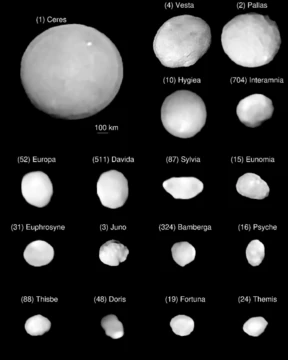
**Origin and Evolution** Families are thought to form from asteroid collisions. In many cases, the parent body was shattered, but some families resulted from large cratering events that did not destroy the parent body—for example, the Vesta, Pallas, Hygiea, and Massalia families. These cratering families typically consist of one large body and a swarm of much smaller asteroids. Some families, like the Flora family, have complex internal structures not yet fully explained, possibly due to multiple collisions in the same region at different times.
Because of their origin, most family members have closely matching compositions. Exceptions include families like Vesta, which formed from a large, differentiated parent body.
- Percentage of main belt asteroids that a
- 33% to 35%
- Number of reliably recognized families
- 20 to 30
- First identified by
- Kiyotsugu Hirayama
- Year of initial identification
- 1918
- First families identified
- Koronis, Eos, Themis
- Largest family by members
- Nysa–Polana complex (19,073 members)
- Oldest known family age estimate
- hundreds of millions of years
Lore & Background
The Japanese astronomer Kiyotsugu Hirayama pioneered the estimation of proper elements for asteroids and first identified several of the most prominent families in 1918. He initially identified the Koronis, Eos, and Themis families, and later recognized also the Flora and Maria families. In his honor, asteroid families are sometimes called Hirayama families, particularly the five prominent groupings discovered by him.
The families are thought to form as a result of collisions between asteroids. In many or most cases the parent body was shattered, but there are also several families which resulted from a large cratering event that did not disrupt the parent body, such as the Vesta, Pallas, Hygiea, and Massalia families. Such cratering families typically consist of a single large body and a swarm of much smaller asteroids. Some families, like the Flora family, have complex internal structures that are not satisfactorily explained at the moment, but may be due to several collisions in the same region at different times.
Asteroid families are thought to have lifetimes of the order of a billion years, depending on various factors, which is significantly shorter than the Solar System's age, so few if any are relics of the early Solar System. Decay of families occurs both because of slow dissipation of the orbits due to perturbations from Jupiter or other large bodies, and because of collisions between asteroids that grind them down to small bodies. Tentative age estimates have been obtained for some families, ranging from hundreds of millions of years to less than several million years as for the compact Karin family.
Reader's Guide
Asteroid families represent a fundamental class of collisional populations in the asteroid belt, with about 33% to 35% of main-belt asteroids belonging to recognized families. Their study provides insight into the collisional history and evolution of the Solar System. The identification of families relies on proper orbital elements rather than osculating elements, which fluctuate on shorter timescales. The hierarchical clustering method and wavelet analysis are used to identify groupings, though boundaries are vague as families blend into the background density. Interlopers—asteroids with similar orbital elements but distinct spectroscopic properties—can be recognized by spectral analysis, as exemplified by 1 Ceres being an interloper in the Gefion family. Families have lifetimes of about a billion years, much shorter than the Solar System's age, meaning few are primordial. The decay of families occurs through orbital perturbations and collisional grinding, with small asteroids eventually ejected from the belt via the Yarkovsky effect and orbital resonances. Old families are thought to contain few small members, and this is the basis for age determinations. Evidence from iron meteorites suggests at least 50 to 100 differentiated parent bodies have been shattered over time, indicating many past families have now dispersed.
Did You Know?
- About 33% to 35% of asteroids in the main belt are family members.
- Kiyotsugu Hirayama first identified the Koronis, Eos, and Themis families in 1918.
- The Nysa–Polana complex is the largest family with 19,073 members.
- The Karin cluster is a compact family with an age of less than several million years.
Frequently Asked Questions
What is an asteroid family?
An asteroid family is a cluster of rocky space objects that share very similar proper orbital parameters—specifically their semi-major axis, eccentricity, and inclination. Scientists believe these groups formed when a larger asteroid was shattered by a high-velocity impact, scattering debris along nearly identical orbital paths.
Who first identified asteroid families and when?
Japanese astronomer Kiyotsugu Hirayama was the first to recognize these groupings back in 1918. He singled out the Koronis, Eos, and Themis clusters as the initial examples of what we now call asteroid families.
What is the largest known asteroid family?
The Nysa–Polana complex holds the record with roughly 19,073 catalogued members, making it by far the most populous family in the main belt. Many of its smaller fragments likely remain undiscovered or unanalyzed.
How many asteroid families exist, and how much of the main belt do they cover?
Astronomers have reliably identified somewhere between 20 and 30 distinct families to date. Together, these groups account for roughly a third of all known main-belt asteroids.
How is an asteroid family different from an asteroid group?
A family implies a shared collisional origin, meaning the members are literally fragments of a single parent body that broke apart. A group is a looser classification based on broad orbital similarities, and its members may have no direct physical connection to one another.
More in Notable Asteroids, Part 4 1-24
Spotted an error? Know more?
Reader corrections go straight into our review queue. Suggest an edit · How this site is sourced