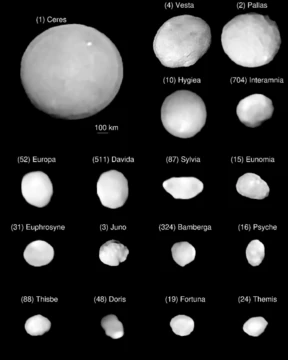
Eunomia family
The largest S-type asteroid family in the intermediate belt.

The Eunomia family (FIN: 502) is a large group of stony, S-type asteroids in the intermediate main belt, named for its biggest member, 15 Eunomia. It ranks as the sixth-largest asteroid family, with nearly six thousand known members—about 1.4% of all belt asteroids—and is the most prominent family in its region.
The family’s largest asteroid, 15 Eunomia, is also the biggest of all S-type asteroids. It measures roughly 300 km along its longest axis, with a mean radius of 250 km, and sits near the family’s center of mass. This single asteroid holds an estimated 70–75% of the original parent body’s material. That parent body, about 280 km in diameter, was shattered by a catastrophic impact. Evidence suggests it was at least partly differentiated, since Eunomia’s surface and the spectra of smaller family members show some compositional variation. However, other studies indicate the parent body may have already been somewhat fragmented by earlier, smaller collisions before the final breakup. The impactor was likely a substantial asteroid, roughly 50 km across, striking at about 22,000 km/h.
The other Eunomian asteroids are spread fairly evenly in orbital space around 15 Eunomia. The next largest identified member, 258 Tyche, has a 65 km diameter, but its orbit sits at the very edge of the family region, so it may be an interloper. The largest clear family members are around 30 km in diameter, with several asteroids in that size range. Spectroscopic studies show the family spans a noticeable range of compositions, though all remain within the S spectral class—stony surfaces rich in silicates and some nickel-iron, and relatively bright for their size.
The family contains a high number of small objects. Since such small bodies are gradually eroded by secondary collisions, gravitational perturbations, and the Yarkovsky effect, this abundance suggests the Eunomia family formed relatively recently in astronomical terms. In 2000, the Cassini-Huygens spacecraft flew by 2685 Masursky, a small family member, but the encounter distance of about one million kilometers was too great to resolve any surface features.
The family lies between Jupiter’s 3:1 and 8:3 resonances, at relatively high inclinations. A 1995 HCM analysis by Zappalà and colleagues identified 439 core members, with proper orbital elements in specific ranges.
- Fin designation
- 502
- Largest member
- 15 Eunomia
- Mean radius of 15 eunomia
- 250 km
- Estimated diameter of parent body
- 280 km
- Percentage of original parent body mass
- 70–75%
- Number of core members (zappalà 1995)
- 439
- Number of identified members (nesvorný 2
- 5,670
Lore & Background
The Eunomia family was created by a catastrophic impact that shattered a parent body with a mean diameter of about 280 km. The impactor was likely a smaller asteroid of roughly 50 km diameter, striking at a speed of about 22,000 km/h. It is probable that the parent body was at least partly differentiated, as the surface of 15 Eunomia and spectra of smaller family members show compositional variation. However, other studies suggest the parent body may have already been somewhat fragmented by previous collisions before the definitive disruption.
The largest member, 15 Eunomia, is about 300 km across along its longest axis and lies close to the family's barycenter, containing an estimated 70–75% of the original parent body's matter. The next largest candidate, 258 Tyche (65 km diameter), orbits at the margin of the family region and may be an interloper. The largest clear family members are about 30 km in diameter. Spectroscopic studies show that family members span a range of compositions but remain within the S spectral class, indicating stony surfaces with silicates and some nickel-iron.
The family contains relatively large numbers of small objects, suggesting it was created relatively recently on an astronomical timescale, as smaller bodies are eroded over time by secondary collisions, gravitational perturbations, and the Yarkovsky effect. The Cassini-Huygens spacecraft flew by 2685 Masursky, a small family member, in 2000, but the encounter distance of about one million kilometers was too large to resolve surface features.
Reader's Guide
The Eunomia family holds significance as the most prominent family in the intermediate asteroid belt and the sixth-largest overall, with nearly six thousand known members. Its study provides insight into the collisional history of the asteroid belt, particularly the catastrophic disruption of a differentiated parent body. The family's relatively recent formation, indicated by the abundance of small objects, offers a window into the processes of secondary collisions and the Yarkovsky effect that erode smaller asteroids over time. The presence of interlopers such as 85 Io, 141 Lumen, and 546 Herodias, identified through spectral differences, highlights the complexity of distinguishing true family members from objects sharing similar orbits. The family's location between the 3:1 and 8:3 resonances with Jupiter, at relatively high inclinations, further informs models of orbital dynamics and resonance interactions. The flyby of 2685 Masursky by Cassini-Huygens, though at a distance too great for detailed imaging, represents a rare direct encounter with a family member. Overall, the Eunomia family serves as a key case study for understanding asteroid family formation, composition, and evolution in the inner Solar System.
Did You Know?
- 15 Eunomia is the largest of all S-type asteroids, with a mean radius of 250 km.
- The impact that created the family likely involved a 50 km diameter asteroid striking at about 22,000 km/h.
- The family contains approximately 1.4% of all asteroids in the asteroid belt.
More in Notable Asteroids, Part 4 1-24
Spotted an error? Know more?
Reader corrections go straight into our review queue. Suggest an edit · How this site is sourced