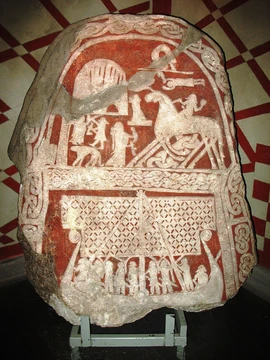
Tyr
Germanic god who lost his hand to Fenrir.

Týr is a god in Germanic mythology and a member of the Æsir. In Norse mythology, which provides most surviving narratives about the Germanic gods, Týr sacrifices his right hand to the monstrous wolf Fenrir, who bites it off upon realizing the gods have bound him. Týr is foretold to be consumed by the similarly monstrous dog Garmr during Ragnarök. The interpretatio romana generally renders the god as Mars, the ancient Roman war god, and it is through this lens that most Latin references occur; for instance, a third-century Latin inscription refers to the god as "Mars of the Assembly [Thing]," reflecting a strong association with the Germanic legislative body known as the thing. Tuesday is named after Týr in English and other Germanic languages, stemming from a calque of Latin "Day of Mars." In Old Norse sources, Týr is alternately described as the son of the giant Hymir or of the god Odin. Snorri Sturluson makes reference to an unnamed consort, perhaps also reflected in the continental Germanic record as Zisa. The god's name derives from the Proto-Germanic theonym *Tīwaz, meaning "God," and is cognate with Old English Tīw and Old High German Ziu. The name may have originally been an epithet that replaced a lost original name. Týr is the namesake of the Tiwaz rune, a letter of the runic alphabet corresponding to Latin T, which often appears as a magical symbol on inscriptions. Place names in Scandinavia refer to the god, such as Tissø in Denmark, meaning "Týr's meadow," and Tiveden in Sweden, possibly meaning "Týr's forest," though this etymology is debated. Due to the etymology of his name and his shadowy presence in the extant corpus, some scholars propose Týr may once have held a much more central place among early Germanic deities.
- Mythology
- Germanic
- Pantheon
- Æsir
- Known for
- Sacrificing his right hand to Fenrir; association with the thing (assembly) and war
- Roman equivalent
- Mars
- Old English name
- Tīw
- Old High German name
- Ziu
- Rune
- Tiwaz (ᛏ)
Lore & Background
In Norse mythology, Týr sacrifices his right hand to the monstrous wolf Fenrir, who bites it off when he realizes the gods have bound him. Týr is foretold of being consumed by the similarly monstrous dog Garmr during the events of Ragnarök. In Old Norse sources, Týr is alternately described as the son of the jötunn Hymir (in Hymiskviða) or of the god Odin (in Skáldskaparmál). Lokasenna makes reference to an unnamed and otherwise unknown consort, perhaps also reflected in the continental Germanic record (see Zisa). The god’s name derives from Proto-Germanic *Tīwaz, meaning ‘God’, itself from a Proto-Indo-European root meaning ‘celestial, heavenly one’. This theonym is cognate with Old English Tīw and Old High German Ziu, and the deity is the namesake of the Tiwaz rune, a letter of the runic alphabet corresponding to Latin T. Early Germanic peoples identified Týr with the Roman war god Mars, as seen in Latin inscriptions referencing Mars Thingsus (‘Mars of the Assembly’), reflecting a strong association with the thing, a traditional legal assembly. This identification also produced the weekday name Tuesday, from Old English Tīwesdæg (‘day of Tīw’), a calque of Latin Martis dies. Place names in Scandinavia, such as Tissø in Denmark (meaning ‘Týr’s meadow’) and Tiveden in Sweden (possibly ‘Týr’s forest’), suggest a cult of the deity, with archaeological traces of sacrifices at some sites. Due to the etymology of the god’s name and his shadowy presence in surviving texts, some scholars propose Týr may once have held a more central place in early Germanic mythology.
Reader's Guide
Týr's significance lies in his role as a war god and his strong association with the Germanic thing, a legislative assembly. This is reflected in the 3rd-century Latin inscription Mars Thincsus ('Mars of the Assembly') found at Housesteads Roman Fort. The god's name is the source of the Tiwaz rune (ᛏ) and of Tuesday in English and other Germanic languages. Place names in Scandinavia, such as Tyrseng in Denmark and Tysnes in Norway, suggest a cult of the deity. Due to the etymology of his name and his shadowy presence in extant sources, some scholars propose that Týr may once have held a much more central place among the deities of early Germanic mythology. The Roman historian Tacitus, in his Germania, likely refers to Týr as Mars, whom the Germanic peoples appeased with animal offerings.
Did You Know?
- Týr's right hand was bitten off by the wolf Fenrir when the gods bound him.
- Tuesday is named after Týr ('Týr's day') in English and other Germanic languages.
- A 3rd-century Latin inscription at Hadrian's Wall refers to Týr as Mars Thincsus ('Mars of the Assembly').
- The Tiwaz rune (ᛏ) is named after Týr.
The Hand Given and the Wolf's Bite
Týr's most defining myth centers on the binding of Fenrir, the monstrous wolf. In the Norse narratives that survive, the Æsir devise a scheme to restrain the beast, but Týr alone is willing to place his right hand in the wolf's mouth as a pledge of good faith. The moment Fenrir realizes he has been tricked and bound, he bites off the god's hand. This act of personal sacrifice—offering his own body as a guarantee—sets Týr apart as a figure of trust and self-giving within the pantheon. His fate does not end there. The prophecies surrounding Ragnarök foretell that during the cataclysmic final battle, Týr will be devoured by Garmr, a monstrous dog of comparable ferocity to Fenrir. Thus the god who gave his hand to one wolf meets his end in the jaws of another, bookending his mythological arc with encounters against canine monstrosities.
A Name That Became a Word
The etymology of Týr's name is one of the most linguistically rich threads in Germanic mythology. The Old Norse form descends from Proto-Norse *Tīwaʀ, which in turn derives from the Proto-Germanic theonym *Tīwaz, a word that simply means "god" or "deity." This root traces further back to Proto-Indo-European *deywós, meaning "celestial one" or "heavenly one," itself built on *dyēus, the "diurnal sky" or "daylight-sky." Cognates ripple across languages: Sanskrit devá, Latin deus, Old Lithuanian deivas, and even the Finnic loanword teivas, which appears as a suffix in deities like Runkoteivas. In Old Norse poetry, the plural tívar simply means "the gods," and the singular týr functions as a generic kenning for individual deities like Odin and Thor. Scholars suggest that *Tīwaz may originally have been a title or epithet that gradually supplanted the god's true, now-lost name, making him the very embodiment of divinity in the Germanic linguistic imagination.
Mars, the Thing, and the Day We Still Name
Roman writers, encountering Germanic religious life, routinely identified Týr with their own war god Mars through the process of interpretatio romana. A third-century Latin inscription from the region names him Mars Thincsus—Mars of the Assembly—revealing a deep connection between the god and the thing, the legislative and legal gathering central to Germanic governance. This association with collective law and public assembly is so strong that it left an indelible mark on the very calendar. The English word Tuesday derives from Old English tīwesdæg, "day of Tīw," a direct calque of Latin Martis dies. Germanic languages that do not transparently preserve the theonym, such as the Old High German Dingesdag (modern German Dienstag), may instead reference the god's tie to the thing assembly. Thus, whether through the name of the god or the name of the institution he presided over, Týr's presence persists in the weekly rhythm of modern European speech.
Shadows in the Sources and Echoes in the Landscape
Despite his mythological prominence in the Fenrir episode, Týr occupies a remarkably thin space in the surviving Germanic textual record. His parentage is inconsistent: Hymiskviða names the jötunn Hymir as his father, while Skáldskaparmál assigns him to Odin. Lokasenna gestures toward an unnamed consort, a figure some scholars tentatively link to the continental Germanic record through the name Zisa. Beyond the texts, physical and toponymic evidence paints a fuller picture. The Tiwaz rune, representing the /t/ sound, bears his name and appears as a magical symbol on inscriptions, including the eighth-century Ribe skull fragment. Place names like Tyrseng in Viby, Jutland—Old Norse for "Týr's meadow"—sit alongside Onsholt, "Odin's Holt," suggesting shared sacred ground where sacrificial traces stretching back 2,500 years have been uncovered. The Swedish forest Tiveden may preserve the name as "Tyr's forest" or, more broadly, "the forest of the gods." Scholars, noting the god's shadowy yet widespread footprint, have proposed that *Tīwaz once occupied a far more central position in early Germanic worship than the fragmentary sources allow us to see.
Common Misconceptions (Editorial)
Some believe Týr is solely a god of war, but the facts show he is also associated with the thing (assembly) and law, as reflected in his Roman equivalence to Mars Thincsus ("Mars of the Assembly"). Others assume Tuesday is named after the Norse Odin, but it is actually named after Týr ("Týr's day") in English and other Germanic languages. It is also a misconception that Týr’s father is always Odin; in the Hymiskviða, he is described as the son of the jötunn Hymir.
Why It Matters (Editorial)
Týr endures as a symbol of sacrifice and integrity—a god who willingly gives his hand to bind a monster for the greater good, knowing it will cost him. His name lives on every Tuesday and in the Tiwaz rune, reminding us that even the most ancient myths shape the words and names we use daily.
More in Norse Myths 1-22
Spotted an error? Know more?
This is a living reference — every entry is fact-audited, and reader corrections feed straight into our audit queue. Suggest an edit · See this site's audit record