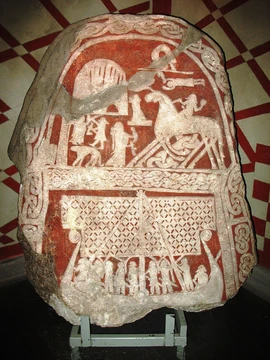
The Norns
Norse deities who weave the threads of fate.

In Norse mythology, the Norns are deities who determine the course of human lives. They are most often depicted as three figures: Urðr, Verðandi, and Skuld. These three are said to spin the threads of fate and also care for the world tree Yggdrasil, keeping it alive at the center of the cosmos.
The word "norn" has an uncertain origin. It might come from a term meaning "to twine," a reference to how they twist the thread of fate. Another possibility, suggested by scholar Bek-Pedersen, links it to a Swedish dialect verb *norna* (or *nyrna*), which means "to communicate secretly." This fits the view of the Norns as obscure, background figures who only reveal a person's fate as it actually happens.
The name Urðr (related to the Old English word *wyrd*, meaning "fate") itself means "fate." Both Urðr and Verðandi come from the Old Norse verb *verða*, "to become," which traces back to a Proto-Indo-European root meaning "to turn." It is often said that Urðr refers to the past ("that which became or happened"), Verðandi to the present ("that which is happening"), and Skuld (from the verb *skulu*, meaning "need/ought to be/shall be") to the future ("that which should become"). However, some scholars argue these names do not strictly denote time periods in Old Norse but rather express past, present, and future in terms of fate itself.
In Old Norse poetry, the line between Norns and other female supernatural beings—such as fylgjas, hamingjas, valkyries, and the general term *dísir*—is blurry. Poets also used these terms for mortal women. Snorri Sturluson’s *Skáldskaparmál* notes that a woman could be metaphorically called by the names of the Asynjur, Valkyrs, Norns, or other supernatural women.
The main surviving sources about the Norns are the *Prose Edda* and the *Poetic Edda*. The *Poetic Edda* contains older pagan poetry that frequently mentions them, while the *Prose Edda* includes similar poetry along with retellings and commentary by the 12th- and 13th-century Icelandic scholar Snorri Sturluson.
In skaldic poetry, a reference appears in Hvini’s poem *Ynglingatal* (stanza 24, found in *Ynglingasaga* 47), where King Halfdan is laid to rest. The phrase "norna dómr" ("judgment of the nornir") is used. Usually, when the Norns pass judgment, it means death for the one judged—here, Halfdan. Bek-Pedersen notes this phrase also gives the Norns a quasi-legal quality, a theme common in skaldic and eddic sources. The phrase can serve as a threat, since death is the final, unavoidable decision the Norns can make about a human life.
The *Poetic Edda* is valuable for preserving older material that Snorri used. Like *Gylfaginning*, it mentions many lesser Norns alongside the three main ones. It also agrees that these Norns came from several races, with the dwarven Norns being daughters of Dvalin. The three main Norns are suggested to be giantesses (female Jotuns).
In *Fáfnismál*, the hero Sigurd asks the dying dragon Fafnir about the Norns. Fafnir replies that they are many and come from several races. *Völuspá* and *Vafþrúðnismál* indicate the three main Norns were originally giants (Jotuns), not goddesses. Their arrival ended the gods’ early days of bliss, but they came for the good of humankind. *Völuspá* says three giants of great might came to the gods from Jotunheim. *Vafþrúðnismál* likely refers to the Norns when it speaks of maiden giants who arrive to protect people as protective spirits (hamingjas).
In *Helgakviða Hundingsbana I*, the Norns visit a newborn child to assign its future. When the hero Helgi Hundingsbane is born, Norns arrive at the homestead. In *Helgakviða Hundingsbana II*, Helgi blames the Norns for forcing him to kill Sigrún’s father and brother in order to marry her.
As Snorri wrote in *Gylfaginning*, a person’s fate depended on the Norns’ goodwill or ill will. In *Reginsmál*, the dwarf Andvari blames his misfortune on an evil Norn, likely one of Dvalin’s daughters. In *Sigurðarkviða hin skamma*, the valkyrie Brynhild blames malevolent Norns for her longing for Sigurd. In *Guðrúnarkviða II*, the Norns actively enter events by informing Atli in a dream that his wife would kill him.
- Known for
- Shaping human destinies and weaving fate
- Primary names
- Urðr, Verðandi, Skuld
- Domain
- Fate, destiny, the world tree Yggdrasil
- Associated with
- Past, present, and future (disputed)
- Races
- Æsir, elves, dwarves (including Dvalinn's daughters), and giantesses
Lore & Background
Beyond the three main norns, many lesser norns exist of various races: some are of the race of the gods (Æsir), some of the Elf-people, and some are daughters of the dwarf Dvalin. The Poetic Edda suggests the three main norns were originally giantesses (female Jotuns) whose arrival ended the early bliss of the gods but came for the good of humankind. In skaldic poetry, the phrase 'norna dómr' (judgment of the nornir) often signals death, bringing a quasi-legal aspect to their nature. The norns are frequently blamed for misfortune in eddic poems, as when the hero Helgi Hundingsbane blames them for forcing him to kill his beloved's kin, or when Brynhild attributes her yearning for Sigurd to malevolent norns.
Reader's Guide
The Norns hold a central place in Norse cosmology as arbiters of fate, their influence extending over gods and humans alike. Their primary significance lies in their role as weavers of destiny, a concept deeply embedded in Old Norse literature and worldview. The three main norns—Urðr, Verðandi, and Skuld—are often interpreted as representing past, present, and future, though this temporal reading is debated; the names may instead emphasize fate's unfolding. Their daily care of Yggdrasil underscores their cosmic importance, linking fate to the health of the world tree. The Norns also blur boundaries with other female supernatural beings such as valkyries, fylgjas, and dísir, as noted by Snorri Sturluson. Their legacy persists in modern culture through the concept of 'weird' (from Old English Wyrd) and in literary and artistic depictions of fate-weaving figures. The uncertainty surrounding their etymology and the disputed nature of their temporal associations reflect the complexity of interpreting pre-Christian Germanic beliefs.
Did You Know?
- The name Urðr is etymologically cognate with Old English Wyrd, meaning 'fate'.
- The three main norns are sometimes considered giantesses (female Jotuns) rather than goddesses.
- In skaldic poetry, the phrase 'norna dómr' (judgment of the nornir) often signifies death.
- The norns water Yggdrasil daily with water from the Well of Urðr to keep it from withering.
Common Misconceptions (Editorial)
- Some assume the three main Norns are purely goddesses, but the facts record they are sometimes considered giantesses (female Jotuns) rather than goddesses. - People often think the name "Norn" has a clear, single origin, but the facts show it may derive either from a word meaning "to twine" or from a Swedish dialect verb meaning "communicate secretly," with no definitive origin.
Why It Matters (Editorial)
The Norns endure because they embody a universal human concern: the balance between destiny and free will. By weaving fate yet also tending Yggdrasil, they remind us that even forces that shape our lives must also sustain the world that contains them.
Spotted an error? Know more?
This is a living reference — every entry is fact-audited, and reader corrections feed straight into our audit queue. Suggest an edit · See this site's audit record