Týr
Germanic god of war, assembly, and sky.
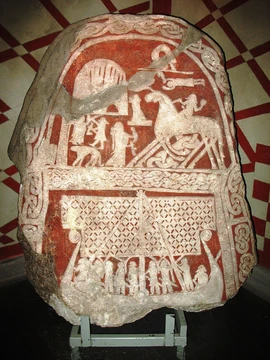
Týr is a god in Germanic mythology and one of the Æsir. In the Norse stories, he loses his right hand to the wolf Fenrir, who bites it off after realizing the gods had tricked and bound him. During Ragnarök, Týr is destined to be killed and eaten by the dog Garmr. Latin sources typically equate Týr with Mars, the Roman war god, and most references to him in Latin follow that identification.
- Known for
- Sacrificing his right hand to the wolf Fenrir; association with the thing (assembly); namesake of Tuesday and the Tiwaz rune
Lore & Background
In Old Norse sources, Týr is alternately described as the son of the jötunn Hymir (in Hymiskviða) or of the god Odin (in Skáldskaparmál). Lokasenna makes reference to an unnamed and otherwise unknown consort, perhaps also reflected in the continental Germanic record (see Zisa). Due to the etymology of the god's name and the shadowy presence of the god in the extant Germanic corpus, some scholars propose that Týr may have once held a much more central place among the deities of early Germanic mythology.
The god is the namesake of the rune ᛏ representing /t/ (the Tiwaz rune) in the runic alphabets. On runic inscriptions, ᛏ often appears as a magical symbol. The name first occurs in the historical record as tyz, a character in the Gothic alphabet (4th century), and it was also known as tī or tir in Old English, and týr in Old Norse. The name of Týr may also occur in runes as ᛏᛁᚢᛦ on the 8th century Ribe skull fragment.
A variety of place names in Scandinavia refer to the god. For example, Tyrseng, in Viby, Jutland, Denmark (Old Norse *Týs eng, 'Týr's meadow') was once a stretch of meadow near a stream called Dødeå ('stream of the dead' or 'dead stream'). Viby also contained another theonym, Onsholt ("Odin's Holt"), and religious practices associated with Odin and Týr may have occurred in these places. The forest Tiveden, between Närke and Västergötland, in Sweden, may mean 'Tyr's forest', but its etymology is uncertain and debated.
Reader's Guide
Týr's significance extends across Germanic religion, language, and culture. The modern English weekday name Tuesday comes from the Old English tīwesdæg, meaning 'day of Tīw', a calque of Latin Martis dies ('Day of Mars'), attesting to an early Germanic identification of *Tīwaz with Mars. Germanic weekday names for Tuesday that do not transparently extend from that lineage may also ultimately refer to the deity, including Middle Dutch Dinxendach and Dingsdag, and Old High German Dingesdag (modern Dienstag), which may refer to the god's association with the thing (*þingsaz), a traditional legal assembly. A votive altar from the 3rd century CE at Housesteads Roman Fort bears the Latin inscription Deo Marti Thincso, where the epithet Thingsus is a Latin rendering of Proto-Germanic *Þingsaz, generally interpreted to refer to Týr. The Proto-Germanic masculine noun *tīwaz means 'a god, a deity', and probably also served as a title or epithet that came to be associated with a specific deity whose original name is now lost. Due to linguistic evidence and early native comparisons between *Tīwaz and Mars, a number of scholars have interpreted *Tīwaz as a Proto-Germanic sky-, war- and thing-god, though others reject his identification as a 'sky-god'.
Did You Know?
- Týr sacrifices his right hand to the wolf Fenrir, who bites it off when he realizes the gods have bound him.
- Tuesday is named after Týr ('Týr's day') in English and other Germanic languages.
- The Tiwaz rune (ᛏ) is named after Týr and corresponds to the Latin letter T.
- A 3rd-century Latin inscription at Hadrian's Wall refers to Týr as Mars Thincsus ('Mars of the Assembly').
Spotted an error? Know more?
Reader corrections go straight into our review queue. Suggest an edit · How this site is sourced