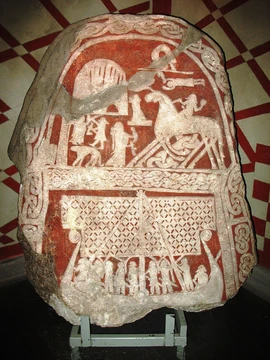
Óðr
God of desire, passion and inspiration, husband of Freyja.
Óðr (Old Norse for 'mind', 'wit', 'soul', 'sense' or 'the frenzied one') is a god in Norse mythology associated with desire, passion and inspiration. He is described in the Prose Edda and Heimskringla as the husband of the goddess Freyja, father of Hnoss and Gersemi, and one of the Vanir. His name is etymologically related to that of Odin, and many scholars consider him a hypostasis of Odin, though the sparse sources leave his nature open to debate.
- Mythology
- Norse
- Associated with
- desire, passion, inspiration
- Spouse
- Freyja
- Children
- Hnoss, Gersemi
- Tribe
- Vanir
Lore & Background
Óðr is attested in the Poetic Edda, where stanza 25 of Völuspá refers to Freyja as 'Óð's girl', indicating a relationship. In Hyndluljóð, a figure named Œdi is mentioned in a taunt by Hyndla to Freyja, but scholars disagree whether this is Óðr or another lover. The Prose Edda's Gylfaginning states that Freyja was married to Óðr, that they had a daughter Hnoss (whose name became a term for treasures), and that Óðr would go on long journeys, causing Freyja to weep tears of red gold and travel among strange peoples searching for him. Skáldskaparmál lists poetic names for Freyja including 'wife of Óðr' and quotes a skald calling her 'Óðr's bedfellow'. Heimskringla's euhemerized account similarly names Óðr as Freyja's husband and father of Hnoss and Gersemi.
Reader's Guide
Óðr's significance lies in his ambiguous relationship with Odin. The names are linguistically parallel to the doublet Ullr–Ullinn, with Óðr (*wōđaz) possibly the elder form from which Óðinn (*wōđa-naz) derived. Both gods are described as undertaking long journeys, yet Snorri Sturluson carefully distinguishes them in his writings. Theories about Óðr range from identifying him as a hypostasis of Odin to seeing reflections of figures like Adonis, Attis, or the Amor and Psyche folktale. The fact that Óðr appears in 11th-century skaldic poetry and in the Poetic Edda indicates he is not a late invention. However, the limited accounts make all theories speculative. Some scholars propose that Óðr and Odin were originally the same figure, with Óðr representing an older layer of the deity, while others note that Freyja's tears for Odin would be unmotivated and that Hnoss as their only child is surprising given Odin's other offspring. The figure of Wod in Swiss folklore suggests a separate tradition of a god by a similar name.
Did You Know?
- Óðr's name derives from Proto-Germanic *wōđaz, meaning 'possessed, inspired, delirious, raging'.
- The name Óðr is etymologically related to the Latin vātēs ('prophet, seer'), likely a Celtic loanword.
- Freyja's tears for the absent Óðr were said to be of red gold.
- Óðr and Odin share a linguistic relationship identical to that of Ullr and Ullinn, often considered variant names of a single god.
Spotted an error? Know more?
Reader corrections go straight into our review queue. Suggest an edit · How this site is sourced