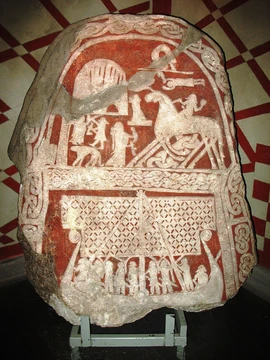
Mjolnir
Hammer of Thor, weapon and blessing instrument in Norse myth.

Mjölnir (pronounced MYOL-neer in the UK, MYAWL-neer in the US; from Old Norse *Mjǫllnir*, pronounced [ˈmjɔlːnir]) is the hammer belonging to Thor, the thunder god of Norse mythology. It served both as a fearsome weapon and as a sacred tool for bestowing blessings. Evidence of the hammer appears in several historical sources, such as the 11th-century runic Kvinneby amulet from Sweden, the Poetic Edda (a 13th-century compilation of eddic poetry), and the Prose Edda (a 13th-century collection of prose and verse).
The origin of the name *Mjǫllnir* is debated among linguists. It evolved from the Proto-Norse word *melluniaR*. One theory links this to Old Church Slavonic *mlunuji* and Russian *molnija*, meaning "lightning," suggesting the hammer's name means "lightning-maker." Another proposal connects *Mjǫllnir* to Old Norse *mjǫll* ("new snow") and modern Icelandic *mjalli* ("white"), giving the meaning "shining lightning weapon." A third theory ties it to Old Norse *mala* and Gothic *malwjan*, both meaning "to grind," resulting in "the grinder."
The Kvinneby amulet, a small copper piece likely worn around the neck and found in Öland, Sweden, dates to the 11th century. It bears an Old Norse Younger futhark inscription that calls upon Thor and his hammer. Runologists Mindy MacLeod and Bernard Mees translate it as: "Here I carve for you (runes of) help, Bofi. Help me! Knowledge (?) is certain for you. And may the lightning hold all evil away from Bofi. May Thor protect him with his hammer which came from out of the sea. Flee from evil! It (?) gets nothing from Bofi. The gods are under him and over him." This inscription references stories later recorded in the Poetic Edda and Prose Edda.
In the Poetic Edda, Mjölnir appears in the poems *Vafþrúðnismál*, *Hymiskviða*, *Lokasenna*, and *Þrymskviða*. In *Vafþrúðnismál*, the wise jötunn Vafþrúðnir tells the disguised god Odin that after Ragnarök, Thor's sons Móði and Magni will wield the hammer. In *Hymiskviða*, after obtaining a huge cauldron for the jötunn Ægir, Thor fights malicious jötnar with the hammer, which the poem refers to as "whales" as a poetic device. In *Lokasenna*, the gods threaten Loki with Mjölnir in a repeated refrain across four stanzas as they trade insults.
The hammer is central to *Þrymskviða*. Thor wakes to find his hammer missing. Furious, he pulls his beard, shakes his head, and searches. He tells Loki, who alone knows the hammer is gone. They visit Freyja, and Loki borrows her feather garment to fly to Jötunheimr. There, the jötunn Þrymr admits he stole the hammer and buried it deep, demanding Freyja as his bride for its return. Loki reports this to Thor. When they ask Freyja to go to Jötunheimr, she refuses angrily, shaking the hall and breaking her necklace Brísingamen. The gods then meet in counsel. Heimdallr proposes dressing Thor as a bride, wearing Brísingamen, to pass for Freyja. Thor resists but agrees after Loki warns that the jötnar will soon take Asgard. Thor is dressed in bridal gear, Loki as his maid, and they ride Thor's goat-led wagon to Jötunheimr, splitting mountains and producing flames along the way. Þrymr sees them and prepares the hall. At the wedding feast, Þrymr is surprised by his bride's appetite—she consumes nine entrees (one ox and eight salmon) and three casks of mead. Loki explains that "Freyja" hadn't eaten or drunk for eight nights out of eagerness to come. When Þrymr lifts the veil to kiss her, he recoils from her terrifying, fiery eyes; Loki says she hasn't slept for eight nights. Finally, Þrymr calls for Mjölnir to sanctify the bride with the goddess Vár. "Freyja" sees the hammer, laughs internally, grabs it, kills Þrymr and another jötunn, and batters the wedding guests. A prose note explains this is how Thor recovered his hammer.
The Prose Edda also mentions Mjölnir throughout its text.
- Filed under
- Mythological weapon
- Cultural sphere
- Scandinavian
- First attested
- 11th century (Kvinneby amulet)
- Primary source texts
- Poetic Edda, Prose Edda (13th century)
- Associated deity
- Thor
- Etymology dispute
- Yes (lightning-maker, shining weapon, grinder)
Lore & Background
Mjölnir is the hammer of the thunder god Thor in Norse mythology, serving both as a fearsome weapon and a tool for bestowing blessings. Its name, derived from Old Norse Mjǫllnir, has disputed origins among linguists; proposed meanings include “lightning-maker,” “shining lightning weapon,” or “the grinder.” The hammer is attested in sources such as the 11th-century Kvinneby amulet from Öland, Sweden, which invokes Thor and his hammer to hold evil away, and in the 13th-century Poetic Edda and Prose Edda. In the Poetic Edda, Mjölnir appears in poems including Vafþrúðnismál, where Thor’s sons Móði and Magni will wield it after Ragnarök; Hymiskviða, where Thor battles jötnar with the hammer; Lokasenna, where gods threaten Loki with it; and Þrymskviða, where the jötunn Þrymr steals the hammer and buries it deep, demanding Freyja as his bride. Thor retrieves it by disguising himself as Freyja, and at the wedding, the hammer is brought forth to sanctify the bride. During the Viking Age, Mjölnir pendants were commonly worn in the Scandinavian cultural sphere, and the symbol appears in archaeological objects. Today, it is again worn by modern Heathens and appears widely in media.
Reader's Guide
Mjölnir is a central symbol in Norse mythology, representing both destructive power and divine blessing. The Kvinneby amulet from 11th-century Sweden invokes Thor and his hammer for protection, referencing narratives later recorded in the Poetic Edda and Prose Edda. The hammer was commonly worn as a pendant during the Viking Age in the Scandinavian cultural sphere, and its image appears on various archaeological objects. Today the symbol appears in a wide variety of media and is again worn as a pendant by various groups, including adherents of modern Heathenry. The hammer's name is attested in Prose Edda accounts, where Thor uses it to bless goats, guard entrances, and strike jötnar. Its legacy endures as an identifiable emblem of Norse mythology and contemporary neopagan practice, though its exact etymology remains disputed among linguists.
Did You Know?
- The etymology of Mjölnir is disputed, with proposed meanings including 'lightning-maker', 'shining lightning weapon', and 'the grinder'.
- A copper amulet from 11th-century Öland, Sweden invokes Thor and his hammer for protection.
- In the poem Þrymskviða, Thor retrieves Mjölnir by disguising himself as the goddess Freyja.
- The Prose Edda describes Thor's three special possessions as Mjölnir, iron gloves Járngreipr, and belt Megingjörð.
Common Misconceptions (Editorial)
- A common misconception is that Mjölnir is only a weapon of destruction. In fact, it is also used as a divine instrument to provide blessings, according to the attested sources. - Some may believe the hammer was always in Thor’s possession, but in the poem Þrymskviða, Mjölnir is stolen by the jötunn Þrymr, and Thor must retrieve it by disguising himself as Freyja.
Why It Matters (Editorial)
Mjölnir endures because it represents the blend of raw power and protective sanctity, embodying both the destructive and generative forces of the thunder god. Its continued presence in modern culture, from archaeology to entertainment, reflects a lasting human fascination with mythological symbols that bridge chaos and order.
Spotted an error? Know more?
This is a living reference — every entry is fact-audited, and reader corrections feed straight into our audit queue. Suggest an edit · See this site's audit record