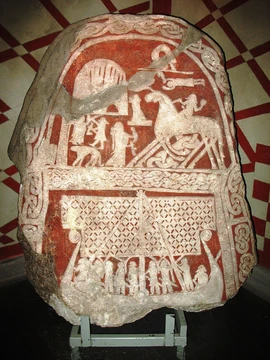
Midgard
The middle enclosure inhabited by humans in Germanic cosmology.

Midgard is the name for Earth in early Germanic cosmology, a term equivalent in meaning to the Greek *oikouménē*, or "the inhabited world." The word appears across Germanic languages: in Old Norse as *Miðgarðr*, in Old English as *middangeard*, in Old Saxon as *middilgard*, in Old High German as *mittilagart*, and in Gothic as *midjun-gards*. All derive from a Common Germanic compound meaning "middle yard" or "middle enclosure." In early Germanic thought, it stands alongside the term *world* (from a compound meaning "man-age"), which also refers to the realm of humankind.
In Norse mythology, *Miðgarðr* was specifically applied to the wall the gods built around the world from the eyebrows of the primordial giant Ymir, as a defense against the giants of Jotunheim. The gods slew Ymir and placed his body into the central void of the universe, creating the world from his flesh (land), blood (oceans), bones (mountains), teeth (cliffs), hair (trees), and brains (clouds). His skull was held aloft by four dwarfs—Nordri, Sudri, Austri, and Vestri—representing the four cardinal points, forming the dome of heaven. The sun, moon, and stars were said to be sparks scattered in the skull.
According to the Eddas, Midgard will be destroyed at Ragnarök. The serpent Jörmungandr will rise from the ocean, poisoning land and sea with its venom and causing the sea to lash against the land. The final battle will occur on the plain of Vígríðr, after which Midgard and nearly all life will be destroyed, the earth sinking into the sea only to rise again, fertile and green, as the cycle repeats.
Though most surviving references to Midgard are spiritual, it also appears in mundane contexts, such as the Viking Age runestone poem from the Fyrby Runestone in Sweden, which reads *á Miðgarði* ("in Midgard"). The Old English form *middangeard* appears six times in the epic *Beowulf* and was transformed into *middellærd* or *middelerde* in Middle English by popular association with the word *earth*. The modern English cognate of *geard* is *yard*. The Old High German *Muspilli* mentions *mittilagart* as the world opposed to sea and heavens, and the Old Saxon *Heliand* uses *middilgard* to refer to the middle earth where all people dwell.
- field
- Germanic cosmology
- known_for
- The inhabited world of humans in Norse mythology
- associated_mythology
- Norse
- linguistic_forms
- Old Norse Miðgarðr, Old English Middangeard, Old Saxon Middilgard, Old High German Mittilagart, Gothic Midjungards
Lore & Background
In Germanic cosmology, Midgard, meaning "middle yard" or "middle enclosure," is the name for the Earth inhabited by and known to humans. The Old Norse form, Miðgarðr, plays a notable role in Norse mythology. According to the Eddas, the gods constructed a wall around the world from the eyebrows of the jötunn Ymir as a defense against the jötnar living in Jotunheim. After slaying Ymir, the gods created the world from his body: his flesh became the land, his blood the oceans, his bones the mountains, his teeth the cliffs, his hairs the trees, and his brains the clouds. Ymir’s skull was held by four dwarfs—Nordri, Sudri, Austri, and Vestri—representing the four compass points, forming the dome of heaven, with the sun, moon, and stars as scattered sparks. At Ragnarök, the world serpent Jörmungandr will arise from the ocean, poisoning the land and sea, causing the sea to lash against the land. The final battle on the plain of Vígríðr will destroy Midgard and almost all life, with the earth sinking into the sea only to rise again, fertile and green. The term also appears in mundane contexts, such as on the Fyrby Runestone in Sweden, which bears the runes meaning "in Midgard." Cognates include Old English middangeard, Old Saxon middilgard, and Old High German mittilagart, all stemming from a Common Germanic compound of "middle" and "yard." The English term "Middle-earth" derives from this tradition.
Reader's Guide
Midgard is central to Norse cosmology as the realm of humans, situated between the gods and the giants. According to the Eddas, it will be destroyed at Ragnarök when Jörmungandr (the Midgard Serpent) arises from the ocean, poisoning land and sea. After the final battle on the plain of Vígríðr, Midgard sinks into the sea only to rise again, fertile and green, as the cycle repeats. The term also appears in Old English poetry, such as Beowulf, and in Middle English as middellærd or middelerde, later popularized by J. R. R. Tolkien as "Middle-earth" in his fantasy works, inspired by references to middangeard in the Old English poem Crist A.
Did You Know?
- The Old Norse name Miðgarðr is cognate with Gothic Midjungards, Old Saxon Middilgard, Old High German Mittilagart, and Old English Middangeard.
- In Norse myth, Midgard was created from the body of the jötunn Ymir, with his skull held by four dwarfs representing the compass points.
- Midgard will be destroyed at Ragnarök when the Midgard Serpent Jörmungandr arises, and later rises again fertile and green.
- The term 'Middle-earth' was popularized by J. R. R. Tolkien, inspired by the Old English word middangeard.
Common Misconceptions (Editorial)
A common misconception is that Midgard refers to the entire planet Earth in the modern sense. In fact, the term is specifically the *inhabited* world of humans, equivalent to the Greek *oikouménē*, and in Norse cosmology it was originally a wall built from Ymir’s eyebrows, not the entire globe. Another misconception is that “Middle-earth” was invented by J. R. R. Tolkien; while he popularized the term, it was actually inspired by the Old English word *middangeard*, a direct linguistic form of Midgard.
Why It Matters (Editorial)
Midgard endures because it represents a foundational human idea: that our world is a defended, meaningful space carved from chaos. Its creation from the body of a giant and its eventual rebirth after Ragnarök remind us that ancient peoples saw the cosmos as both violent and cyclical—themes that still resonate in modern fantasy and in our attempts to understand humanity’s place in a vast universe.
Spotted an error? Know more?
This is a living reference — every entry is fact-audited, and reader corrections feed straight into our audit queue. Suggest an edit · See this site's audit record