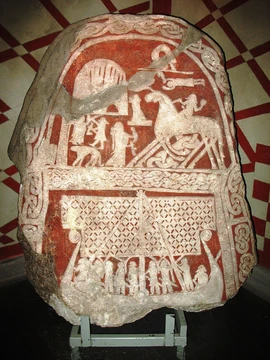
Höðr
Blind Norse god who slew Baldr with Loki's trickery.
Höðr is a god in Norse mythology, the blind son of Odin. He is best known for his role in the death of Baldr, the otherwise invulnerable god, whom he killed with a mistletoe arrow shot with the guidance of Loki.
- Field
- Norse mythology
- Known for
- Killing Baldr with a mistletoe arrow
Lore & Background
Höðr is introduced in the Prose Edda as a blind god. According to the Prose Edda and Poetic Edda, the goddess Frigg made everything in existence swear never to harm Baldr, except for the mistletoe, which she considered too unimportant. The gods amused themselves by throwing weapons at Baldr, which always failed to harm him. Loki, discovering Baldr's sole weakness, fashioned a dart from mistletoe and guided Höðr's hand to shoot it at Baldr, killing him. In response, Odin fathered Váli by Rindr, who grew to adulthood within a day and slew Höðr.
The Danish historian Saxo Grammaticus recorded an alternative version in which Hotherus is a mortal hero competing with the demigod Balderus for the hand of Nanna. In this account, Hotherus slays Balderus in battle after obtaining a special sword from the satyr Mimingus. Later, Bous, son of Othinus and Rinda, avenges his brother by killing Hotherus, though Bous also dies from his wounds.
Reader's Guide
Höðr's significance lies in his central role in the myth of Baldr's death, a pivotal event in Norse cosmology that foreshadows Ragnarök. The story illustrates themes of deception, fate, and the limits of divine protection. Höðr is portrayed as a passive instrument of Loki's malice, yet his actions set in motion a chain of vengeance and cosmic renewal. The alternative version in Saxo's Gesta Danorum presents a more active, heroic figure, suggesting that the myth may have had multiple interpretations. Höðr's name, meaning 'warrior' or 'battle', appears in skaldic poetry as a kenning for warriors, which some scholars find incongruous with his depiction as a blind god unable to harm without help. This may indicate lost myths where Höðr played a more vigorous role. After Ragnarök, according to Völuspá, Baldr and Höðr are reconciled and inhabit the renewed world, symbolizing the possibility of redemption and harmony after destruction.
Did You Know?
- Höðr's name is related to Old Norse hǫð ('war, slaughter') and Proto-Germanic *haþuz ('battle').
- In the Prose Edda, Höðr is not mentioned again after Baldr's death, but he appears in the description of the post-Ragnarök world.
- Saxo Grammaticus's version makes Hotherus a human hero who slays Balderus with a sword obtained from the satyr Mimingus.
- In the Poetic Edda, Váli is emphasized as Baldr's avenger, slaying Höðr.
Spotted an error? Know more?
Reader corrections go straight into our review queue. Suggest an edit · How this site is sourced