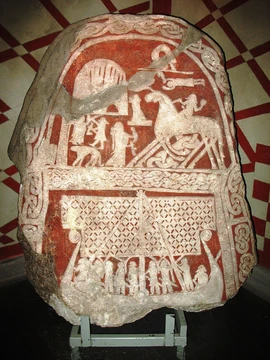
Freyr
Norse god of peace, fertility, and good harvest.
Freyr (Old Norse for “Lord” or “Master”) is a Norse god linked to kingship, peace, fertility, prosperity, fair weather, and good harvests. Also called Yngvi-Freyr, he was particularly tied to Sweden and considered an ancestor of the Swedish royal line. According to Adam of Bremen, Freyr was connected with peace and pleasure and was depicted with a phallic statue at the Temple at Uppsala. Snorri Sturluson described him as “the most renowned of the Æsir” and said he was honored for good harvests and peace.
In the myths found in the Poetic Edda and Prose Edda, Freyr belongs to the Vanir. He is the son of the god Njörðr and Njörðr’s unnamed twin sister, and the twin brother of the goddess Freyja. As a teething gift, the gods gave him Álfheimr, the realm of the elves. He rides the dwarf-made boar Gullinbursti, which shines, and owns the ship Skíðblaðnir, which always has a favorable wind and can be folded up and carried in a pouch when not in use. Freyr was also associated with a horse cult and kept sacred horses at his sanctuary in Trondheim, Norway. He had three servants: Skírnir, Byggvir, and Beyla.
The most detailed surviving myth about Freyr tells of him falling in love with the female jötunn Gerðr. She eventually becomes his wife, but first he must give away his sword, which fights on its own “if wise be he who wields it.” Without that sword, Freyr still defeats the jötunn Beli using an antler. However, because he lacks his sword, he will be killed by the fire jötunn Surtr during Ragnarök.
Like other Germanic deities, worship of Freyr was revived in modern times through the Heathenry movement.
The Old Norse name *Freyr* (“lord”) likely comes from a Proto-Norse form *frawjaʀ, from the Proto-Germanic noun *frawjaz ~ *fraw(j)ōn (“lord”). It is related to Gothic *frauja*, Old English *frēa*, and Old High German *frō*, all meaning “lord” or “master.” The runic form *frohila*, from earlier *frōjila*, may also be connected. Another proposed etymology derives the name from a nominalized form of the Proto-Scandinavian adjective *fraiw(i)a- (“fruitful, generative”). Linguist Guus Kroonen notes that Old Norse words like *frjar*, *frjór*, and *frær* (meaning “fertile” or “prolific”) come from a stem *frai(w)- meaning “fecund,” and suggests that *fraiwa- (“seed”) may have been metathesized from *frawja-, a collective form.
- Also known as
- Yngvi-Freyr
- Associated with
- kingship, peace, fertility, prosperity, fair weather, good harvest
- Family
- son of Njörðr and his unnamed twin sister; twin brother of Freyja
- Realm
- Álfheimr (given as a teething present)
- Mythological artifacts
- boar Gullinbursti, ship Skíðblaðnir
- Servants
- Skírnir, Byggvir, Beyla
Lore & Background
Freyr is the son of the god Njörðr and his unnamed twin sister, and the twin brother of the goddess Freyja. The gods gave him Álfheimr, the realm of the Elves, as a teething present. He rides the shining dwarf-made boar Gullinbursti and possesses the ship Skíðblaðnir, which always has a favorable breeze and can be folded together and carried in a pouch when not in use. Freyr is also associated with the horse cult and kept sacred horses in his sanctuary at Trondheim in Norway. He has three servants: Skírnir, Byggvir, and Beyla.
The most extensive surviving myth about Freyr relates his falling in love with the female jötunn Gerðr. Eventually she becomes his wife, but first Freyr must give away his sword, which fights on its own 'if wise be he who wields it.' Although deprived of this weapon, Freyr defeats the jötunn Beli with an antler. However, lacking his sword, Freyr will be killed by the fire jötunn Surtr during the events of Ragnarök.
According to Adam of Bremen, Freyr was associated with peace and pleasure and was represented with a phallic statue in the Temple at Uppsala. Snorri Sturluson wrote that Freyr was 'the most renowned of the Æsir' and was venerated for good harvest and peace. The name Freyr is thought to descend from a Proto-Norse form reconstructed as *frawjaʀ, stemming from the Proto-Germanic noun *frawjaz ~ *fraw(j)ōn ('lord'), cognate with Gothic frauja, Old English frēa, or Old High German frō, all meaning 'lord, master.'
Reader's Guide
Freyr holds a central place in Norse mythology as a god of peace, fertility, and prosperity, particularly venerated in Sweden where he was considered an ancestor of the royal house. His attributes—the boar Gullinbursti, the ship Skíðblaðnir, and his association with good weather and harvests—underscore his role as a bringer of abundance and favorable conditions. The myth of his marriage to Gerðr, for which he gave away his self-fighting sword, is the most extensive surviving story about him and carries tragic consequences: at Ragnarök, lacking that sword, he is fated to be killed by the fire jötunn Surtr.
Descriptions of Freyr from Adam of Bremen (c. 1080) and Snorri Sturluson (13th century) show both similarities and differences. Adam assigns control of weather and produce to Thor, while Snorri gives those domains to Freyr; Adam also includes explicitly sexual references that Snorri omits. These discrepancies may reflect different goals of the authors, regional variations in pagan practice, or distorted information. Freyr's veneration was revived in the modern period through the Heathenry movement, and his name—meaning 'lord'—connects him to a broader Germanic linguistic tradition. His legacy endures as a symbol of peace, fertility, and the complex interplay between love, sacrifice, and fate in Norse mythology.
Did You Know?
- He rides the dwarf-made boar Gullinbursti, whose mane glows to illuminate the way.
- Freyr gave away his self-fighting sword to win the giantess Gerðr as his wife.
- At Ragnarök, lacking his sword, Freyr is killed by the fire jötunn Surtr.
Spotted an error? Know more?
Reader corrections go straight into our review queue. Suggest an edit · How this site is sourced