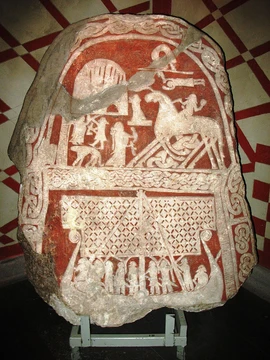
Hel
Norse being who rules the underworld realm of the same name.
Last updated
Her name derives from the Proto-Germanic feminine noun *haljō- meaning 'concealed place, the underworld'.[1] The Old Norse word Hel is also etymologically related to the English word "hall" and to Valhöll 'Valhalla'.[2] In Norse mythology, the entity Hel shares her name with the domain she governs.[1]
Quick Facts
- Mythology
- Norse
- Attested in
- Poetic Edda
- Prose Edda
- Heimskringla
- Egils saga
- Gesta Danorum
- Known for
- Ruler of the underworld realm Hel, daughter of Loki
- Appearance
- Half blue and half flesh-coloured, gloomy and downcast
- Realm
- Niflheim, with vast mansions and servants
Facts from the source article.
Key facts and history
Hel's realm is described as having great mansions with extremely high walls, a hall called Éljúðnir, a dish called "Hunger", and a knife called "Famine"[3] In the Heimskringla, Hel is referred to as "howes'-warder" (guardian of the graves) and as taking King Halfdan Hvitbeinn from life.[4] In January 2017, the Icelandic Naming Committee ruled that parents could not name their child Hel because the name would cause the child significant distress.[5] In the Poetic Edda poem Völuspá, Hel's domain is called the "Halls of Hel"; Grímnismál stanza 31 places Hel beneath one of three roots of Yggdrasil.[6]
Jacob Grimm characterized Hel as a "half-goddess" and contended that in Germanic mythology, "half-goddesses" rank above "half-gods".[7]
What the cited sources add
The Old English Gospel of Nicodemus contains a female figure called Seo hell who engages in flyting with Satan.[8] Michael Bell states that Seo hell's personification invites comparison with the Norse underworld goddess Hel and Frau Holle of German folklore.[8] The Old Norse Bartholomeus saga postola mentions a "Queen Hel" whom a devil refers to as the one Jesus "made war on"[9] Michael Bell says that in Bartholomeus saga postola, Hel "is clearly the queen of the Christian, not pagan, underworld"[10]
Hilda Ellis Davidson argued that the description of Hel as a goddess in surviving sources appeared to be literary personification, as the word hel was "used simply to signify death or the grave"[11] John Lindow stated that most details about Hel as a figure are not found outside of Snorri's writing in Gylfaginning.[12]
References
- Wikipedia, "Hel (mythological being)" (CC BY-SA 4.0), which cites: Orel 2003, p. 156, 168; Kroonen 2013, p. ; Kroonen 2013, p. ; Kroonen 2013, p. (original not read by us) en.wikipedia.org
- Wikipedia, "Hel (mythological being)" (CC BY-SA 4.0), which cites: This is highlighted in Watkins (2000:38). (original not read by us) en.wikipedia.org
- Wikipedia, "Hel (mythological being)" (CC BY-SA 4.0), which cites: Orchard (1997:79).; Orchard (1997:79). (original not read by us) en.wikipedia.org
- Wikipedia, "Hel (mythological being)" (CC BY-SA 4.0), which cites: Hollander (2007:46). (original not read by us) en.wikipedia.org
- Wikipedia, "Hel (mythological being)" (CC BY-SA 4.0), which cites: "Not allowed to name after Nordic goddess Hel", Iceland Monitor, 9 January 2017; "Mál nr. 98/2016 Úrskurður 6. janúar 2017" , Mannanafnanefnd, 6 January 2017 (original not read by us) en.wikipedia.org
- Wikipedia, "Hel (mythological being)" (CC BY-SA 4.0), which cites: Larrington (1999:9).; Larrington (1999:56).; Larrington (1999:61).; Larrington (1999:225 and 232).; Larrington (1999:243). (original not read by us) en.wikipedia.org
- Wikipedia, "Hel (mythological being)" (CC BY-SA 4.0), which cites: Grimm (1882:397). (original not read by us) en.wikipedia.org
- Wikipedia, "Hel (mythological being)" (CC BY-SA 4.0), which cites: Bell (1983:263). (original not read by us) en.wikipedia.org
- Wikipedia, "Hel (mythological being)" (CC BY-SA 4.0), which cites: Bell (1983:263–264). (original not read by us) en.wikipedia.org
- Wikipedia, "Hel (mythological being)" (CC BY-SA 4.0), which cites: Bell (1983:265). (original not read by us) en.wikipedia.org
- Wikipedia, "Hel (mythological being)" (CC BY-SA 4.0), which cites: Ellis (1968:84). (original not read by us) en.wikipedia.org
- Wikipedia, "Hel (mythological being)" (CC BY-SA 4.0), which cites: Lindow (1997:172).; Lindow (2001:82–83). (original not read by us) en.wikipedia.org
Each numbered sentence above was checked against the source it cites before publication. Sentences citing Wikipedia adapt text from the English Wikipedia article Hel (mythological being) (contributors), used under CC BY-SA 4.0; this entry is available under the same licence. Other sources were used for facts only; no text or images are copied from them.
Sources
Compiled from Wikipedia and the sources listed below. Text from Wikipedia is available under CC BY-SA 4.0; this entry is adapted from it.
- Wikipedia: Hel (mythological being) (CC BY-SA 4.0).
Spotted an error? Know more?
Reader corrections go straight into our review queue. Suggest an edit · How this site is sourced