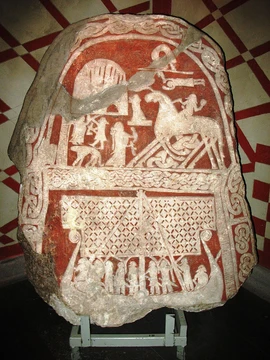
Heimdall
Watchman god who blows Gjallarhorn at Ragnarök.
Last updated
Heimdall is a Norse deity associated with light, dawn, and guarding the rainbow bridge Bifröst.[1] The god is described as "the white As," great and holy, born of nine sisters.[2]
Quick Facts
- Field
- Norse mythology
- Also known as
- Rig
- Hallinskiði
- Gullintanni
- Vindlér or Vindhlér
Facts from the source article.
Key facts and history
In the Prose Edda, Heimdall lives in Himinbjörg near Bifröst and serves as the watchman of the gods.[2] Heimdall is likely mentioned on a 10th to 12th century lead spindle-whorl from Saltfleetby, England, which records a charm asking for help from Odin, Heimdallr, and Þalfa.[3] Scholars have not reached a consensus on the origin of Heimdall's name, though one interpretation suggests it means 'the one who illuminates the world'.[4] The god owns a horn called Gjallarhorn, whose blast is audible throughout every realm.[2]
What the cited sources add
The Random House Webster's Unabridged Dictionary defines Heimdall as the Norse god of light and dawn and guardian of the rainbow bridge Bifrost.[1] The same dictionary provides usage examples from modern media, including references to Heimdall in Marvel films and news articles.[1]
References
- "Heimdall". Random House Webster's Unabridged Dictionary.. facts only, no text reused. dictionary.com
- Wikipedia, "Heimdall" (CC BY-SA 4.0), which cites: Faulkes (1995:25-26). (original not read by us) en.wikipedia.org
- Wikipedia, "Heimdall" (CC BY-SA 4.0), which cites: Hines 2017; Jesch 2020 (original not read by us) en.wikipedia.org
- Wikipedia, "Heimdall" (CC BY-SA 4.0), which cites: Simek (2007:135 and 202).; "Heimdall". Random House Webster's Unabridged Dictionary. (we also read that source) en.wikipedia.org
Each numbered sentence above was checked against the source it cites before publication. Sentences citing Wikipedia adapt text from the English Wikipedia article Heimdall (contributors), used under CC BY-SA 4.0; this entry is available under the same licence. Other sources were used for facts only; no text or images are copied from them.
Sources
Compiled from Wikipedia and the sources listed below. Text from Wikipedia is available under CC BY-SA 4.0; this entry is adapted from it.
- Wikipedia: Heimdall (CC BY-SA 4.0).
Spotted an error? Know more?
Reader corrections go straight into our review queue. Suggest an edit · How this site is sourced