Hyksos
Last updated
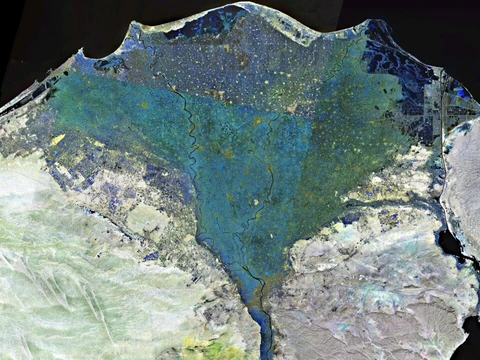
The Hyksos were the kings of the Fifteenth Dynasty of Egypt, ruling from their capital at Avaris in the Nile Delta during the mid-17th century BCE. They are notable as the first foreign rulers of Egypt, a period that marked significant cultural and technological exchange between the Levant and Egypt. Modern scholarship questions the traditional portrayal of the Hyksos as invaders, instead viewing their rise as a gradual settlement of Canaanite peoples.
History
Contacts between Semitic peoples and Egyptians occurred throughout Egypt's history. An early tablet from around 3000 BCE depicts Pharaoh Den smiting a Western Asiatic enemy. During the reign of Senusret II, tomb paintings show Western Asiatic foreigners, possibly Canaanites, labeled as Aamu, including a figure named Abisha the Hyksos—the first known instance of the name. The Sebek-khu Stele from Senusret III's reign records an Egyptian campaign in the Levant, mentioning Sekmem (likely Shechem) and Retenu.
The only ancient account of the entire Hyksos period comes from the Hellenistic historian Manetho, preserved through quotations by others. Manetho's invasion narrative is now rejected by most scholars, as archaeology shows a continuous Asiatic presence at Avaris for over 150 years before Hyksos rule, with gradual Canaanite settlement beginning around 1800 BCE. Strontium isotope analysis of inhabitants at Avaris supports a migration model rather than invasion, finding a high proportion of non-local females.
Rule and administration
Hyksos rulers adopted the full ancient Egyptian royal titulary and employed Egyptian scribes and officials, while also using Near-Eastern administrative forms such as a chancellor. The names, order, length of rule, and number of Fifteenth Dynasty rulers are not fully known. The Turin King List included six Hyksos kings, but only the name of the last, Khamudi, is preserved. Manetho also lists six names, but reconciling them with other sources is difficult due to corrupted name forms.
The name Apepi appears in multiple sources. Most scholars agree that Apepi and Khamudi were the last two kings, with Khyan, Yanassi, Apepi, and Khamudi as the likely order. Sakir-Har is proposed as the first king. Recent finds suggest Khyan may have been contemporary with Thirteenth Dynasty pharaoh Sobekhotep IV, prompting reconsideration of Hyksos chronology without consensus as of 2018.
Society and culture
The Hyksos produced little court art, instead appropriating earlier monuments by inscribing their names on them, many bearing the name of King Khyan. A large palace at Avaris was built in Levantine style, likely by Khyan. King Apepi patronized Egyptian scribal culture, commissioning the copying of the Rhind Mathematical Papyrus. The so-called 'Hyksos sphinxes' are royal sphinxes of Amenemhat III later reinscribed by Hyksos kings, initially thought to depict the Hyksos themselves.
Seven such sphinxes are known, all from Tanis. Distinct Hyksos burial practices include burying the dead within settlements, burials of young females possibly as sacrifices, and interring infants in imported Canaanite amphorae. They also practiced burial of horses and other equids, a custom combining Egyptian associations of the god Set with the donkey and Near-Eastern notions of equids as status symbols.
Potential biblical connections
Josephus associated the Hyksos with the Jews, quoting Manetho to claim that expelled Hyksos founded Jerusalem. It is unclear if this is original to Manetho or Josephus's addition. Josephus also recounts a later event where lepers led by Osarseph were expelled to Avaris, allied with the Hyksos, ruled for thirteen years, and were driven out; Osarseph then changed his name to Moses. This second account may mix the Amarna period with the Hyksos invasion, with Osarseph possibly standing for Akhenaten.
Most modern scholars do not believe biblical story elements can be demonstrated historically. Some scholars suggest the exodus narrative may have been inspired by the Hyksos expulsion, the only known large-scale expulsion of Asiatics from Egypt. Others point to conflicts between the portrayal of Hyksos as a ruling elite with trade backgrounds and the biblical portrayal of oppressed Israelites.
Did You Know?
- The term 'Hyksos' derives from the Egyptian 'heqau khasut', meaning 'rulers of foreign lands'.
- Josephus interpreted 'Hyksos' as 'shepherd kings' or 'captive shepherds' in his work Against Apion.
- The Hyksos capital Avaris was identified with the site of Tell El-Dab'a, excavated from 1966.
More in Nile Delta
Sources
Compiled from Wikipedia and the sources listed below. Text from Wikipedia is available under CC BY-SA 4.0; this entry is adapted from it.
- Wikipedia: Hyksos (CC BY-SA 4.0).
Spotted an error? Know more?
Reader corrections go straight into our review queue. Suggest an edit · How this site is sourced