Evgeni Malkin
Russian centre and alternate captain for the Pittsburgh Penguins.

Evgeni Vladimirovich Malkin, known as "Geno," is a Russian professional ice hockey centre and alternate captain for the Pittsburgh Penguins in the NHL. He started his career with his hometown club, Metallurg Magnitogorsk, playing for both its junior and senior teams. The Penguins selected him second overall in the 2004 NHL entry draft, but a dispute over his international transfer delayed his NHL debut until 2006. Malkin is considered one of the top players of the modern NHL era and a key part of the Penguins' success under the salary cap.
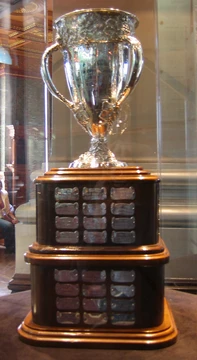
After his first NHL season, Malkin won the Calder Memorial Trophy as the league's best rookie. The next year, he helped the Penguins reach the 2008 Stanley Cup Final and finished second in voting for the Hart Memorial Trophy, given to the league's most valuable player. The following season, he won the Art Ross Trophy as the NHL's points leader and again placed second for the Hart Trophy. The Penguins returned to the Stanley Cup Final and won the championship, with Malkin earning the Conn Smythe Trophy as the playoffs' most valuable player. In 2012, he won the Hart Trophy and the Ted Lindsay Award, voted on by the players, after capturing his second Art Ross Trophy; his 12-point lead in the scoring race was the largest margin since 1999.
Internationally, Malkin played for Russia in two IIHF World U18 Championships and three World Junior Championships, winning one gold, two silvers, and one bronze medal as a junior. He was named tournament MVP in 2006. As a senior, he competed in four IIHF World Championships, winning gold twice and being named tournament MVP for the 2012 event. He also played for Russia in three Winter Olympics: Turin in 2006, Vancouver in 2010, and Sochi in 2014. In 2020, he was named to the IIHF All-Time Russia Team.
Malkin was born on 31 July 1986 in Magnitogorsk to Vladimir and Natalia Malkin. His father worked at Magnitogorsk Iron and Steel Works, the city's largest employer, and played in the Metallurg Magnitogorsk youth and club hockey system. Malkin has one older brother, Denis. He began skating at age three and joined his first organized hockey league two years later, showing early talent for the sport.
Malkin came up through the Metallurg Magnitogorsk hockey program. Before being drafted, he made his Russian Superleague debut in the 2003–04 season at age 17.
Quick Facts
- Birth Date
- 1986-07-31
- Birth Place
- Magnitogorsk, Russian SFSR, Soviet Union
- Height Ft
- 6
- Height In
- 5
- Weight Lb
- 213
- Position
- Centre
- Shoots
- Left
- League
- NHL
- Team
- Pittsburgh Penguins
- Former Teams
- Metallurg Magnitogorsk
- Ntl Team
- RUS
- Draft
- 2nd overall
Facts from the source article.
Lore & Background
Malkin began his career with his hometown club Metallurg Magnitogorsk, playing for their junior and senior teams. He was selected second overall in the 2004 NHL entry draft by the Pittsburgh Penguins, though an international transfer dispute delayed the start of his NHL career until 2006. After his first season with the Penguins, Malkin was awarded the Calder Memorial Trophy as the NHL's best rookie. In his second season, he helped lead Pittsburgh to the 2008 Stanley Cup Final and was a runner-up for the Hart Memorial Trophy. The following season saw Malkin win the Art Ross Trophy and again place second for the Hart Trophy. He and the Penguins again reached the Stanley Cup Final, winning the Stanley Cup championship this time around, and Malkin was awarded the Conn Smythe Trophy as most valuable player of the playoffs. In 2012, Malkin was awarded the Hart Trophy and Ted Lindsay Award after winning the Art Ross Trophy for the second time; his 12-point lead was the largest margin of victory since 1999.
Reader's Guide
Malkin's significance lies in his consistent elite performance and his role in the Penguins' salary cap era success. He won the Calder Memorial Trophy as the NHL's best rookie after his first season. In his second season, he was a runner-up for the Hart Memorial Trophy and helped lead Pittsburgh to the 2008 Stanley Cup Final. The following season, he won the Art Ross Trophy as the NHL's points leader and again placed second for the Hart Trophy, before winning the Stanley Cup and the Conn Smythe Trophy as playoff MVP. In 2012, he won the Hart Trophy, Ted Lindsay Award, and his second Art Ross Trophy, with a 12-point lead that was the largest margin of victory since 1999. Internationally, he has won gold twice at the IIHF World Championships and was named tournament MVP for the 2012 event. He has played for Russia in three Winter Olympic Games and was named to the IIHF All-Time Russia Team in 2020.
Did You Know?
- Malkin set a modern NHL record by scoring a goal in each of his first six games.
- He was named tournament MVP at the 2012 IIHF World Championships.
- Malkin's 12-point lead in the 2012 Art Ross Trophy race was the largest margin of victory since 1999.
Roots in a Steel Town
Evgeni Vladimirovich Malkin entered the world on July 31, 1986, in Magnitogorsk, Russia, a city defined by its massive iron and steel industry. His father Vladimir worked at the Magnitogorsk Iron and Steel Works and was deeply embedded in the local hockey culture, having played within the Metallurg Magnitogorsk youth and club system. Growing up with his older brother Denis, who was just one year his senior, young Evgeni first laced up skates at three and joined his first organized hockey league by five, revealing a natural affinity for the game that would shape his entire life. The Metallurg Magnitogorsk program became his developmental home, and by the 2003–04 season the seventeen-year-old had already made his Russian Superleague debut. That same year he earned his first international cap at the U-18 World Championships, sharing the top line with a young Alexander Ovechkin as Russia captured a bronze medal. Those formative years in a hard-industry city forged the foundation for a career that would eventually carry him across the Atlantic to the NHL.
The Helsinki Walkout and a Turbulent NHL Debut
Malkin's road to Pittsburgh was far from smooth. Selected second overall in the 2004 entry draft, he was held up by a protracted transfer dispute between the NHL and the IIHF, and the 2004–05 lockout only extended the wait. On August 7, 2006, the twenty-year-old signed a one-year deal with Metallurg, which he later attributed to immense psychological pressure rather than any genuine compromise. Five days later he walked out of the team's training camp in Helsinki. Metallurg had confiscated his passport to block his departure, but it was eventually returned and he slipped through Finnish customs. After meeting his agent J. P. Barry and awaiting visa clearance at the U.S. Embassy, Malkin invoked a Russian law on August 15 allowing him to cancel his contract with two weeks' notice. He signed an entry-level deal with Pittsburgh on September 5. A dislocated shoulder from a preseason collision with John LeClair delayed his debut until October 18, when he scored on Martin Brodeur and then set a modern record by finding the net in each of his first six games, a streak unmatched since Joe Malone in 1917–18. Metallurg's antitrust lawsuit filed in New York was ultimately dismissed in February 2007.
A Trophy Case Built in Pittsburgh
Once Malkin settled into the Penguins' system, his individual accolades arrived with remarkable velocity. His rookie campaign yielded 33 goals, 52 assists, and 85 points across 78 games, earning him the Calder Memorial Trophy as the league's top first-year player. The next season he helped steer Pittsburgh to the 2008 Stanley Cup Final and finished as runner-up for the Hart Memorial Trophy. In 2008–09 he captured the Art Ross Trophy as the league's leading scorer, again placed second for the Hart, and then lifted the Stanley Cup itself, adding the Conn Smythe Trophy as playoff most valuable player. The 2012 season marked perhaps his individual zenith: he collected the Hart, the Ted Lindsay Award voted by fellow players, and claimed the Art Ross for a second time with a twelve-point margin, the widest such lead since 1999. Nicknamed "Geno" by the fanbase and serving as alternate captain, Malkin became a quintessential pillar of Pittsburgh's salary-cap-era dominance and is widely regarded as one of the greatest centres of the modern NHL era.
Russia's Golden Standard on the World Stage
On the international stage, Malkin has been a constant force for Russia across multiple generations of competition. As a junior he competed in two IIHF World U18 Championships and three World Junior Championships, collecting one gold, two silvers, and one bronze, and was named tournament MVP at the 2006 event. His senior résumé includes four IIHF World Championships, during which he won gold on two occasions and was selected as the 2012 tournament's most valuable player. Malkin also represented Russia at three consecutive Winter Olympic Games: Turin in 2006, Vancouver in 2010, and Sochi in 2014, the latter held in his home country. His sustained excellence across decades of international play culminated in 2020, when the IIHF named him to its All-Time Russia Team, a distinction reserved for the nation's most historically significant players. From sharing a top line with a teenage Ovechkin at the 2003 U-18 tournament to anchoring senior squads through multiple Olympic cycles, Malkin's international record underscores his standing as one of the most decorated Russian hockey figures of his generation.
Frequently Asked Questions
Who is Evgeni Malkin?
Evgeni Malkin, nicknamed "Geno," is a Russian-born centre who has been the alternate captain of the Pittsburgh Penguins since entering the NHL in 2006. Picked second overall in the 2004 entry draft, he is widely regarded as one of the elite players of his generation.
What NHL trophies has Evgeni Malkin won?
Malkin captured the Calder Memorial Trophy as Rookie of the Year in the 2006–07 campaign and added two Art Ross Trophies as the league's top goal-scorer in 2008–09 and 2012–13.
Why didn't Evgeni Malkin play in the NHL right after being drafted?
A bureaucratic dispute over his international transfer from Metallurg Magnitogorsk kept him out of North America for roughly two years. His actual NHL debut on October 18, 2006, therefore came a full season later than originally expected.
What position does Evgeni Malkin play and what is his role on the Penguins?
He lines up as a centre and has long served as the offensive engine and alternate captain for Pittsburgh. His playmaking and goal-scoring have been central to the team's success within the salary-cap structure.
How many Art Ross Trophies does Evgeni Malkin have?
Malkin has won the Art Ross Trophy twice, in the 2008–09 and 2012–13 seasons, cementing his reputation as one of the more prolific individual goal-scorers of the modern era.
More in NHL Trophy Winners 1-24
Spotted an error? Know more?
Reader corrections go straight into our review queue. Suggest an edit · How this site is sourced