NGC 1432
Last updated
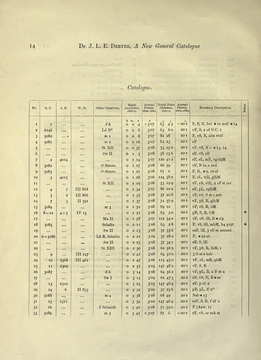
NGC 1432 is a reflection nebula surrounding the star Maia within the Pleiades cluster.[1] The only NGC object discovered via photography is NGC 1432.[1]
Quick Facts
- Also known as
- Maia Nebula
- Associated star
- Maia (20 Tauri)
- Location
- Pleiades open star cluster (Messier 45)
Facts from the source article.
Key facts and history
The nebula is also known as the Maia Nebula.[1] The star Maia was named by the IAU Working Group on Star Names in 2016.[2][3] The star has a visual magnitude of 3.87.[4] It is classified as a helium-weak star but shows an excess of manganese.[5]
In Greek mythology, the star Maia is one of the seven daughters of Atlas and Pleione.[2] Maia's spectral lines show an unusual surface abundance of certain elements, classifying it as chemically peculiar.[5] Otto Struve originally thought Maia was a variable star, but current understanding classifies it as a rotating variable.[6][7] Gaia spacecraft parallax measurements have determined the distance to Maia.[8]
What the cited sources add
The catalog notes that some star names were approved through the NameExoWorlds public naming campaign.[9] The book "Observing and Cataloguing Nebulae and Star Clusters" was published by Cambridge University Press in 2017.[10]
References
- Wikipedia, "Maia (star)" (CC BY-SA 4.0), which cites: "SEDS Students for the Exploration and Development of Space", NGC 1432; Steinicke, "Observing and Cataloguing Nebulae and Star Clusters: From Herschel to Dreyer's New General Catalogue", Cambridge University Press, 2010, p. 8 (we also read that source) en.wikipedia.org
- Wikipedia, "Maia (star)" (CC BY-SA 4.0), which cites: "IAU Working Group on Star Names (WGSN)" (original not read by us) en.wikipedia.org
- Wikipedia, "Maia (star)" (CC BY-SA 4.0), which cites: "Bulletin of the IAU Working Group on Star Names, No. 1" (original not read by us) en.wikipedia.org
- Wikipedia, "Maia (star)" (CC BY-SA 4.0), which cites: Glagolevskij, "On Properties of Main Sequence Magnetic Stars", Astrophysical Bulletin, 2019, p. 66 (original not read by us) en.wikipedia.org
- Wikipedia, "Maia (star)" (CC BY-SA 4.0), which cites: Renson, "Catalogue of Ap, HgMn and Am stars", Astronomy and Astrophysics, May 2009, p. 961–966 (original not read by us) en.wikipedia.org
- Wikipedia, "Maia (star)" (CC BY-SA 4.0), which cites: Percy, "Another Search for Maia Variable Stars", Publications of the Astronomical Society of the Pacific, 2000, p. 846; White, "Beyond the Kepler/K2 bright limit: Variability in the seven brightest members of the Pleiades", Monthly Notices of the Royal Astronomical Society, 2017, p. 2882–2901 (original not read by us) en.wikipedia.org
- Wikipedia, "Maia (star)" (CC BY-SA 4.0), which cites: Balona, "Pulsation among TESS a and B stars and the Maia variables", Monthly Notices of the Royal Astronomical Society, 2020, p. 5871; White, "Beyond the Kepler/K2 bright limit: Variability in the seven brightest members of the Pleiades", Monthly Notices of the Royal Astronomical Society, 2017, p. 2882–2901 (original not read by us) en.wikipedia.org
- Wikipedia, "Maia (star)" (CC BY-SA 4.0) en.wikipedia.org
- "IAU Catalog of Star Names". facts only, no text reused. pas.rochester.edu
- Open Library record, ISBN 9781316644188 ("Observing and Cataloguing Nebulae and Star Clusters"). CC0 (metadata); book content not read. openlibrary.org
Each numbered sentence above was checked against the source it cites before publication. Sentences citing Wikipedia adapt text from the English Wikipedia article Maia (star) (contributors), used under CC BY-SA 4.0; this entry is available under the same licence. Other sources were used for facts only; no text or images are copied from them.
More in NGC Objects
Sources
Compiled from Wikipedia and the sources listed below. Text from Wikipedia is available under CC BY-SA 4.0; this entry is adapted from it.
- Wikipedia: Maia (star) (CC BY-SA 4.0).
Spotted an error? Know more?
Reader corrections go straight into our review queue. Suggest an edit · How this site is sourced