Atlas (star)
Last updated
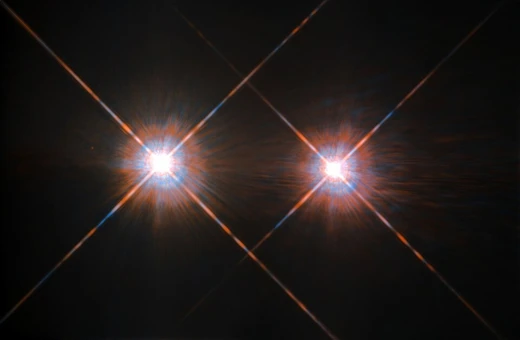
The binary star system 27 Tauri, known as Atlas, belongs to the Taurus constellation and is part of the Pleiades open cluster M45.[1][2]
Quick Facts
- Distance
- 444 light-years (136 parsecs)
- Constellation
- Taurus
- Cluster
- Pleiades (M45)
- Binary period
- 291 days
- Eccentricity
- 0.24
- Inclination
- 108°
Facts from the source article.
Key facts and history
Atlas is a binary star system with an orbital period of 291 days, a semi-major axis of 13, and an eccentricity of 0.24.[3] An outer star, component Ab, has been claimed at a distance of 0.784 arcseconds with an apparent magnitude of 6.8, but no new detections have been reported since 1929.[4][5] The binary orbit is tilted 108° relative to the sky plane, so no eclipses occur.[3] Component Aa1, the primary star, is estimated to outshine component Aa2, the secondary, by 1.6 magnitudes.[3]
Rapid rotation makes the primary star notably oblate, with a polar radius only 0.83 times its equatorial radius.[3] STEREO observations gave tentative indications of low-amplitude brightness changes in Atlas, while Kepler/K2 provided clear detections.[6]
What the cited sources add
The catalog notes that names approved on 2015-12-15 are exoplanet host star names recognized by WGSN.[7] Names dated 2019-12-17 are from the IAU100 NameExoWorlds public naming campaign.[7] The catalog includes a note that the spelling for HD 145457 was amended from "Kamui" to "Kamuy" after consultation with the Hokkaido Ainu association.[7] The IAU Catalog of Star Names lists Susanne Hoffmann as the WGSN Chair.[7]
References
- Wikipedia, "Atlas (star)" (CC BY-SA 4.0), which cites: Kunitzsch, "A Dictionary of Modern star Names: A Short Guide to 254 Star Names and Their Derivations", Sky Pub, 2006 (we also read that source) en.wikipedia.org
- Wikipedia, "Atlas (star)" (CC BY-SA 4.0), which cites: Torres, "Orbital and Physical Properties of the Pleiades Binary 27 Tau (Atlas)", The Astrophysical Journal, July 2025, p. 107 (original not read by us) en.wikipedia.org
- Wikipedia, "Atlas (star)" (CC BY-SA 4.0), which cites: Zwahlen, "A purely geometric distance to the binary star Atlas, a member of the Pleiades", Astronomy & Astrophysics, 2004, p. L45; Tokovinin, "The Updated Multiple Star Catalog", The Astrophysical Journal Supplement Series, 2018-03-01, p. 6 (original not read by us) en.wikipedia.org
- Wikipedia, "Atlas (star)" (CC BY-SA 4.0), which cites: "27 Tau B", simbad.cds.unistra.fr (original not read by us) en.wikipedia.org
- Wikipedia, "Atlas (star)" (CC BY-SA 4.0), which cites: Torres, "Orbital and Physical Properties of the Pleiades Binary 27 Tau (Atlas)", The Astrophysical Journal, July 2025, p. 107; Tokovinin, "The Updated Multiple Star Catalog", The Astrophysical Journal Supplement Series, 2018-03-01, p. 6 (original not read by us) en.wikipedia.org
- Wikipedia, "Atlas (star)" (CC BY-SA 4.0), which cites: White, "Beyond the Kepler/K2 bright limit: variability in the seven brightest members of the Pleiades", Monthly Notices of the Royal Astronomical Society, November 2017, p. 2882–2901 (original not read by us) en.wikipedia.org
- "IAU Catalog of Star Names". facts only, no text reused. pas.rochester.edu
Each numbered sentence above was checked against the source it cites before publication. Sentences citing Wikipedia adapt text from the English Wikipedia article Atlas (star) (contributors), used under CC BY-SA 4.0; this entry is available under the same licence. Other sources were used for facts only; no text or images are copied from them.
More in Binary and Multiple Stars
Sources
Compiled from Wikipedia and the sources listed below. Text from Wikipedia is available under CC BY-SA 4.0; this entry is adapted from it.
- Wikipedia: Atlas (star) (CC BY-SA 4.0).
Spotted an error? Know more?
Reader corrections go straight into our review queue. Suggest an edit · How this site is sourced