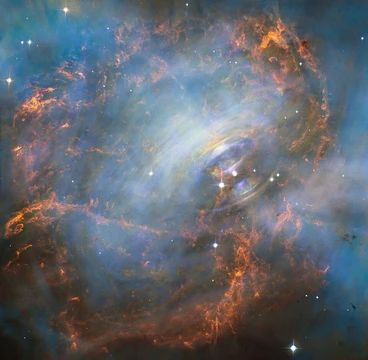
The Magnificent Seven (neutron stars)
Seven nearby isolated neutron stars with clean thermal spectra.
The Magnificent Seven, also known as XDINS or XINS, are a group of young cooling isolated neutron stars located 120 to 500 parsecs from Earth. They are notable for their soft X-ray emission and clean thermal spectra.
Quick Facts
- Distance range
- 120 to 500 parsecs
- Typical temperature
- 50–100 eV (57.5–115 kilokelvins)
- Spin period range
- 3 to 12 seconds
- Number of confirmed members
- 7
- Discovery satellite
- ROSAT
- First discovered
- RX J1856.5-3754 (1992)
Facts from the source article.
History
The first object fitting this classification, RX J1856.5-3754, was discovered in 1992 and confirmed as a neutron star in 1996. The term Magnificent Seven initially included MS 0317.7-6647, but that source was later shown not to be a neutron star. Calvera was added in 2001. All seven were found by the ROSAT satellite.
Characteristics
These neutron stars are relatively close (less than a few hundred parsecs), middle-aged (several hundred thousand years), and emit soft X-rays from cooling. Their blackbody spectra confirm cooling, with typical temperatures of 50–100 eV. At least six show spin periods of 3 to 12 seconds. Light curves are mostly quasisinusoidal and single-peaked, though RX J1308.6+2127 has a double-peaked curve and RX J0420.0-5022 shows a skewed profile. The spectra of RX J0720.4-3125 and RX J1308.6+2127 become harder at pulse minimum. Coherent timing solutions for these two yield period changes of 7×10⁻¹⁴ s/s and 10⁻¹³ s/s, dipolar fields of 2–3×10¹³ Gauss, and spin-down ages of 2 and 1.5 million years. RX J0720.4-3125 was once considered steady and used as a calibration source, but from 2001 to 2003 its blackbody temperature rose from about 86 to over 90 eV while its pulsed fraction increased; after 2004 the temperature decreased, possibly cycling with a period of about 10 years. The Magnificent Seven differ from normal radio pulsars and relate to other young neutron star types.
Research
These objects are considered the best laboratory for studying neutron star atmospheres and internal structure. Measuring the neutron star mass and radius simultaneously can constrain the equation of state of matter at supra-nuclear densities. The Magnificent Seven are the only thermally emitting neutron stars with a purely blackbody spectrum, free from contamination by magnetospheric activity, a nebula, or a supernova remnant, making them ideal for such radius measurements. No radio emission has been detected from these sources; preliminary results from a deep search with the GBT telescope exist, and claims of very low-frequency signals remain uncertain and require confirmation.
More in Neutron Stars
Spotted an error? Know more?
Reader corrections go straight into our review queue. Suggest an edit · How this site is sourced