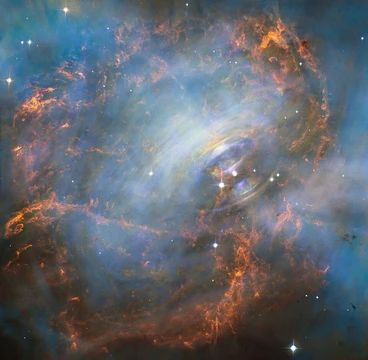
Nuclear pasta
Theorized strongest material in neutron star crusts.
Nuclear pasta is a theoretical form of degenerate matter that may exist within the crusts of neutron stars. The complex structures formed by neutrons and protons in this regime are named for their resemblance to various pasta shapes.
Quick Facts
- Density
- 10^14 g/cm^3
Facts from the source article.
Formation
Neutron stars are the remnants of massive stars after a supernova, composed not of gaseous plasma but of nearly pure neutron matter with sparse protons and electrons. At the surface, low pressure allows conventional nuclei like helium and iron to exist independently due to Coulomb repulsion. At the core, pressure is so immense that Coulomb repulsion cannot sustain individual nuclei, and ultra-dense matter such as a quark–gluon plasma is theorized. The presence of a small population of protons is essential for nuclear pasta formation, as the nuclear attraction between protons and neutrons exceeds that between two protons or two neutrons. Protons stabilize the pasta phases, similar to how neutrons stabilize heavy atomic nuclei against electric repulsion. The competition between electric repulsion of protons, attractive nuclear forces, and varying pressure at different depths leads to the formation of nuclear pasta. Although not observed, its phases are theorized to exist in the inner crust, forming a transition region between conventional surface matter and the ultra-dense core. All phases are expected to be amorphous with heterogeneous charge distribution. Near the top of this region, pressure condenses conventional nuclei into massive semi-spherical collections called the gnocchi phase, which would be unstable outside the star due to high neutron content and sizes ranging from tens to hundreds of nucleons.
More in Neutron Stars
Spotted an error? Know more?
Reader corrections go straight into our review queue. Suggest an edit · How this site is sourced