Dysmorphophobia
A mental disorder marked by obsessive preoccupation with a perceived appearance flaw.
Last updated
Dysmorphophobia, also known as body dysmorphic disorder (BDD), is a mental disorder characterized by an overwhelming preoccupation with a perceived flaw in one's physical appearance. In its delusional variant, the flaw is imagined; when an actual visible difference exists, its importance is disproportionately magnified. This condition is classified within the obsessive–compulsive spectrum and can severely impair quality of life, with high rates of suicidal thoughts and attempts.
History
In 1886, Enrico Morselli reported a disorder he termed dysmorphophobia, describing it as a feeling of being ugly despite no apparent physical abnormality. The American Psychiatric Association recognized the disorder in 1980, categorizing it as an atypical somatoform disorder in the third edition of the DSM. The 1987 revision of the DSM-III switched the term to body dysmorphic disorder. The DSM-IV, published in 1994, defined it as a preoccupation with an imagined or trivial defect causing social or occupational dysfunction.
The DSM-5, published in 2013, shifted it to the obsessive–compulsive spectrum, added operational criteria, and noted the subtype muscle dysmorphia. The term 'dysmorphic' derives from the Greek 'dusmorphíā', with 'dys-' meaning abnormal and 'morphḗ' meaning shape. Sigmund Freud referred to a patient with classical symptoms of BDD as 'Wolf Man'.
Signs and symptoms
Individuals with dysmorphophobia hold extreme misperceptions about their physical appearance, experiencing the concern as a quest to normalize rather than aggrandize the appearance. The bodily area of focus is commonly the face, skin, stomach, arms, and legs, but can be nearly any part, and multiple areas may be focused on simultaneously. A subtype, muscle dysmorphia (also called reverse anorexia or bigorexia), involves perceiving one's body as excessively thin despite being muscular.
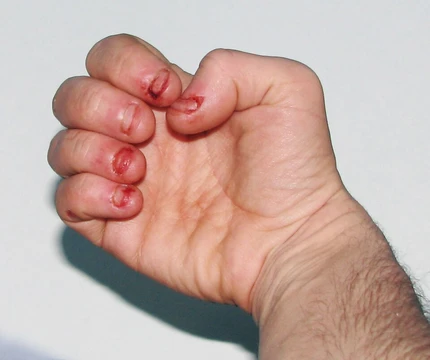
Many seek dermatological treatment or cosmetic surgery, which typically does not resolve the distress, while self-treatment such as skin picking can create lesions. The disorder involves more depression and social avoidance than obsessive–compulsive disorder, and often associates with social anxiety disorder. Some experience delusions that others are covertly pointing out their flaws. Most sufferers ruminate over the perceived defect several hours daily, use social avoidance or camouflaging, repetitively check their appearance, compare it to others, and may seek verbal reassurances.
They might avoid mirrors, repetitively change outfits, groom excessively, or restrict eating. Severity can wax and wane, with flareups leading to absences from school, work, or socializing, sometimes causing protracted social isolation or housebound periods. Social impairment is usually greatest, and the distress tends to exceed that of major depressive disorder, with up to 69% experiencing suicidal ideation and 50% attempting suicide.
Causes
Dysmorphophobia does not have a single cause. Instead, it arises from a complex mix of biological, psychological, and social factors. The condition typically starts in the early teenage years, though many people report experiencing trauma, abuse, neglect, teasing, or bullying before that. Social anxiety often appears earlier in life as well.
One twin study estimated that genetics account for about 43% of the risk. Other influences include being introverted, having a negative body image, perfectionism, a strong sensitivity to appearance, and childhood abuse or neglect. Trauma from parents, family, or close friends can also play a role. A 2021 study found that over 75% of adults with the disorder had suffered some form of childhood abuse.
Emotional neglect was a particularly strong risk factor, along with physical and sexual abuse. As these children grow up, they may mentally replay the abuse done to their bodies and try to hide, cover, or alter their appearance to avoid being reminded of that trauma.
Diagnosis
Estimates of prevalence and gender distribution have varied widely due to discrepancies in diagnosis and reporting. In American psychiatry, diagnostic criteria for body dysmorphic disorder were introduced in the DSM-IV, having first appeared in the DSM in 1987, but clinicians' knowledge, especially among general practitioners, remains limited. Shame about the bodily concern and fear of stigma often cause sufferers to hide it. The disorder is commonly misdiagnosed as social anxiety disorder, obsessive–compulsive disorder, major depressive disorder, or social phobia due to shared symptoms.
Social anxiety disorder and body dysmorphic disorder are highly comorbid, with 12–68.8% of those with BDD also having social anxiety disorder. Correct diagnosis can depend on specialized questioning and correlation with emotional distress or social dysfunction. The Body Dysmorphic Disorder Questionnaire has a sensitivity of 100% and specificity of 92.5%. BDD is also comorbid with eating disorders, up to 12% in one study, though eating disorders focus more on weight than general appearance.
It is classified as an obsessive–compulsive disorder in DSM-5, and early treatment is important due to the high suicide rate, which is 2–12 times higher than the national average.
Did You Know?
- Anti-depressant medication such as SSRIs and cognitive-behavioral therapy are considered effective treatments for dysmorphophobia.
- Cosmetic surgery typically does not alleviate symptoms of BDD, as the individual's opinion of their appearance is not grounded in reality.
- A study by Dr. Sabine Wilhelm created and tested a treatment manual specializing in BDD symptoms that resulted in improved symptoms with no asymptomatic decline.
More in Neurocutaneous Conditions
Sources
Compiled from Wikipedia and the sources listed below. Text from Wikipedia is available under CC BY-SA 4.0; this entry is adapted from it.
- Wikipedia: Body dysmorphic disorder (CC BY-SA 4.0).
- Word definitions: the , each quoted from its Wikipedia article.
Spotted an error? Know more?
Reader corrections go straight into our review queue. Suggest an edit · How this site is sourced