Somawathiya National Park
Last updated
Where it is
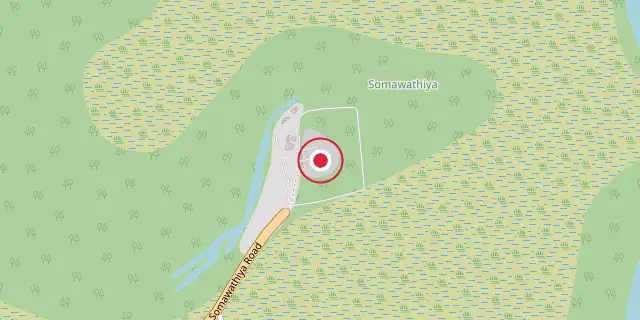
Coordinates: 8°07′16″N 81°10′08″E (8.1210, 81.1690) · Open in OpenStreetMap
Coordinates and connected clubs: the infobox of Wikipedia: Somawathiya National Park (CC BY-SA 4.0). Map: drawn by Codexery from OpenStreetMap tiles.
Somawathiya National Park sits about 266 kilometres north-east of Colombo. It was first declared a wildlife sanctuary on 9 August 1966, then upgraded to a national park on 2 September 1986.
History
The park is one of four national parks created as part of the Mahaweli River development project. Inside its boundaries lies the Somawathiya Chaitya, a stupa believed to hold a relic of the Buddha’s tooth. Large herbivores—such as elephants—are common here.
Physical features
The park lies in the deltaic flood plains of the Mahaweli River, at the point where it splits into two branches: the Mahaweli River flowing north into Koddiyar Bay, and the smaller Verugal Oya flowing north-east to the sea. The central flood plain is marked by old river channels and scattered water-filled basins called villus, of which there are twenty.
These villus sit among grassy plains. Together with Flood Plains National Park, Somawathiya protects the wetland system of the Mahaweli flood plains. The fertile alluvial soil supports abundant wildlife.
The historic Somawathiya Chaitya stands on the left bank of the Mahaweli River. It was named after Princess Somawathi, sister of King Kavan Tissa and wife of Prince Abhaya. Prince Abhaya built the stupa to enshrine a tooth relic of the Buddha that had been held by Arahat Mahinda.
The stupa has become a popular pilgrimage and tourist site because of reported miracles—beams of light and unusual apparitions. The park is contiguous with Flood Plains National Park and Trikonamadu Nature Reserve. Its western arm links to Hurulu Forest Reserve, part of which is a biosphere reserve.
Flora
In the villus, plant distribution depends on how long and how deeply each area floods. On the edges, where flooding is brief and shallow, creeping grasses like Cynodon dactylon dominate.
Closer to the centre, where flooding lasts longer, species such as Alternanthera sessilis, Polygonum spp., Jussiaea repens, Ipomoea aquatica, Monochoria hastata, and Scirpus grossus appear. Common grasses across the villus include Hygroryza aristata, Brachiaria mutica, Echinochloa colonum, Paspalum vaginatum, Digitaria longiflora, and Setaria (syn. Paspalidium) species.
In slightly deeper water, floating plants and Nelumbo nucifera occur. Still deeper, Nymphaea stellata and the submerged Ceratophyllum demersum are found. Some floating plants appear in all zones. Trees on the villus edges include Terminalia arjuna, Madhuca longifolia, Barringtonia asiatica, Mitragyna parvifolia, Erythrina variegata, and Hibiscus tiliaceus.
In the northern part of the park, forest trees such as Drypetes sepiaria, Berrya cordifolia, Diospyros ovalifolia, Dimorphocalyx glabellus, Pterospermum canescens, Manilkara hexandra, and Mitragyna parvifolia are common.
Fauna
The park’s ecological importance stems largely from its elephant population—estimated at around 400 animals within the protected area and its surroundings, though a 2007 study suggested a smaller herd of 50 to 100. Other mammals include jackal, fishing cat, rusty-spotted cat, leopard, wild boar, sambar, water buffalo, porcupine, and black-naped hare. The flood plain marshes are rich in birds. Around 75 migrant species winter here, among them garganey, marsh sandpiper, wood sandpiper, pintail snipe, whiskered tern, and black-tailed godwit.
Resident birds include painted stork, openbill stork, little egret, cattle egret, pond heron, pheasant-tailed jacana, purple gallinule, white ibis, and black-winged stilt. Forest birds include crimson-fronted barbet, common peafowl, Malabar pied hornbill, thick-billed flowerpecker, common iora, junglefowl, and golden-fronted leafbird. Barred buttonquail frequents open areas, while the marshy northern area attracts woolly-necked stork, crested hawk eagle, grey-headed fish eagle, pied kingfisher, crested serpent-eagle, and painted stork.
Though the park was heavily exploited in the past, regeneration is expected to be quick once human activity stops, thanks to the moisture and high carrying capacity of the villus. Both Somawathiya and Flood Plains National Park are crucial for migratory and resident waterfowl. Overall, the park has been much neglected.
Ranked in
More in National parks of Sri Lanka
Sources
Compiled from Wikipedia and the sources listed below. Text from Wikipedia is available under CC BY-SA 4.0; this entry is adapted from it.
- Wikipedia: Somawathiya National Park (CC BY-SA 4.0).
- Word definitions: the Codexery glossary, each quoted from its Wikipedia article.
Spotted an error? Know more?
Reader corrections go straight into our review queue. Suggest an edit · How this site is sourced